Sunday, March 9, 2014

Good times in Carolina (both of them).

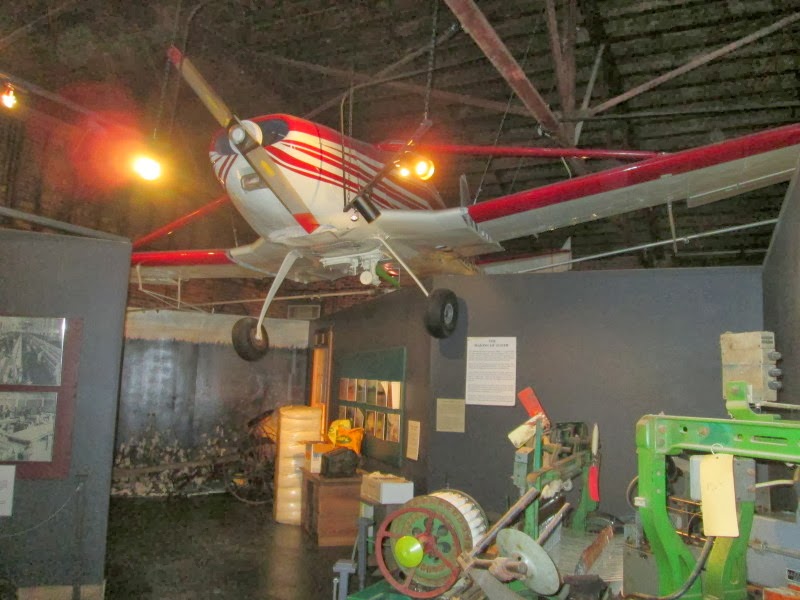
So last week I made my way to Raleigh, North Carolina where I was met by SAM Ashley.  This was my first on-the-job visit to North Carolina.  Ashley has only been there less than a year.  Anyway, we had several tasks to complete over the next few days.  One of those was to meet with some researchers in North and South Carolina about conducting some fertilizer plot work.  But on our way to Southern South Carolina, there was a sign for the South Carolina Cotton Museum in Bishopville.  Well you know me and interesting sounding roadside attractions.  So we took the exit and found our way to the museum.  And it was well worth the price of admission.  Here we see Ashley all excited to begin the tour.
It showed some of the old time tools of cotton production.  Like this tool for application of guano called the Guano Sower.  What's guano you ask?  Well it's bird and bat droppings.  And I don't mean feathers. In this case it was mostly sea gull droppings according to the description.  Now I don't know who had the job of following sea gulls around with a bucket to get the supply of guano.  But that would certainly be an inspiration to do well in skool.  Not sure if farmers used to go to meetings where guano sales and research reps would try to get growers to use their brand.  How far we've come.  (Or have we?)
And here is a fertilizer grinder.  I think this was in the post-guano period in 1920.  But the sign says it was for "soda, acid and kainite".  What's kainite you ask?  Well it's a blend of potassium chloride (potash?) and magnesium sulfate (epsom salts?).  It has a handle on the side to grind it up.  Hope it worked.  But this was in the period when fertilizers were gaining more use. Before, cotton was not fertilized at all and people wondered why it didn't yield well after a couple of years.  
And everyone has probably heard of the boll weevil.  It was the number one pest of cotton for many years.  Anyway, below is the Cotton Mopper. It was used back in the 1930's and the cloth was coated with molasses and some sort of weevil poison and would spin as you walked along to coat the flowers with the stuff to kill the weevils.  It was sticky and dirty work.  But was the best way to control the pest at the time.  Evidently they used to really use mops before this tool came along.  In fact, I read a little of the "mopping" history, and evidently no one liked doing it. You got covered in molasses and flies. They used to make kids do it, since the adults didn't want to.  There is reference to former president Jimmy Carter mopping cotton as a kid in Georgia.  He would stand his pants in the corner at night since they were so stiff from the molasses. 
Here is a boll weevil model.  I didn't know they were so big.  No wonder they were so hard to control. But now thanks to Bt cotton, the cotton plant can defend itself and it is no longer necessary to spray multiple treatments of insecticides.  Or to mop either.  Thank goodness for GMO technology to increase cotton production while protecting the environment.
They had lot's of old machines that turned the cotton fiber into thread.
There was plenty to see and it was well worth the stop.  I give it a hearty thumbs up.
After meeting with several researchers about test plots on crops like cotton, soybeans and tobacco, we proceeded to the other activity for the fertilizer mission.  That being a grower meeting at our AM in Eastern NC: Dark Water Enterprises of Pantego, NC.  They have been selling Liquid fertilizer for several years in this part of North Carolina.  It is run by the Boyd Family and they have done a great job in a relatively short time.  There is a lot of good farmland around here, large and flat fields growing corn, soybeans, cotton and some tobacco, sweet potatoes and other crops.  It was my first time here.
Need some Liquid fertilizer?  They can certainly provide...and deliver as well.  That's just one of several tanker trucks on the premises. 
Ashley started the meeting with an interesting lead in on AgroLiquid history and products.  But she made the connection and tied it all together very well.
The farmland in this area has an interesting history that I was not aware of.  It seems that much of this area was covered with cedar swamp.  But in the early 1970's a Wall Street millionaire ended up buying 325,000 acres of this ground and set about clearing it for farmland, starting in 1973.  Specifically, it is in the Albemarle-Pamlico Peninsula, if anyone wants to know the exact location. He called the operation First Colony Farms, and had the goal of establishining a sustainable crop and livestock operation once the ground was cleared.  Well there was so much trees and swamp, that drainage ditches were also built and the cleared trees were put in piled strips.  Some of the land had many feet of peat and tree residue, so another operation was started to harvest the peat for an energy source. But as with many gigantic ventures, it never came to be and the investor saw his millions dwindle away into bankruptcy.  Kind of like the joke: "How do you become a millionaire in farming?  Start with ten million."  It was re-bought a few times and the most of the land was in fact cleared and is farmed today. But not as a super farm.  I'm not sure where the boundaries are of this venture, but somewhere around where we were.  But most of the land was at one time covered with swamp and cedar forest.  We talked to a researcher near Dark Water, and the ground is generally high organic matter.  Plus it is high in P and K from chicken litter, a common application.  Below is one of the fields where we may have some plots this summer. 
It was cold and rainy most of the week.  On the way back to Raleigh, we passed a piece of ground that was evidently being cleared.  So this is what it might have looked like back in the 1970's when it was being cleared.  Except there are no bulldozers seen here in the winter. It is definatily dark organic ground. 
So now there are some large individual farming operations in place, and it is our goal to have AgroLiquid feeding the crops there.  There was a lot of interest after our stellar grower meeting.  At least I thought it was. 

Tuesday, March 4, 2014

Florida Field Checks (No Wonder So Many People Come Here in the Winter)

So after a couple of days at home in Snowland after my trip to California, it was time to make some field checks in Florida last week.  I mean, that's where stuff is growing this time of year.  The only thing growing in Michigan is frustration with the non-ending winter.  Anyway, there is a lot of Liquid activity going on in Florida.  One of the stops was to see our fertilizer test on sugarcane.  Below we see Field Agronomist Mike and SAM Paulino trying to keep up with me as I excitedly walk the line looking at the field-sized plots.  It was in the low 80's so I was extra happy to be there.  
Below is a field shot taken last November 13.  I posted this in the blog back then which was on my last visit.  This sugarcane was planted in late September.
And here is the same place now, or on Feb 26 when I was there.  It's over my head, the size of the cane that is.  It is time for the next application which will likely be the last time the high clearance ground rig with drop nozzles will be able to make it through.  But it may be possible in the next one in May, but we will have to see.  Otherwise it will be aerially applied.   
Everyone says to watch out for alligators that will often come out to sun themselves in the numerous drainage ditches through the fields.  Well I have never seen one yet in my two visits here.  That would be a great addition to the blog.  Below Paulino is on gator watch.  I asked him to dangle his feet in the water to try and attract one.  But he said "no".  Well actually it was a little more colorful than that.  I guess he is not an animal enthusiast like I am.
Below is the smoke from a sugarcane field being burned before harvest.  Fields are burned to remove the leaves which makes the cane harvest easier.  They burn really fast and it does not harm the sugarcane.  They harvest from late fall through as late as April.  I don't really understand the whole sugarcane growth procedure.  In Louisiana where I have reported on our sugarcane research before, the sugarcane emerges in late March, then fertilizer is applied one time, and it is harvested in November.  Easy.  But in Florida, it is planted in early fall, grows all winter, gets fertilized several times over the next year, and then is harvested from late fall to the next spring.  Our plots here probably won't be harvested until a year from now.  That will be around a year and a half since planting. But maybe it will be earlier.  It all has to do with scheduling with the mill.  But that will give me extra time to visit it.  
We also visited a crop that has more immediate personal gratification: Strawberries!  Now who doesn't like a fresh picked strawberry?  If you raised your hand, then seek help immediately.  Actually there are solid Liquid recipes established for growing strawberries in Florida where they are being used extensively.
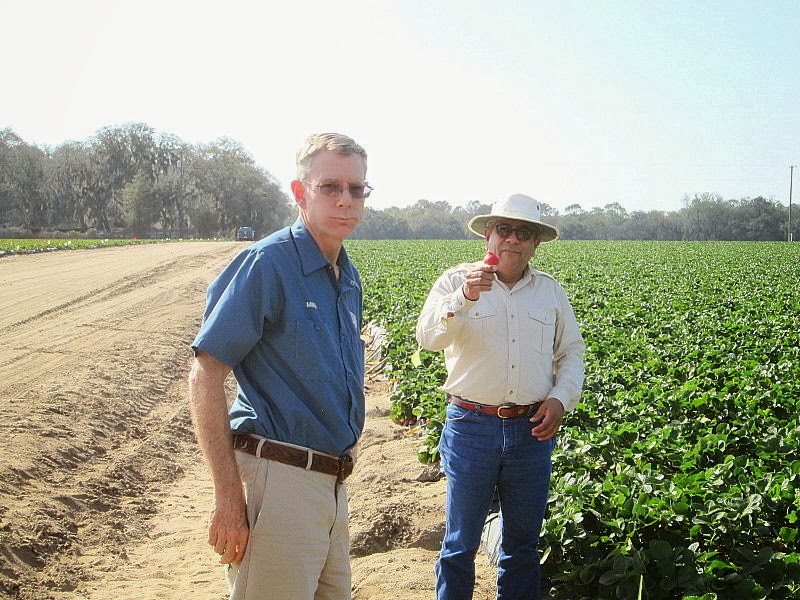
Below we are in a field that was picked today. They are picked every couple of days as the berries keep coming on. Here they have 4 rows per bed compared to the usual 2 rows per bed.  They think it has higher production.  It is late afternoon and the pickers have quit for the day, but you can see the picking equipment in the background.  They are picked, and put into the clear "clamshell" containers that are in the stores, and shipped all over the country.  Most likely the strawberries you see in the store now are from this area of Florida.  There are probably several weeks of picking left.  The liquid fertilizer is run through the drip lines under the plastic over the beds.  Fertilizer is run in small doses usually every day along with the irrigation water.  We see Paulino, Mike and Area sales manager Jim making inspections.  Jim is busy with fertilizer business on the phone.
Paulino is still enjoying the strawberries (all in the name of science), but it looks like Mike has exceeded his fill capacity.
Here is how you see them in the store.  Enjoy the Liquid fed goodness.
We also visited a field test at another location.  The pickers were in action here.  They pick thousands of flats every day.  Not sure how big a flat is, but thousands of them must be a lot.
We finished my Florida fertilizer mission with a visit to a Dole blueberry field.  Like the strawberries, Liquid has been feeding here for several years. Jim is still busy with fertilizer business on the phone.
Look at all of the future blueberries on this branch.  They are really loaded up and will be picked in a few weeks.  After blueness sets in that is.  Make room in the fridge for some delicious blueberries, coming soon! 
Well the next day it was back to Michigan.  Snow or not, it's home.
But it was sure nice being warm for a few days.  Look at my ever-so-accurate car thermometer as I left for AgroLiquid HQ yesterday morning.  That would be 103 degrees colder than where I was a few days before.
Cold or not, it's home.


Friday, February 28, 2014

Bountiful Winter Crops

So last week (the week of the 17th) I was out to the annual research meetings of the Fluid Fertilizer Forum in Scottsdale, AZ.  I have attended that many times over the past years, and it is a good opportunity to hear the latest in university research with fluid fertilizers.  After that I went on some fertilizer missions out into the desert.  First stop was Yuma, AZ to visit a Liquid dealer there.  What turns desert into crop land?  Water of course.  And thanks to the Colorado River, many areas of desert are providing winter crops to feed the country.  And when things are growing back up North, this area of the country is trying to stay cool as it's too hot to grow anything then.  Below is a Google Earth pic of where I was.  That's Yuma in the lower right corner.  You can see irrigated farmland there.  Next I went to the Imperial Valley of California which is that green area below the Salton Sea.  But let's not get ahead.  (Google Earth is so cool, isn't it?)
 I have been to the Yuma area before as several years ago we conducted some experiments on Lemon trees with the University of Arizona at their experiment station nearby.  We had favorable results that are posted on the Research Tab of the website (in Research Results.)  That research contributed to the importance of micronutrients for tree crops and the product ferti-Rain.  This area is considered the salad bowl of the country in the winter as much of the nation's lettuce comes from here.  Below is a field of cabbage.
 Here is a harvest crew picking lettuce.  Now that's real work to do that all day every day.
 Here is the reason for all of the crops grown here.  They said since this is river water, that they aren't as threatened as the rest of California that relies on rain and snowmelt to support crops.  But it is still a very precious commodity.
 Here is a field of spinach that is just coming up and being irrigated.  This grows to maturity in 30 to 40 days now that the days are warmer.
 Here is another field.  It looks so pretty in the nice straight beds.  Now that I know how much work it takes to grow it, I try not to leave any in my salad bowl.
 And then as you can see in the Google Earth picture above, go West and you are out of the crop land and into the desert.  There is a stretch of sand dunes, that you can also see on the Earth pic.  It is popular with sand dune vehicles, and I know that Albert has ventured here to test his sand rail.  It has also been the site of many movies shot over the years.  In fact, I understand that my uncle, who was career Army, was part of a war movie that was shot here back in the years after WW2.  He was one of the many soldiers that you see in such movies going across the dunes in battle.  (Although I never did learn what it was.  Hmm..)
Then about an hour up to the Imperial Valley.  I had never been there before, but had always heard of it.  Like the Yuma area, it is an important area for winter crops.  It has over 500,000 acres of cropland, which was started in 1901 when the Colorado River was diverted through a series of canals and water channels.  So that made it possible to grow crops in an area that receives less than 3 inches of annual rainfall.  Well wouldn't you know, but in 1905 there was flooding which overran the irrigation channels and all that water ran into an area that became the Salton Sea.  I understand that it used to be used for recreation, but now it is salty and there is some agricultural runoff that had gotten into it in the past.  So environmental stewardship, especially in a place like California, is of concern.  Anyway, today the irrigation river water is distributed more responsibly and everyone is happy.  Top crops are alfalfa/grass hay (and large dairy and beef operations), spinach, carrots, onions, wheat, lettuce....and, believe it or not, there are around 25,000 acres of sugarbeets.  When I learned of this last fall, I was surprised.  But they have been growing beets in the Imperial Valley since 1932.  And as it turned out, we were able to participate in some field plots with planter applications of Pro-Germinator, Sure-K and Micro 500. Below are some of the plots with Liquid fertilizer.  They have them at two locations.  These were planted in late October and will be harvested in the summer.
Harvest is one of the interesting things with these Imperial Valley beets.  In the North where most of the sugarbeets are grown (like North Dakota, Minnesota, Montana and Michigan), they are havested in the late fall and then hauled to piling locations, where they are piled up in huge piles.  (Interesting how "pile" can be both a noun and a verb).  Then they are trucked to the mill and re-piled then run through the mill in fall and winter producing sugar.  But they can't do that here with harvest starting in May.  It is so hot by then that they would just rot away.  So they schedule harvests such that only what can be processed is brought to the mill.  So they sit there in the ground until it is their turn to be dug and hauled to the mill. That could be as late as August when it is over 115 degrees!  So it is a challenge.  I am happy to visit the plots now when it is in the low 80's, but I'll ask for pictures at harvest.

Another thing I learned is that there is a weed there called wild sugarbeet.  It is an annual weed that is genetically close enough to sugarbeets that they could cross pollinate.  Now sugarbeets grown here generally do not produce seed.  Sugarbeets are a biennial crop that requires vernalization or a cold period or dormancy in order to reproduce and make a seed.  Kind of like winter wheat.  In fact, sugarbeet seed comes from the Pacific Northwest after a complicated process of transplanting and pollination after dormancy in mild winter (vernalization).  But there is a small chance here for a rogue beet plant to "bolt" or become reproductive.  Well almost all sugarbeets are now glyphosate (Roundup) resistant, and there is fear of a Roundup resistant cross into a weed sugarbeet, which would lead to Roundup resistant wild sugarbeets.  That wouldn't be good.  So as soon as Wild Sugarbeets are seen in a field, they are forcibly removed.  That is a wild sugarbeet in the picture below.  I saw to it that it would not become a reproductive threat.
Below is the sugar mill in Brawley, CA.  Look at the silo. It has a line that says "sea level".  The Imperial Valley is some 235 feet below sea level!
So after an exciting day in the beet fields and seeing and learning about all things Imperial, I headed West back through the desert.   
Amazing going from "with water" to "without water".  


Thursday, February 27, 2014

Aerial Assault

So I was sitting at my desk today, and it seemed like something was missing.  Hmmm...what was it??? And then I remembered:  Hey, I've got a blog!  Has it really been almost a month since my last post?  Has anyone missed it?  Well, whether you did or not, here is the next installment.  (And I'm sitting on several adventures that I will get on the blogosphere ASAP).  

So some people may think that this is the slow time for us folks at AgroLiquid.  I mean, most of the country is under snow, how much fertilizer stuff is going on now?  Well plenty.  There's planning, answering phone calls, planning, buying stuff for the upcoming season, planning....and grower meetings.  All of us researcher types have been involved in some meetings around.  Stephanie, Tim, Brian and even me.  Like the week before last there were some dealer meetings in North and South Dakota.  Now Cory happened to be in St. Johns and since the meetings were kind of hard to get to, we rented a small plane to take us out there.  Cory is a junior pilot himself, so he took the right front seat to watch and talk to our pilot all the way from Michigan to South Dakota.
We left in the late afternoon and got to watch the sun go down as we headed West.  
We flew to Watertown, SD to pick up SAM Brad and then went up to Jamestown, ND for the night.  Here we are lined up on the runway to land.  It was incredibly cold and windy after getting out of the plane.  It was North Dakota after all.
Tyson, who works for AM Chad picked us up that night and the next day drove us into the coldness of the ND winter to our meeting.  It was a thumbs up performance.  Then back to Jamestown and fly to our next meeting back in Watertown.
Here Brad enjoys the scenery on the trip.
Cory explains the many virtues of AgroLiquid to the spellbound audience.
Then the next morning it was goodbye Brad, drop Cory out, I mean off near his home in Iowa, and then back to Michigan.  I got to sit in the front then.  I made sure I didn't touch anything.  That's the frozen Mississippi River below.
And we landed back where we started at the airport in Grand Ledge, MI.  Which coincidentally is where I live.  Well several miles to the North anyway.  That plane ride was a good way to get around. 
 Thanks to our pilot Pete who has flown Liquid people around before, but I'm sure this was his favorite trip.


Thursday, January 30, 2014

Meanwhile Back at the NCRS....

So while some were out in the ocean surf, the cold weather back in Michigan made conditions perfect for....ice fishing!  Now the crew is busy on a variety of projects in the shop, so they couldn't take any time off to go out to a lake.  Well the parking lot was covered in solid ice...why not give it a try?  So on the morning break we see Ron, Phil, Tim B and Jeff out dipping their lines.  The tip up says that chances are good here.  Thanks to Tim D for the pics.
And patience, and the right bait of some minnows dipped in Pro-Germinator, pays off for Tim B.  That's a keeper.   
Lunch was tasty that day.  Who knew the parking lot would make such a great fishing spot?  Only at the NCRS.

Tuesday, January 28, 2014

Beautiful Kauai

So in the last blog post I described some of the official goings on at the AgroLiquid Research Trip to Kauai. We had some educational field tours of island agriculture, some hopefully inspirational and motivational addresses to many of the top sellers of AgroLiquid, and most importantly, a chance to soak up some of the beauty of this island paradise.  So in this episode, I wanted to share some of the cool pictures that I took.  Below is a resting Monk Seal.  Monk Seals are found only in Hawaii, and they are very much a protected species.  They come ashore from time to time to rest.  And when they do, a protective zone is established with poles and yellow tape.  It is against the law to harass them.  Sleep well.  In fact, a short time later I had climbed up on top of that cliff in the background and we saw it swimming away...well rested no doubt.
Now I am fortunate to have been to Kauai several times over the years.  They say the best way to see the island is from a helicopter.  But alas, I had never done that.  Well this time I did, and it was great.  There are a number of helicopter companies, but I picked one that only had a pilot and four passengers....and no doors.  That would be a couple and the pilot in the front, and two in the back, each by an opening where there should be a door. That's where I was.  So this would be great.  I will say that I was a little nervous lifting off, but soon got used to it.  
  
 There have been numerous movies and TV shows filmed on Kauai over the years.  Below is the beach that was part of the land owned by George Clooney's family in The Descendants.  It is called Kipu Kai beach and is not accessible by land, as it really is privately owned.  But one thing about Hawaii is, that you can own the land, but not the beach.  So if you can get there by boat, then come on down!
We flew by Manawaiopuna Falls in the Hanapepe Canyon.  But it is better known as the falls in Jurassic Park.  It too is not accessible by land.  Well I guess you could walk...if you want to maybe get eaten by a dinosaur.
Most visitors to Kauai visit Waimea Canyon.  It is called the Grand Canyon of the Pacific.  Well you can drive to various lookouts along the main canyon.  But there are arms of the canyon that you can only see from a helicopter, like here.  I guess I didn't know that.  It was cloudy that day in parts of the island, but still impressive to see.
And here is that sea cave that Captain Jack Sparrow walked out of in Pirates of the Caribbean.  Well actually this is the backside.  The sun prevented a good shot on the other side that was in the movie.  So you'll have to settle for Johnny Depp's backside...well if you were there during filming.
But here is what it looks like from the ocean.  It's that opening on the lower right.
Here is the famous Kalalau Valley from the overlook, not the helicopter.  It is along the Napali Coast.  It is a series of beautiful cliffs along the ocean.  In fact I am 4000 feet above the ocean here.  It was alternating sunny and cloudy.  A few minutes before and a few minutes after this pic, it was solid clouds and you couldn't see the ocean or anything.  But everyone knows how patient I am, so I waited for the good shot.
Here is the end of the canyon from the helicopter.  It is said that there used to be more than a thousand Hawaiians living in and around the valley. You would really have to like fish if you lived there I guess.  
Here is the beach at the end of the Kalalau Trail.  It is a little over 11 miles from the start of the trail, and pretty treacherous.  Or so I've read.  I'm not doing it, although I have read that it's spectacular.  But it's walk in, camp here, and walk out.  No taxi service.  You can see a tent down there.
And here is the famous Mt. Waialeale volcano crater.  It is over 5000 feet above sea level, and has the distinction of being the wettest place on earth.  Since 1912, it has averaged 452 inches of rain a year.  And in 1982 it rained 683 inches!  Wish it would send a few clouds over to California.
Heading around the North side of the island we see the Kilauea lighthouse there at the end of that peninsula. Well it's that little white speck.  But it is 52 feet tall.  It opened in 1913 and was active for 62 years when it was decommissioned.  But it still has a beacon, a visitor's center and a National Wildlife Refuge for birds on the cliffs around it.  Always a pretty visit.
And here is Wailua Falls.  It is a 113 foot drop and a popular sight.  You can drive to this.  It is said that ancient Hawaiian's would dive off it to prove their manhood.  Hopefully they kept their manhood after the splash.  
Here is the Kauai Beach Resort where we called home for a week.  Those black things in the front are solar panels on top of parking lot.  Those are new since my last visit.  There are solar panels all over, which apparently is a good idea.  Well shortly after that we landed after a 65 minute ride.
If there is another opportunity like that in the future...I'm in!  So it was a very nice week.  The large group in the AgroLiquid delegation surely also had a great time.  Anyone can go...it's not easy, but well worth it. Many are there every year.  But as for me...thanks for the opportunity Liquid!