Sunday, April 13, 2014

Liquid's Gazelle Girls. Don't Get in Their Way!

So while all us Liquid dudes were hanging around doing regular weekend stuff, it seems that the Liquid ladies assembled in Grand Rapids for a charity race this morning.  It was called the Gazelle Girls Half Marathon and 5K.  There were four charities that were the beneficiaries of the funds raised.  Below is the Liquid contingent.  It looks like most of the women of Liquid showed up.  And they are certainly dressed for the occasion.  I certainly would have gone if not for that pesky Y chromosome that I have. Stephanie sent me these pictures to document this charitable endeavor. 
I think that Eustaquia was the recruiter/organizer for this out of town road trip.  She loves to run and actually ran the half marathon.  The rest did the 5K which is still pretty far... especially on foot.  I'm not sure when this pic was taken.  So I don't know if she is smiling because she looks so swift in her gear before the race, or after the race because she is done.
Here we see BFF's Stephanie and Tracy.  I knew that Stephanie's race "skirt" would be pink.  If she had her way all of the tractors and equipment at the farm would be pink.
Time for the start of the big race.  Pretty good turnout I would say.   
So I guess that they had fun too.  Did you know that Liquid is sponsoring a 5K race out at the NCRS on August 30?  But it is open to both sexes, so choose carefully.  And I don't know if you have to wear running "skirts" or not.  But Eustaquia is in charge, so you never know.  Details forthcoming.

Saturday, April 12, 2014

Meanwhile Back At The NCRS....

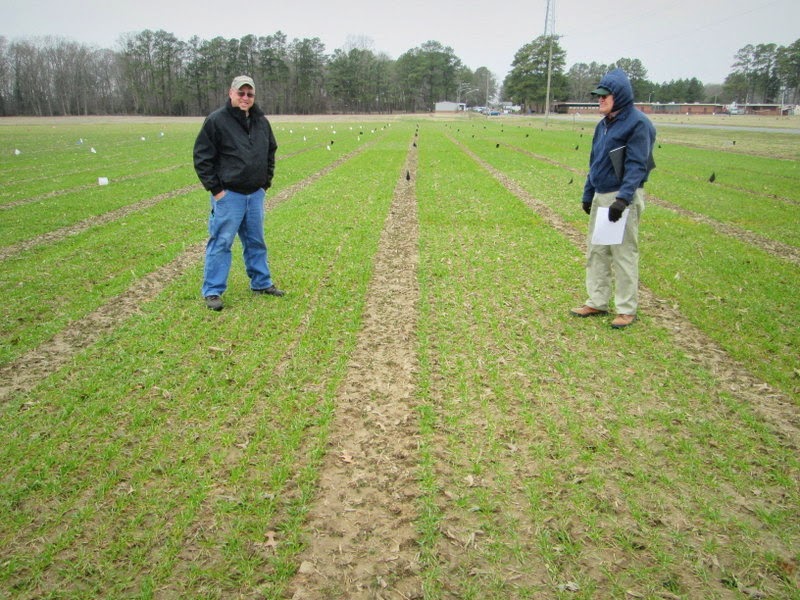
So before continuing with the saga of my Oklahoma wheat tour, let's see what happened with NCRS wheat last week.  It seems that last Wednesday the field crops crew was able to get the wheat plots topdressed.  And the production wheat too.  I was surprised to get the call about this as I thought it would still be awhile before this would happen since there are still diminishing patches of snow around.  But pictures don't lie, especially ones on the internet.  Here are Tim and Stephanie navigating the plot Hagie sprayer around a wheat trial on Farm 3.  You will recall that some of the seed tubes on the drill are plugged where the sprayer tires go.  So this leaves tram lines and no tracks on the harvested plot rows.  They are using stream nozzles.  
And because we don't discriminate, we applied some urea for comparison.  In case you are a new reader, this is our air spreader for dry fertilizers.  It was originally designed and built by Doug years ago, and has been renovated by Phil and Tim.  And probably Jeff too.  We have it accurately calibrated for the different types of dry fertilizers used around here.  It works very well for this.  That's Jeff at the helm.
And this is the Farm 3 field after treatments were applied.
Now Grow!!!

Friday, April 11, 2014

Oklahoma Wheat Tour - Day 1

So earlier this week I was in Oklahoma on a fertilizer mission.  On Monday I met up with Area Manager Todd near Perry, in North Central OK.  It seems like on each visit to my home state I am reporting on the need for rain.  Well it is the same this year.  Some areas are in better shape than others, but anyplace would sure benefit from a good soaking.  Here is a shot of a field of some of Todd's own wheat.  It looks really good, especially compared to wheat in the area with non-Liquid fertilizer.  This wheat is following corn, which makes for a good rotation.  Plus there is residual N left over from the corn which didn't yield to full potential from last year's drought.  On this field he put on 5 gallons of Pro-Germinator + 1 qt of Micro 500 per acre with the drill.  Then he topdressed with 18 gallons of a 60/40 blend of 28-0-0-5 with eNhance / High NRG-N.  On close inspection, it needs rain, but looks really good. 
 Remember that on-farm trial that I reported on during my visit here last October?  (Well if you don't, it was posted last October 26.)  Well here it is now.  The area to the left of the left of the left stick received 6-24-6 with the drill, the middle area received no fertilizer at planting, and the wheat to the right of the right stick received Pro-Germinator + Micro 500 + UAN with the drill.  (Rates in next pic.)  They were all topdressed with equal rate of 28% UAN.  This field is really dry and the wheat is smaller than in should be with good moisture, plus it was a cold winter and spring.  But my unbiased eye thought the right side looked more uniform with even color.
It was tough to dig these up.  But we saw that the wheat with the Pro-Germinator was taller and darker green.  This was also what we saw last October soon after emergence.  There were bigger roots then with the Pro-Germinator.  The roots don't necessarily look bigger now, but maybe they stuck in the ground as that particular spot seemed drier than the others.  It's only a one spot shovel sample, but that wheat was noticeably taller.  Unfortunately if it doesn't rain soon we will not be able to measure the effects on yield as the wheat won't make it.  So send positive brain waves to the sky.
In another field North and West of Enid there was a field of wheat after wheat.  This is common out here.  Below Todd makes an unfortunate discovery.
This field had a pretty bad infestation of aphids.  Unfortunately, they were the dreaded cherry bird oat aphid.  Now that's a mouthful.  They were very prevalent throughout this wheat on wheat field, and on a variety that yields well, but is seemingly susceptible to aphid infestation.  (They were in the picture, but are too tiny to see.  Look it up for a picture.) Why is this particular aphid a problem?  Well they are a vector of Barley yellow dwarf virus.  This is a very serious yield-robbing disease of which there is no cure or control.  It is characterized by yellow and reddish leaf tips leading to more yellowing of leaves.  You can see it in the wheat below.  That's why crop rotation is a good idea. But this grower, who incidentally did not use Liquid through the drill, uses wheat for pasture and needed the wheat acres.  But this field is in trouble, and is droughty besides.  It shows the importance of scouting fields so that pests can be controlled before causing more problems.
Later we saw another field that had an interesting comparison.  This grower wanted to add some zinc to his topdress of UAN solution, and had a field comparison.  Can you see the divide?  I have looked at many on-farm comparisons over the years, but have rarely seen one with this much visual difference. The dark green wheat on the right had 1 qt/A of Micro 500 in the topdress application.  The wheat on the left had 1 qt/A of straight 7% zinc from another company.  And there is only 1.8% zinc in Micro 500, but also 4 other micros.  Plus it was much cheaper, I mean less expensive. (I don't want to say who the other company is, but the name is in a well known saying just before the word handbasket.) Again, hopefully they get some rain so that the wheat will grow to maturity for treatment yield determination. 
You see all kinds of odd things as you drive through the country.  Like in the field below.  I really don't know what was going on here to cause that.
Wheat pasture is very common in Oklahoma.  For non-ag folks, this is where wheat is planted and used through the winter and early season for wheat pasture for cattle.  It is usually planted early to enable faster development so cattle can be let out to graze.  If you want to have it develop into grain for harvest, you need to pull the cattle off by March 1.  There is a yield penalty for pasture, but it is a good feed source for cattle.  Some keep cattle out all season because the wheat is more important for pasture instead of grain.  Anyway, some cattlemen do not use drills to establish wheat pasture, electing to mix some MAP and urea fertilizers with wheat seed and broadcast spread it with a spinner spreader. Then it is lightly cultivated in.  Now a drill would give a better stand, but for pasture many like the broadcast method for speed and ease.  It usually works well, except in a cold and dry fall and winter. Like the field below did not get any wheat to grow from the broadcast application.  What you see is weeds...and no cattle.  We saw several fields like this.  Too bad.  A drill and Liquid would have given a good pasture as we have seen.
So it was quite a day and I learned a lot.  Thanks to Todd for the tour.  I did feel good that AgroLiquid is still producing better looking crops, in this case, winter wheat.  But this was just the first day.  The next blog outlines Day 2.  Guaranteed to please.  

Monday, March 31, 2014

FFA Invasion Here

So last Friday was an interesting day here at AgroLiquid headquarters.  It seems that some time ago, Tim and Stephanie, along with Burt, our Education & Outreach Manager, had a great idea to help train Michigan's FFA chapters for their state skills contest.  So Burt spread the word among the chapters and Tim and Stephanie designed the training.  They put together slides of information on growing crops, crop uses, crop seed id, weeds, weed seed id, and probably lots of other stuff too.  They also made handouts to take home.  There were over 80 FFA students who took them up on the offer.  Troy kicked off the day with an enthusiastic speech, and was joined by the always popular Farm Guy.  (Those aren't poinsettias on the back table, but different crops for identification.  Harder than it sounds.)
Tim and Stephanie are former FFA members who remember what the state contests are like themselves.  They also prepared demonstrations, such as the seed id on the back table.  So they went through a lot of material.  They got a good meal and then back to the classroom for a short while longer before being dismissed with a head full of knowledge.  It was an overwhelming success and the kids and their advisors are already asking for a repeat performance next year.  Once started, you can't stop. So look for version II next time to be even better.
Everyone liked the building and the meeting room.  In fact several chapters posed for group pics around the sign out front.  (Now there is some good publicity.  Hope their parents all see that pic.)
Even the company souvenir stand had some business.
If you know Troy, you know that he is passionate about FFA and the future of youth in agriculture.  He serves on the Michigan FFA board and is active in other states activities as well.  Plus Tim and Stephanie get to give back to an organization that played a big part of their lives.  And Burt was a previous FFA advisor himself, so it's good to keep that going.  So AgroLiquid delivers high performance crop nutrition for today's growers, but also gives assistance to future farmers and agribusiness people as well.  Good luck at State.

Thursday, March 27, 2014

Nope...spring hasn't arrived out East either.

So I was on a fertilizer mission earlier this week out East.  It seems that winter just doesn't want to end this year.  Anywhere.  Well, there is no spring in Virginia, or Maryland where I was on Tuesday.  I met up with SAM Benjy first thing Tuesday morning in Baltimore and we drove down Maryland's Eastern shore to Quantico where the University of Maryland has an experiment station.  I have reported from there several times in the past.  We met with our friend Ron Mulford who, although officially retired, just can't give up plotwork and includes AgroLiquid in many of his trials.  If it looks cold in the picture below, that's because it is.  It was around 30 with a very strong wind.  That's Ron and Benjy looking out at a winter wheat fertilizer test. 
This is a high yield test where Ron is trying for...well...high yields.  Hopefully the weather warms up someday so that it can get some wheat.  The plot on the left where I am standing received a broadcast application of Pro-Germinator + Sure-K + Micros and some N at planting and was topdressed a few weeks ago with some more eNhanced UAN, Sure-K and Liquid micros.  The state does not encourage fall applications of fertilizer to winter wheat, thinking it is more efficient and responsible to be applied in the spring topdress at green up.  So the plot where Ron is standing received dry potash, DAP, AMS and urea.  Hopefully you can see that it is behind in growth.  I'll be back to check on it later on. Assuming spring and summer ever happen.
After that there was a nice discussion on the other tests that Ron will run this year in corn and soybeans.  Fortunately it lasted long enough so that I could have my usual lunch of Maryland crabcake.  After that, we headed back North to Baltimore.  We crossed the Bay Bridge to get across the Chesapeake Bay.  I reported on it last June 6 and had a cool pic then.  But in case you forgot, it is 4.3 miles long and 186 feet high at the shipping channel.  The Eastbound side was completed in 1952, and the Westbound side, where we are, was completed in 1973.  It was just starting to snow here in the late afternoon.
Well as it turned out, Baltimore received about an inch or two, but Ron said he got over five inches of snow overnight.  As I took off to come home yesterday morning (Wednesday) you could see the extent of the snowfall.  It wouldn't be there long, but it shouldn't be there at all this time of year.  I usually prefer an aisle seat, but this is a short flight to Detroit, so I took a window and was glad I did.
As we flew over Lake Erie, you could see that the West end of the lake was still covered in ice. Looking to the South I saw a couple of islands that were obviously inhabited, by humans I presume. But I didn't know what ones they were at the time.  Now I know that the main one there is South Bass Island.  It has a nice resort/tourist town there called Put In Bay.  My parents have actually been there years ago, although not in the winter.  They said they had a really nice time there.  So now that I have seen it from above, I may have to visit too.  That's Ohio at the top of the pic.
 There is still ice covering the West side of the lake.  But I don't think I would want to walk across it.
 Here is the remaining snow cover as we are coming into land at Lansing, which is about 20 miles South of St. Johns.  Still plenty there and temperatures aren't getting warm enough to melt much, if any today.
But it was a good time visiting with Benjy and Ron and getting set up for yet another year of fertilizer research.  Top that if you can!

Monday, March 24, 2014

New Faces...and a face full.

So last week I was in St. Johns all week to get caught up on important stuff.  I went out to the NCRS one morning and took a pic of this cool sunrise through a grain storage system.  
There are two faces at the North Central Research Station (NCRS).  One is Mitch who started in January as the NCRS Operations Specialist.  This means that he will be the general overseer of equipment and buildings at the NCRS.  So don't you dare use a wrench and leave it sitting out on a bench when done. But we needed someone to keep up with vehicle and tractor maintenance and upkeep of buildings and property.  Mitch has his bachelors degree in Crops and Soils from MSU, and was manager of a research station in the Michigan State University system for several years.  He also farms and has his CDL besides.  So he ought to be ready for anything that is thrown at him.  (That's just a saying by the way, don't try it.) 
Next is Dan who just started a couple of weeks ago as the Specialty Crops Research Coordinator.  He will be working with Brian and Tim B on the specialty crop research plots, such as fruits and vegetables.  But he will be working a great deal in the new apple orchard.  Dan is well qualified for that as he operates his own apple orchard at his home.  Dan has a bachelors degree in Biology from Grand Valley State University and has worked for many years in a contract research business.  So he comes well qualified for plot research.  So you'll be seeing both of these new guys when you make it out to the Research Field Days this summer.
Well I think I might have said that there are many groups that use our new office building for meetings. There are various types of meetings going on weekly here.  Mostly they just sit and talk or look at slides.  You know, regular stuff.  But this display for a training meeting of the Michigan Milk Producers Association was certainly eye-catching.  So being curious, before their meeting started, I went in and asked the meeting coordinator what's up with this cow stuff?  She said it was for dairy worker training on how to correctly apply cow teat dip.  Now there's a class!  Sorry I didn't sign up my own self.  But it's an important part of milking to apply it correctly before and after milking to prevent infectious disease like mastitis and to keep the milk pure.  She said one of the MMPA guys built all of these himself out of ceramic plaster.  Look at the accuracy right down to the veins.
Naturally I had to try one out.  Mmmm.  Fresh from the tap!
Should have brought my Cheerios.

Sunday, March 16, 2014

St. Patrick's Day and Wheat College (What a Week!)

So Happy St. Patrick's Day.  I'm pretty sure there is no Irish blood in my circulatory system, but any excuse for a party, right?  My town of Grand Ledge celebrated the day with a parade and other festivities this past Saturday.  (I have reported on past parades on past blog posts.)  You wouldn't know it was already mid-March by all of the snow still on the ground.  But at least the sun was shining and the no wind made the low 30's temperatures bearable.  I was again with my Knights of Columbus group and our train full of kids and passing out Tootsie Rolls to the thousands of people...well hundreds I'm sure. There's the Leprechaun out looking for his Lucky Charms or some Pro-Germinator.  (I think AgroLiquid is having a big St. Patrick's Day price mark down on all of the green fertilizers: Pro-Germinator, Micro 500, ferti-Rain, and whatever else is green.  Well maybe not, but they should.) 
Here we are downtown.  There were lots of marcher groups, and even two bagpipe marching bands. I'm sure it was chilly in the kilts that they wore.  Again, no wind, so that persistent question could not be answered.  Anyway, it was fun and I enjoy doing it every year.
Earlier in the week Stephanie and I went to Dallas for a meeting with Galynn and some of the Sales Account Managers (or SAM's).  Well nothing there was blog-worthy.  But wouldn't you know that on Thursday there was one of the Farm Journal crop colleges up in Ardmore, OK.  This was a one-day Wheat College, so we went along with SAM Clint.  I made Clint pull over at the Oklahoma line for pictures.  Here are Stephanie and myself as Clint took the picture, documenting Stephanie's first venture onto Oklahoma soil.  She is now among the gifted.
The college was worthwhile.  Among the speakers was well known wheat agronomist Phil Needham.  Among his tips and observations, mainly for OK wheat, but could apply some of it anywhere:

  • Poor stand uniformity is the biggest hindrance to good wheat yields.  Check your drills for uniform seed distribution.
  • In Oklahoma, there should be around 450 heads per square yard in dryland, and 600 in irrigation.
  • To determine head count number (in 7.5" rows):  count the number of heads per yard of row x 4.8 to get heads per square yard.
  • Base your spring topdress rate on tiller counts.
  • You should include a nitrogen rich strip as an indicator.  This rate would be a higher rate in the 60 to 100 lb N/A range.  So use this strip as a guide.  If wheat under your rate of applied N looks like the N-rich strip, then you applied enough.  If your wheat starts to look pale compared to the N-rich strip, you may consider applying more.  But use stream nozzles if you apply more of a UAN solution.
  • There should be 60% ground cover at the jointing stage for maximum yield.
  • One problem for no-till crops following wheat harvest is poor distribution of chaff and straw out the back of the combine.  In England, where Phil is originally from, they routinely grow 120 bu/A wheat.  One thing they do is have smaller grain heads, like 20 or 25 feet or so, so that the trash spread is not narrower than the width of the grain head.  He did show some newer tools, some still experimental, for better spread.  There was one that could even be adjusted for wind and blow it more evenly even in wind.  Pretty cool.
  • He does not like spinner spreaders for urea.  Use an air machine for that.  And stream or fertilizer nozzles are recommended over broadcast for UAN.  But watch boom height if using the 3-stream fertilizer nozzles.  He showed pictures of streaking when too high or low.
And there was plenty of other useful information from him and the other speakers as well.  Stephanie and Tim have been to corn college in Michigan and thought highly of it.  But it included outdoor field stuff and was in the summer.  But this was a good day of wheat information, and it was cold so I was glad to be inside.