Friday, May 8, 2015

Busy Week at the NCRS

So it's been a busy week here at the NCRS.  After some rain delay early in the week it was full steam ahead after that.  Several times I have shown Brian planting potatoes, but maybe you haven't gathered how that planter contraption works.  Well here you can see the seed potatoes in the planter.  These are 'Snowden' potatoes.  The planter drops them into the ground as Brian applies the different fertilizer treatments in the test through the shanks on either side of the row.
 Here you can see a seed potato that has dropped into the soil.  There is also a nozzle applying insecticide before it is covered with the closing hilling disk.   This has been a great way to do potato fertility plot research.  I can't think of a better way of running potato research as it is similar to commercial potato equipment, which increases the validity.  

Here we see Tim walking along behind to make sure that it is planting properly.  This is necessary and a great exercise program.  I dare you to challenge Tim in a walking race.
 Yesterday, on Thursday, we had our first corn emerged.  This was over on Farm 6 which was planted last Wednesday.  It is pretty sandy and should emerge quickly.  But like a parent at the newborn hospital unit, we are so proud.
 And look, here are some sugarbeets.  These are over on Farm 7 which has heavier loam soil.  These were planted the previous Monday.  Sugarbeets are always tricky to have good emergence as the seed is somewhat delicate.  But after emergence they will grow quickly to ultimately be the big root crop we all know and love.
 Here is the orchard yesterday, as this variety was in bloom.  Did you know that the state flower of Michigan is the Apple Blossom?  Well now you do.  It has been since 1897, so even then they knew the importance of apples to the state.  And how many state flowers turn into something you can eat? So there you other states.
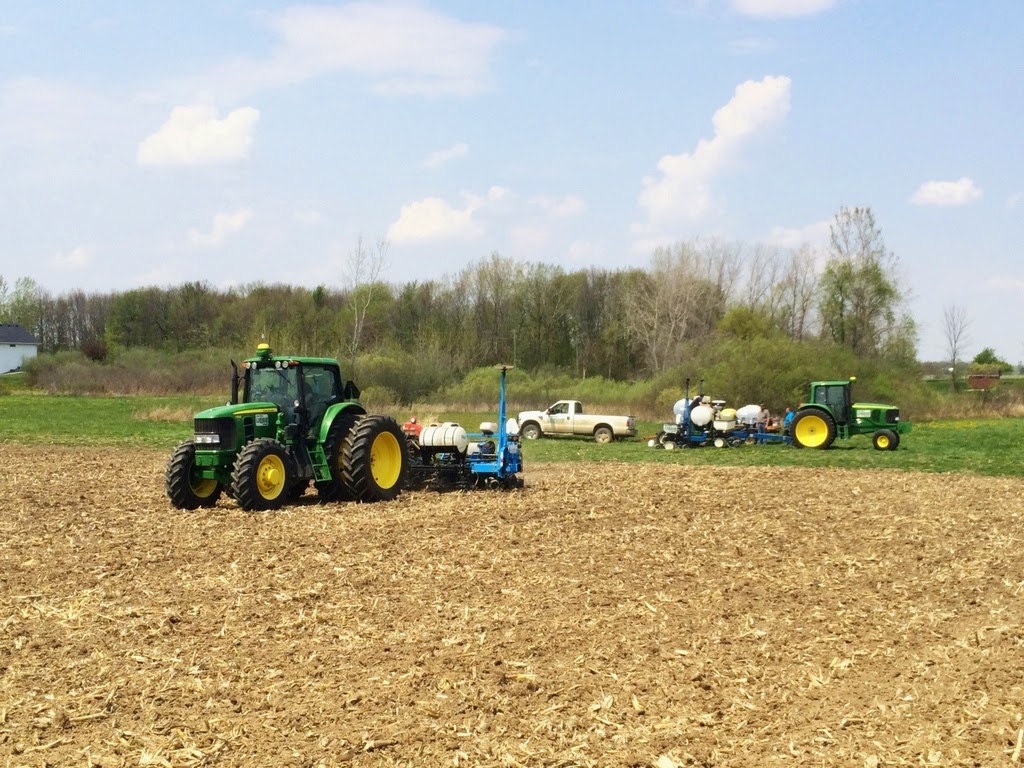
Yesterday was still a busy day of planting corn.  Here we see Tim planting a test plot with the Monosem planter while Jeff has stopped by for a fill up for the Kinze from the fertilizer wagon.  As you can see it was a nice day.  The temperature was up in the low 80's which is unusually warm, but it felt good.  We are behind on rain, but have good soil moisture, particularly in our no-till fields. Most of the fields are planted in no-till, although we do run our vertical till machine over the corn stalks in some fields of corn on corn, which still kind of counts as no-till.
 Today we planted some soybeans.  Here is the drill on Farm 7 planting no-till in corn stalks.  Both of the planters were still planting corn, so it was good to get the drill in action.
So it has been long days here lately.  But that is the way of farming in the spring.

Wednesday, May 6, 2015

Soil School is Now in Session

So last week I got to be a teacher for a class.  The Agriculture, Food and Natural Resources class from nearby Fowler High School came by for a lesson.  From me no less.  There were around fifteen students who showed up at 7:40 to listen and learn.  And that's a.m. by the way.   So I filled their heads with a lesson on soils, soil chemistry and nutrients, growing crops and careers in agriculture. Now there's a class worth taking. In fact if I wasn't the teacher I would have enrolled just to hear it. But it was fun for me and I know the students learned a thing or two.  

Well during the class I talked about the importance of a soil test as a guide for farmers to know what fertilizers to apply to the crop they are growing.  I mentioned that how a soil sample is collected can influence the results.  Now I have often talked about how you should use a clean plastic bucket to put the samples in, and not to use a metal pail as this could influence results.  But like a lot of know-it-all talkers, I had never actually done a comparison.  So I made the students do it for me.  Isn't that what teachers do?  
So we went outside to a field behind the parking lot.  I'm not sure who is farming there, but sadly they don't use AgroLiquid fertilizers.  Anyway, we had three sampling comparisons.  First was the use of a stainless steel probe and a plastic bucket, which is the recommended procedure.  Second was the use of a stainless steel probe and a galvanized bucket.  And third was the use of a shovel and hand scoop. Many people use this when they don't have a probe.  But you stick the shovel in the ground, pull it forward leaving a space in the soil, and make an upward scoop with your hand from a depth of around eight inches.  Then put the soil in a plastic bucket.  So we took ten samples around the field, with each method collected right next to each other.  I sent the results to Midwest Labs, and just got them back.  Selected results are in the table.
The results were similar for pH, organic matter (%OM), cation exchange capacity (CEC) and P1 phosphorus.  The phosphorus is really low here.  (I would use Pro-Germinator for sure.).  Potassium has a little variance, but is generally close and also very low.  (Kalibrate would help.)  But look at the Zinc readings.  The level from the galvanized bucket is super high.  After all, galvanization is a zinc coating of steel, and enough flaked off into the sample to alter results.  So don't do that!  The copper level was also higher, but not sure if that is from the metal pail.  Maybe there was a penny in the ground or something.  But lesson learned.  Class dismissed.  (And no one even gave me an apple.  Do they still do that?)

Friday, May 1, 2015

Farming Big Time at the NCRS

So planting at the NCRS is in high gear now.  It's still pretty cool in the air and soil, but warmer weather is coming.  Yesterday Brian and Jacob planted potatoes for the fertilizer tests on that important crop.
 One of the new farms had some trees cleared and it was finally dry enough to have them hauled away.  No more planting through the woods. 
Here is Phil applying herbicide after a corn experiment was planted.  Having gps guidance makes this so much easier, and more accurate, than the days of foam markers.  The boom covers 45 feet or three plots per pass, which is plenty for our tests.
Over on Farm 12, Stephanie and Tim had a visitor.  Troy dropped by to check progress.  He gets antsy if planters aren't planting when the weather is nice.  And he found his "antsy" alert was a false alarm.
 After getting loaded with another treatment, Tim makes another round.  Repeat till done.  Then move on to another test.
I will give an unsolicited plug to one of our equipment suppliers.  We use Ag Xcel's GX2 Tower Pump System on our Monosem planter.  It is the most accurate and trouble-free pump system that we have ever seen. Each row applies exactly the same amount of fertilizer over a range of rates used in our tests.  In our work, accuracy is the key, and this does a great job.  It is a little spendy, but is well worth it, especially considering the cost of inconsistent output and downtime.
So we hope the nice weather holds for awhile to get further ahead.  More reports to come.

Monday, April 27, 2015

Unleash The Planters!

So it's not the early start that we were hoping for, but at long last planting started today at the NCRS. The weather was still cold (40's) and cloudy most of the day, but soil conditions were good for sugarbeet planting.  Below we see Tim and Stephanie conferring at the fertilizer "War Wagon".  The wagon received an update of more tanks and look at the labels on all of the valves.  Quite an array of Liquid on tap. 
 Tim guides the planter through the randomized plot layout here on Farm 7.
I guess hands are considered planters in the case of Tim B and Jacob setting transplant onions on Farm 12.  There are two rows per bed, and the Liquid fertilizer is banded several inches under the sets.  These are a new type of onion for the NCRS, and will grow to be giant bulbs.  They are using a piece of drip tape with marks to indicate where to push in the transplant.  Good plan.
And so it begins.  Soon all of that vacant ground will have growing plants, with many enjoying a season of invigorating Liquid nutrition. (Well some have to suffer with inferior Brand X for comparison.)  Makes me want to grab a drink.

Sunday, April 26, 2015

OK Now It's Almost Time. Really.

So on the last blog post it looked like we were about to get to the field.  But then... reality stepped in. Last week was a return to winter with temperatures in the 20's at night and 30's by day, snow flurries and rain.  But on Friday it warmed up and dried out enough for Tim and Stephanie to make some strip till applications here on Farm 2.  Now the forecast is for sunny and warm in the week ahead.  So hopefully the next post shows a planter.  Planting I mean.

Tuesday, April 14, 2015

It's Almost Time....

So I was out to the NCRS this morning and saw that the barn thermometer says that it is almost time to go to work in the fields.  Well it was around 60 or so.  The fields are still wet, but with a stretch of warm weather ahead, they will soon be ready for some seeds.  There was a lot of equipment outside, including the loaded fertilizer wagon.  No people though.  Was it something I said?

Monday, April 6, 2015

Oklahoma Wheat Express


So again I am slow on the blog reporting...but this is worth the wait.  The week before last I found myself back where I grew up in Oklahoma.  I took a day to look around the OSU campus and here is the library.  Believe it or not, I actually spent a lot of time here when I was a student.  Now that was back in the pre-internet days, and if you wanted to look up an article or a book, you actually had to find that article or book.   A Search back then meant getting up out of your chair and searching for it on the shelves.  
 I usually come down here in the spring to look at the wheat.  I spent one day with Retail Partner Todd Woods from near Perry, OK in the North Central part of the state.  Todd is a busy guy and was frequently on the phone with customers.
 But the wheat treated with Pro-Germinator, High NRG-N and Micro 500 through the drill in the fall and then topdressed with High NRG-N is the best looking wheat around.  A popular rotation is wheat following milo.  
 We did see a field that did not have AgroLiquid that had some disease.  Now I will say that the fertilizer may not have been the reason, but who knows.  Do you know what it is?  It's Barley Yellow Dwarf virus.  It was in these yellow spots around the field.
 Here is the vector: the Bird Cherry Oat aphid.  Now the disease and this aphid have complicated names, and this is a complicated disease.  But the virus gets inside the aphid from feeding, then it spreads it as the wind blows them around and they feed on more wheat.  We did see aphids on about all the wheat if you looked hard enough.  But we did not see disease symptoms on all of the wheat as aphid population was usually below threshold. Some guys were spraying though as the disease can be very yield reducing.
You probably have heard that with the reduction in world-wide oil price, that domestic production has vastly cut back.  Well Oklahoma is a major oil state, and this has had an effect.  Like you can see that the well in this wheat field was not pumping.  Although I guess a pumping well would look the same in a picture.  Well I assure you that if I took a series of pictures that they would all look the same.
 And unfortunately, as is often the case in Oklahoma, dryness is a near constant factor.  Like here you can still see the opening from the drill last fall.  Fortunately parts of the state got some rain last week, but I don't think they did up here.
 The next day I met up with Retail Partner Parker Christian of Cordell in the Southwestern Oklahoma.  We met near Hinton where we have some replicated test plots.  That's Parker on the right with Brennon who made the plot applications.  It was cold and windy that day.
 Here is a topdress nitrogen plot.  There are several new formulations in this test.  It is very sandy ground, but they can put on some water if it gets too dry.
 And here is a growers field that has the full AgroLiquid program.  It also is following milo.  This makes a good rotation as the stalks are small and easy to plant through, plus the wheat can scavenge left over nitrogen. 
Don't let this happen to you.  We were driving and came by this field of new alfalfa that has been decimated by the feeding of the alfalfa weevil.  Further out there is no alfalfa left.  Scouting and a call to Parker who also has a spraying operation could have prevented this.  
 But here is another full AgroLiquid wheat field that looks great.  You can really see the benefits as it seemed that the AgroLiquid wheat in all the fields we saw was all uniform in size and color throughout the field.  
 Here is a field that was not AgroLiquid and it lacks the uniformity in size and color.  Not sure what was used here.
So it was a good crop tour.  Hopefully they get the needed rain to get a crop this year.  Last year was not so lucky.  In fact several grower trials that were set up were not even able to be harvested.  But everything is set up for another year.  The fertilizer is all applied and so the growers have done their part.