Saturday, July 8, 2017

Dine and Discover at the NCRS

So you may recall the blog post on April 19 about Lunch and Learn at the NCRS.  That was where area farmers were invited to the NCRS for Lunch and also to Learn about our well-researched crop nutrition products.  There was a good turnout, and it was decided to have more of these types of events during the growing season.  Well that happened last Thursday with Dine and Discover at the NCRS.  I was not able to attend either event, which may be why both were successful and well attended.  Although I hope it was because there was good interest generated at the last event, and growers wanted to see what is happening so far in the research plots this year.  Several experiments were shown on Farm 7 where the event was held.  Some growers brought soil tests, all asked questions and all enjoyed the Dining part.  Stephanie reported that there were 58 in attendance, including staff and farmer kids.   You can't start Discovering too early, so all were welcome. One guy drove 5 hours from Ohio! Photographer Adam from Marketing sent me some pictures to share. 


So that looked fun.  Lunch and Learn.  Dine and Discover.  It appears that there is an alliteration theme here.  Hopefully after harvest there will be Brunch and Brag.  

Ag PhD Field Day Learning Center Preview

So last Thursday I went on a Fertilizer Mission to Baltic, SD, the home of Hefty Seed Company and the Ag PhD Field Day coming up in three weeks.  AgroLiquid has shown at the field day for a number of years, and has always had some plot demos.  Well this year the plot has grown into a Learning Center.  What's that?  Well we have teamed with FMC, Farmers Edge and Hypro to provide a multi-team approach to learning more about various aspects of crop inputs.  Here is a view across part of the Learning Center showing soybeans, corn and sunflowers. There are also sugarbeets, date of corn planting (which will have a root pit), planter problems on corn emergence, interactions of crops and crop protection products, and probably lot's more.  It will be extra good because Stephanie and intern Adam went out in May to help get it established.  There will be a good staff of people from all of these partners to give a good overview of what is happening.  
 The guy in charge of getting the whole Field Day established for all vendors is our friend Glenn Herz from Hefty.  He is giving Retail Partner Chad Schlechter and I an overview of the Field Day layout.  I have never been here prior to the Field Day.  Usually we just show up and it all  looks great and ready to go.  But like everything, there is plenty of work in getting it that way, and Glenn does a great job every year.  
 At the Learning Center, there is a date of corn planting demo and the last date was the day we were there.  This is to see corn development all at the same time.  There is also another plot of different crops and the effects of different herbicides and other crop protection products on growth. Sort of a mode of action demo.  Glen is planting that below.  That wheat in the background will be the parking area.
This is a view from the Learning Center corn plots looking at the other crop demos below.  Varieties, crop protection, tillage, genetics and other ag aspects will be shown to the many thousands of visitors in just three weeks.  Of concern is the weather.  Well that is always a concern, but it is so hot and dry.  It was in the mid-90's when I was there, and calls for 100+ in the upcoming days.  And no rain before or after in the forecast.  Fortunately it was wet in May, in fact planting was delayed until May 18.  So the heavy soil is retaining moisture....so far.  But I wasn't in the heat of the afternoon.  But I'm optimistic the Learning Center and entire Field Day will be great as usual come July 27.
There was one more task to complete.  I wanted to collect some soil samples from several of the sunflower plots here for some Haney Soil Health evaluations.  There are different nutrient inputs that may have an influence on soil health, so I will take some samples, send them off and find out. Although the dry conditions may have an effect, we will see and learn, which is why it's a Learning Center.  Chad is kind enough to bring me a small shovel and more importantly, some water.
I also had a chance to visit with several of the Hefty agronomists, Darren Hefty before the radio show, radio show producer Janelle, and the always delightful Marketing Director Matt.  So it was a good day.  See you at the Learning Center on the 27th.

Saturday, July 1, 2017

Other Sights to See in Oregon

So it's no secret that one of my favorite things about traveling all over is seeing other sites worth seeing all over.  On my Oregon trip, Eric and I stopped by this place high over the Columbia River.  It is the Vista House at a place called Crown Point,  It was opened in 1918.  
 It is still in it's prime at 99 years old.  There is a gallery and shop inside.
 But the main attraction is the view of the Columbia River.
 Eric enjoyed the view while on a business call, as he often was.
Another stop was up river in the town of Boardman, OR, the site of the SAGE Center.  SAGE is a museum of Science, AGriculture and Energy.  It opened in 2013 and was developed by the Port of Morrow which is a major port for shipping of agricultural products from the area to the world.  There was an exhibit showing destinations all around the world for their local products.  So naturally we had to take a visit.
Even though they were right by the river, early area farmers had a tough time producing crops without water in the early 1900's.  Boardman, OR was first settled in 1903 by Samuel Boardman, who worked for 13 years to develop irrigation in the region, which changed the area forever.
 Eric learns the history of the area.  We did see a movie of how the town had to be relocated to higher ground in 1965 to make way for the John Day Dam.  The dams all along the river enable lots of energy, and more importantly, flood control.
There is plenty to learn about food production.  I will say that this is in a very small town, but is off of an interstate highway.  I hope they get enough people stopping by.  It was pretty good for explaining that food doesn't just come from a grocery store.
 Potatoes are a major crop in the area, and there was an exhibit on how potatoes are processed into consumer products.
 Curly fries....at a store or restaurant near you.  From out of the ground to a delicious food product just like that.  I found it very interesting.  By the way, all of this was moving in the exhibit.
So you may think that the SAGE center is similar to the IQ Hub.  Well, I found out that our own Burt Henry visited the SAGE center for ideas and sources back when the IQ Hub was being developed. Looks like both places are prime sites to visit for an education on real agriculture.  Both are worth the trip.

Friday, June 30, 2017

Everyone Likes Onions!

So onions aren't exactly like blueberries where you pop one into your mouth and eat it straight.  But onions help make food into good food.  So back to my trip to the PNW last week...on the trip out you could see lots of center pivot irrigation fields, especially here along the Columbia River.  And as you have heard or experienced yourself, not everyone knows what these are.  The guy next to me asked what those round things were.  Rather than be a wise guy and say they're huge putting greens on a 90 hole golf course, I explained that they are for watering fields for food production.  And they still look cool.
So I'm not sure if this is a map of the same place as in the above picture, but Eric and I were given a map to go find an onion field that has a fertilizer test in it.  Now that was a challenge.  This is a very large corporate type farm.  Well it's not exactly a corporation as we know it, but rather a substantial religious operation.  And very well run it is.  
So why water?  Well the picture below shows ground without water and a field of potatoes with water.  No irrigation, no food.
We finally found the correct pivot, and then located the stakes that divided the fertilizer treatments.  I am standing in the division of two treatments.  On the left is the normal application of 20 gal/A of 10-34-0 and 10 gal/A of Pro-Germinator on the right. To me the Pro-Germinator is bigger and thicker. Another treatment in the test is Pro-Germinator + C-Tech.  It looked good as well.  The plots are very big. However there is an unknown in this test.  The fertilizers were broadcast and incorporated prior to planting, which is different than the preferred band application.  But this farm is so large,  that's the way they say it has to be done.  So we will see come harvest.
This is over on the other side of the pivot.  I was surprised at how much of a change in elevation there was.  It's hard to tell in this picture, but I am way up higher than the top of the pivot towers down below.
This is a nice looking field of potatoes.  Not AgroLiquid.  But today onions...tomorrow potatoes.
Several miles away was another series of center pivot fields with this same large farm business. Again we are looking at pre-plant incorporated applications of 10-34-0 on the left and Pro-Germinator on the right.  As before, I am seeing better growth on the right with Pro-Germinator.  This population of onions seems lighter than the other field, and thinner yet on the left.  I moved over ten beds on each side from the center and took stand counts at five equal distances into the plots.  There were 20.5% more plants on the Pro-Germinator side.  But something was odd here.
This is a center pivot field, you can see the pivot in the above picture.  But they are using buried drip tape here for the water source.  That certainly enables increased water efficiency, but really only if the tape can water the whole width of the planted rows.  The picture shows that the outside rows are dry. They are probably getting some water underground, but not uniform for all rows. It was like this everywhere.  This is probably why the stand is thinner here than the other place.
While on this farm we noticed a variety of crops again.  And look at the thick trees at the back of this corn field.
Well this isn't an Oregon forest, but a crop of hybrid poplar trees.  There are some 50,000 acres of these in the PNW.  They are made to grow fast, up to 110 feet in 12 years at which time they are harvested.  Uses are lumber, wood building pieces, chips for pulp to make paper, among others.  It also provides plenty of wildlife habitat.
But how do they grow in this sandy desert?  There is drop tape at the base of the trees.
So that was interesting to see such crop diversity.  There is so much food and consumer products produced here in the Columbia basin where plentiful water enables so much.

Wednesday, June 28, 2017

Field Harvest of Alfalfa Plots

So I reported earlier about some alfalfa plots that we have on some area dairy farms.  Well those fields were cut yesterday (Tuesday), so it was time to take some yield checks.  I was away on a fertilizer mission, but Stephanie sent these pics of the operation using the methods we came up with.  MSU intern Jacob is in charge, and he assembled this frame that is 15 feet long and gives a rigid border to make the sample cut on the row of fresh-cut hay on the ground.
 Quinten and Jacob load the sample onto a tarp.
Then the sample is weighed on the scale wagon.  A sample is collected and saved for moisture determination to equate the various sample weights.  There were multiple samples collected like this for each treatment.
Samples were also collected as the hay was chopped for submission to the lab for quality measurements. These good field techniques will hopefully provide useful information.  That's AgroLiquid research in action.

Sunday, June 25, 2017

Everyone Likes Blueberries!

So as the title says: Everyone Likes Blueberries.  If not, then who are you?  Lots of states grow blueberries, and Oregon is one.  Michigan is #1 in acreage though.  But Oregon's are just as good I'm sure, especially when grown with AgroLiquid.  Eric and I visited this large farm in Amity, OR which is South of Portland.  They are doing some field comparisons with AgroLiquid.
The AgroLiquid program has both drip and foliar applications.  This is the AgroLiquid block on 'Draper' variety blueberries.  They are certainly tall and bushy.  Measure against Eric who is 9' tall. Well probably not quite that tall I guess.  But they are big.  You couldn't easily walk through the rows.
And they are loaded up.  By starting to turn color, harvest is not far off.  It was interesting to note that the place is loud with all kinds of bird noise.  But this noise is out of speakers and the farm has them in place to scare away the birds who are waiting for the berries to turn blue and sweet.  Good luck.  Although I don't recall seeing any of the flying kind.  Just the noise kind.
We also noticed shoots coming from the base for future limbs of production.
Now here is the grower's program on another similar 'Draper' block where other "specialty" type fertilizer is used.  This is in line with where Eric was walking, but there was not near the size and they weren't as green.  They did seem to have lot's of berries though.  But the plants weren't as big so probably have less.  Harvest will tell us.  But you could easily walk through the rows and we did not see very much new shoot growth.  But again, will wait for harvest as I admittedly see things through Agro-green tinted glasses.  But this is what we saw.  We made a video of our visit that hopefully will be shared on the web-site someplace for family viewing.
And waiting for harvest looks like some new harvesters.  They'll need them for sure.  We are supposed to get yield comparisons on these different fertilizer blocks.  So hopefully in the future I can give a report on programs and yields.
So don't those look similar to the ones at Kauai Coffee that has been shown in several blog posts over the years.  Except these are new and shiny.  Well they use blueberry harvesters there for coffee you know.  Since they aren't likely to be using these in the winter here, maybe they can swim them over to Kauai to help with the coffee harvest.  Or not.

Into the PNW

 So last week I was on a Fertilizer Mission out to Oregon and Washington, or the Pacific North West (PNW).  On the flight from Minneapolis to Portland, I had a window seat on the North side of the aeroplane.  Good thing.  Here is a picture getting close to Portland. That is the town of The Dalles and the Dalles Dam on the Columbia River.  And in the background are two mountains that are former volcanoes. 
Here are the mountains.  That is Mt. Adams (12,280 ft) and Mt. Ranier (14,411 ft).  Quite a picture if I do say so myself.  They are on the Washington side of the Columbia River.
 And here is a closer up picture of the dam.  I didn't know at the time that I would stay there the next night (Tuesday).  Well not on the dam, but in a motel.  
 In fact, here is a ground-level view of it.  Not letting out as much water now as before.
 And here is another famous mountain, Mt. Hood.  It was on the Oregon side of the Columbia River.  I made Eric stop so that I could take this dam picture, and turned around and was surprised to see this mountain behind us.
OK, time to get to work.  I was working with Sales Account Manager Eric Collins this week.  One of the things we were looking at was AgroLiquid applications for Ryegrass.  We were in the Willamette Valley South of Portland.  It seems that this is the grass seed capital of the country.  The major grass grown is ryegrass (perennial and annual) with 234,000 acres. There is another 30k acres of other grasses like fescue.  There is a Retail Partner, Koenig Custom Application, that we did a grower meeting with, as reported here on December 15, 2015.  Well some of those growers that grew ryegrass seed were intrigued with the possibility of foliar applications of Sure-K on rygrass grown for seed production.  Well they saw increases of 20% or more.  So Robin Koenig is making more applications this year.  Eric and I visited several of these fields to see how they look as they are getting closer to harvest.  Eric moves in for a close evaluation.
But you don't really have to look too hard to see that these foliar applications are having a positive visual effect.  Can you see which sede looks like it is doing better?  Well hopefully it is right side where Sure-K + Micro 500 were applied several weeks ago. 
 This is looking back the other way.  So now the AgroLiquid Sure-K + Micro 500 application was on the left side.  Again, this is visual assessment, but this has shown big response in tests last year.  So hopefully this works out again.  
Now foliar applications of other potassium fertilizers are made to growing ryegrass.  But now with Sure-K, results like this should show growers that there is a new option.  The Retail Partner is very excited with the results and prospects, as are the growers involved.  This is a new market for AgroLiquid application. How many other new crops are out there waiting to be shown the benefits of AgroLiquid?  Well it's probably a lot.
And evidently in Oregon, ryegrass is not the only grass grown for some sort of consumption.  We didn't stop, so no jokes please.
 So this was a piece of equipment in Robin's yard.  What the heck is this for?  Well this is a Rubber Duk applicator built in Eugene, OR.  It is for spreading fertilizer in muddy fields or for application on crops in wet fields that don't want to be tracked up.  Love to see this in action.  Except for the dry spreader part.
We are also working with a researcher on these foliar applications of potassium and micronutrients on ryegrass.  Here is a view of the plot area.  You know it's research from all of the flags.  
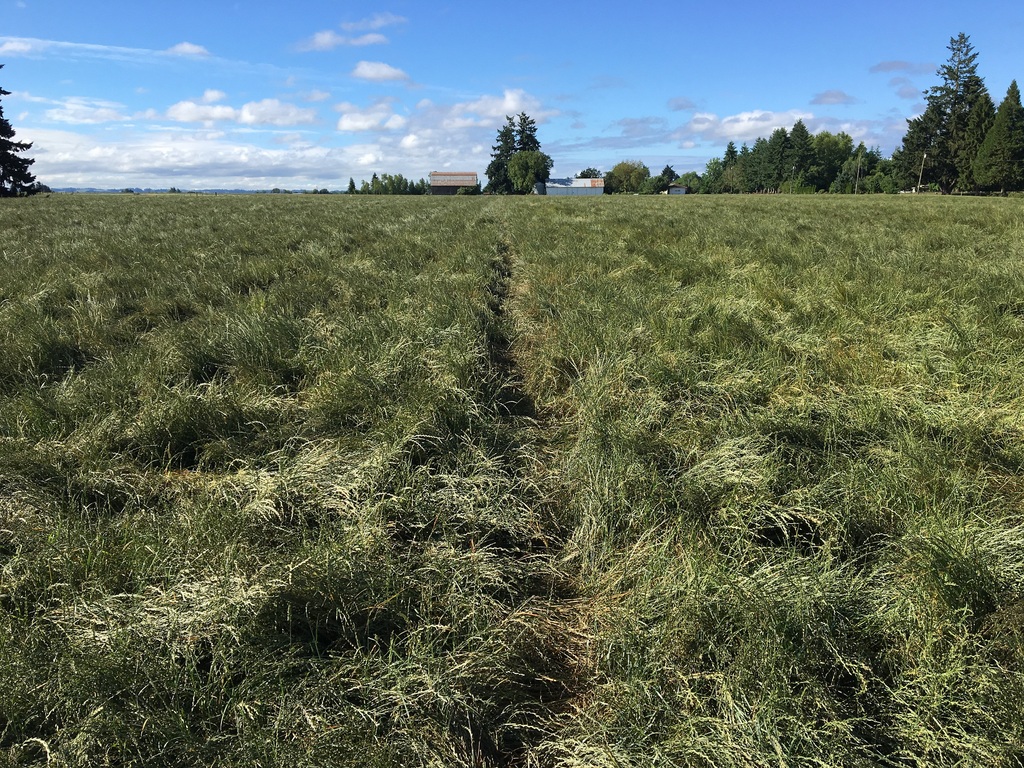
 One thing that is common practice of ryegrass seed producers is application of the plant growth regulator Palisade.  It helps to keep the plant standing up. This is a section adjacent to the plots that did not get a Palisade application.  Evidently you want it standing longer, and it does lay over after the heads get heavy with seed.  I've seen Palisade used on wheat, but the effects are not near so dramatic.
So we will have harvest results from these tests later in the year.  But It was fun to see a new crop for me.