Wednesday, December 22, 2010

Four Go In....Five Come Out!


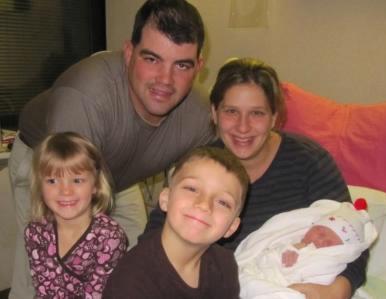
Here's the happy family just before leaving the hospital last weekend. Baby Gabriel is a wonderful present for the whole family. Just look at the happy faces. I'm sure that everyone will want to hold him, and knowing Stephanie, there are already hundreds of pictures taken around the tree. Merry Christmas to you all!

Thursday, December 16, 2010

Ryan and Stephanie Plus Three

So do you remember that Stephanie was pregnant? Well she was, but not anymore. Yesterday morning she and Ryan welcomed child number 3 into this place we call Earth. It is a healthy boy! As of late yesterday afternoon, he was still named Zelinko Boy, as there was lack of agreement on a name. I mean, you can't make such an important decision like that in only 9 months. But whatever he is ultimately named, he is a lucky boy with such loving parents and brother and sister. And I think I see a future Liquid user here. So Stephanie will be away from her desk for awhile getting this guy off to a good starter. BTW, she has internet access in the hospital, so feel free to submit your ideas for names.


Saying Goodbye....

So Mr. Cook was laid to rest today. Yesterday there was visitation with the family at the funeral home. It was a sad yet comforting time sharing stories and expressions of admiration. Today was the funeral and even more stories and memories were shared during the service by son-in-law and Pastor Don Ruff, daughter Debbie and Mr. Cooks church Pastor Kathy Leydorf. It was a most remarkable and touching service attended by a large number of friends and family. So now it has at last sunk in. We can see the cemetary and marker from Farm 3. But we will continue to see his influence and memory all over the NCRS.

Wednesday, December 15, 2010

Mr. Douglas Cook: His Legacy Will Live On In All of Us

By now most of you may be aware that Mr. Douglas Cook passed away last Sunday night. He had been ill for some time now, and his passing wasn't a surprise. But it is still tough to accept that he is gone and we won't be seeing him anymore. He was the definition of a visionary: a man who saw what plant nutrition could be, went against what is the norm, and paved the way to make it happen. What was started literally as a backyard venture in manufacturing new formulations of plant food has grown into an international venture benefitting growers, dealers, and LIQUID's loyal family of employees. He was more than just an agronomist and businessman. He saw what good a person was capable of doing if they would work hard and be kind and helpful to others. He would certainly challenge you to do your best and to think.
I remember when I first interviewed with Agro-Culture Liquid Fertilizers to be the new research manager back in 1992. He asked me if I had done much work in the science of plant fertility. I said that I had used and applied fertilizers before, but my specialty then was weed control, not fertility so much. He said that was good because I wouldn't have to unlearn any bad habits and that he could teach me the right way to feed plants. And so it was for over 18 years. I also remember at the start of my LIQUID career when someone in the office who learned that I was from Oklahoma mentioned that Garth Brooks was also from there (and incidently, also graduated from OSU). Mr. Cook then told me that I would make a bigger impact on the world than Garth would. Now I may have fallen short on that, and at the time, thought what he said was nonsense. But then I remember thinking that Mr. Cook really did have faith in me that I could do that. That made me feel good, and he certainly thought that his employees could move mountains. And I think that they have.
Since the NCRS was right in his backyard, we would see him almost daily during the growing season. He would always ask what we were up to, and what was the most exciting thing we had learned that day? And he really loved the PLFP tours of farmers, Area Mangers and company employees because then he had an audience. He would delve into his philosophy on feeding plants and often on life itself.
I would enjoy sharing a stop on the NCRS tours with him because you could always count on some back and forth banter and fun challenges that we shared.
Another great thing I enjoyed was being in Hawaii when he was there in the winter. Besides the beautiful scenery and climate, there was the opportunity to visit the Mid-Pacific Research Station on Kauai. It was his winter lab where he could continue to explore plant nutrition and visit with local growers. It was there that I had the opportunity to visit and interact with Mr. Jim Cassel, on whose property had the research station. There was a great friendship between these two gentlemen, and I enjoyed being with them. He will also always be on my most admired people list. Sadly he passed away in 2008. I will always remember the two of them singing Hawaiian songs with band and hula accompanyment in front of our banquets there. Now they are singing together again.
It is said that Life is for the Living. And that is true. We will all go on about our business and lives. And the company will continue to grow. But it will be different now as new people come to work for, or do business with LIQUID, and they will not have had the opportunity to know Mr. Cook personally. I don't think they will have the same level of appreciation for where we came from. But for those of us who had that great privilege, we will be glad to tell them.


Wednesday, December 1, 2010

Probably Our Last Field Project of the Year

So what is Tim doing in that hole? Well recall last week we were installing our leaching test site, and last Monday we connected the tile line to the collection wells. It was important to accurately place the hole for the connector pipe, so first we measured the depth of the tile at the end of the hole. To do this we used a surveyor's transit. It was kind of fun, if you're into that sort of thing.

Then we added a quarter of an inch to the depth at the end of the tile, and made a mark on the well. This also was done using the transit. We wanted the depth at the well deeper than at the end of the tile so that the water will flow downhill into the well. It's easier that way compered to flowing uphill. (This will all be clear in a minute.) Here Phil marks where the top of the hole will be.

After all of the wells were marked, Phil drilled the holes in the wells with a hole saw.

Then the pipe that was connected to the tile was inserted into the well. Here is the view from the top of the well.

Then Tim applies a bead of silicone around the hole to keep water out.

Back at the other end of the pit, the pipe is connected to the tile. Recall that the wells are 15 feet from the end of the plot in order to maneuver the equipment, like the planter and sidedress rig. We didn't want any fertilizer from in the alley outside the plot to get into the well, so we used PVC pipe from the end of the tile to the well itself. Clever, huh?
Here is a look at the whole thing. There were 16 of these, so it was a busy day!

We finished just before dark, which happens around 5 pm now, and Doug filled in the holes. So they will rest now until next season. They will need the rest as they will be busy then.

We knew we had to get it all done on Monday as the forecast was for rain that night. And the forecast was correct as it rained that night and Tuesday, and then snowed today. So I suspect that will be the last field project of the year. And what a year it was. It is all outlined in this blog going back to planting in May. Not sure what will be posted here from now on, but check back from time to time, you never know. Thanks for looking in on us. HH.


Thursday, November 25, 2010

Something New For the NCRS

So I went to the office today and was surprised to find that I was the only one there. Guess there must be some flu epidemic or something. But anyway, it gave me some peace and quiet to add a new installment of the NCRS blog. I know it's been a while, but most of the stuff I am doing is not out at the NCRS anymore. But yesterday we did something that is blog worthy. Now usually I don't really like to talk about stuff before it happens, but this is kind of cool so here you go. We are installing an area where we can evaluate different corn nitrogen programs not only for yield effects, but also for nitrate leaching potential. As mentioned previously, we are doing some tiling of our new farms 7 and 8 this fall. That is now complete, but had the idea of putting some tiles on Farm 2 where we could collect tile drainage and test for nitrates. So we laid out some plots where we could do this, and yesterday was the day. Follow along with the pictures. The first picture shows where the tile was buried. It was installed on Tuesday, but I missed it and have no pictures. But the tiles are on 30 foot spacing and run the 140 foot length of the plots, plus an additional 20 feet into the alley. We plan to collect water in, for lack of a better word, "wells" at the end of each plot. We put some concrete in the bottom of the holes and inserted the wells into the concrete. It took a good bit of labor and we had Doug, Phil, Ron and Tim on hand to help. Brian stopped by later too.
Here we see Doug pushing the well down into the concrete base. The slats are our depth gauges.
Tim checks to make sure that they are straight.

Here is the finished tube. After the concrete cures, we will attach the drainage tile.

Here we see the well and the end of where the plot will be. We will attach the tile to the PVC pipe and then cut a hole and insert the pipe into the well for collection of drainage water. We use PVC pipe in the alley so that no water from the alley will go into the tile. The alley is where we get the planter and sidedress rig set up, and that include running it on the ground a little for priming. So we didn't want any of that extra fertilizer getting into the wells. And we needed to have the wells out in the alley so that we can set the planter and sidedress rig down into the ground before the plot.

The tiles are on 30 foot spacing. The plan is to have a 6 row plot (15 feet) of corn over the tile. And then we will plant 6 rows of soybeans between the corn for borders. Then we will collect drainage water as it happens and have it analyzed for nitrate. We will also be able to pump out the wells and use a hose-end meter to measure gallons so that we can determince pounds of N lost through the tiles. We will have 16 of these wells for our leaching experiment. So it is a pretty ambitious project, and we will let you know what happens.
Oh by the way, there was a nice turkey dinner waiting for me when I got home. So it was a pretty good work day here.


Friday, November 12, 2010

LIQUID Invades Midwest Labs

So a bunch of us management types were in Omaha this week for a company meeting to work on strategery for the upcoming sales and marketing season, with a healthy dose of research. We could have met anywhere, but we wanted to go to Omaha so that we could tour Midwest Labs. We have worked with Midwest Labs for more than ten years in setting up a relationship for handling our soil test programs, and it has been a great relationship indeed. We really like the speed of the analysis, posting results on the internet, converting recommendations to Liquid products, and the nice price to the grower for going through Liquid. But I wanted to show a few pictures of the behind the scenes tour that we were given. Our hosts were Mr. John DeBoer, Vice President and one of the owners and John Paul DeBoer, Information Systems Manager. These two have worked closely with Stephanie over the years as she mainly manages the soil test program for Liquid. We also heard from Midwest in-house agronomist John Menghini, with whom I have visited numerous times over the phone. The picture below shows a couple of guys that open the boxes of soil test bags that have just arrived. Fall is the busiest time of year for volume of soil received, as post-harvest sampling is probably the best time for this. It was stressed how important it is to follow the directions for sample submission. Namely, have the bags in order and place the submission sheet on the top of the bags inside the box. This speeds the operation, and speed is important. In fact, they said that on a recent day they received 29,000 bags of soil for analysis! So they don't want to be slowed down looking for the form and getting the bags in order.
After opening the bags, the soil is placed in these trays and dried. Each sample is numbered so that it can be followed through the entire analysis process. Then the samples are run through this grinder for the many steps of the analysis process.

John Paul DeBoer shows the containers of the ground up soil. A small scoop of soil is collected for the different tests. There are samples of a standard soil sample included throughout these trays for quality controls. The tests are conducted in a number of rooms throughout the building, and it looked like a bee hive as everyone was very busy in order to process the volume of samples that come through each day.

This particular area in the picture below was for the analysis of micronutrients. A soil sample is placed in the filter paper and a solvent is poured in for extraction of the nutrients, and then analyzed somehow for content. It was all very complicated, but they had all the right equipment and the right people to run it all.

Here is where they measure the pH of the soil. The samples are mixed with water, and continually swirled around as four pH probes are inserted for measurement. And then they lift out and are rinsed with water and the tray moves down for the next group. We were amazed that there were no spills as the "mud" swirled around to the top of the tray cup, but did not spill. I guess they have done this before. It was mentioned that they developed the robotics for this process themselves. Here the pH measurements are shown on this screen, as Justin watches. If the pH is over 7 and an Olsen bicarb test is requested for phosphorus, it is somehow flagged and a sample of that soil is directed to the bicarb tester. This was the most amazing thing to me in that there are samples of the same soil all over the place getting all the different tests run, and in the end, they all get recorded back together on the correct soil test report.

This wild looking instrument below is for running the Olsen bicarb test for phosphorus. The Bray tests are run in a different area. They can also do a Mehlic and Morgan test, if requested.

Now the instrument below is an inductively coupled argon plasma (ICAP) machine used primarily for the sulfur test. I think it also tests other non-nutrient things too. But that flame is very hot. How hot, you ask? Try 6000 degrees Celcius, or 10,832 degrees Farenheit, or sun temperature. I'm not exactly sure how it works, but it probably won't come up in daily conversations, but it was impressive. And they have a number of these in the lab where they were.


You know how you can get a test re-run on a particular nutrient if the result you get looks odd? But where do they keep the soil in the mean-time? In the basement, samples are retained for a period of time. And due to the coding of samples, they can go right to it. We have had a few tests re-run over the years, and they do a good and quick job of it. It kind of reminded me of that last scene in the first Indiana Jones movie.

Below is some of the group being led by John DeBoer to another building where additional tests are run. It's not all soil and tissue testing there. They also do things like food and pet food analysis, fertilizer analysis, water analysis for contaminants, and so on.

Here we see the results of a sample run for water contamination.

So it was a great visit. Like many of you, I have been sending samples to Midwest for many years, but did not really know what happened to them once they got there. But it is anextremelly well run, efficient and very high-tech operation. And very clean too with all of the soil running through it. One last thing...do you wonder what they do with all of that soil after they are through? Well it is collected outside in these containers, and is used to cap landfills in the area. So no soil is wasted in this operation.

So thanks to Midwest Labs for the enlightening day.