Thursday, August 8, 2013

Everyone Should Have Been in Brownsburg Today

So today I was in Brownsburg, IN for the Cover Crop & Nutrient Management Field Day hosted by Area Manager Mike Starkey.  The Hendricks County Soil and Water Conservation District was the co-host.  Brownsburg is right next to Indianapolis.  It was attended by around 50 area growers who are all seeking ways to best farm ground close to urban developments.  This would include the use of cover crops and no-till.  I used to live in the Indianapolis area and it was sure a contrast to see corn growing so close to the city.  The Starkeys have been farming here for six generations, and are very conscious about using responsible cropping management practices. 
One of the featured guests was Barry Fisher who is Indiana's Soil Health Specialist.  He is well known and evidently has spent more time down in soil pits than up on the ground.  Here he is in a pit in a soybean field that had a cover crop of cereal rye.  It was flown on prior to corn harvest last year.  Well last year this area was hard hit by drought.  This left a lot of unused nitrogen in the soil, and it was utilized by the rye, which was up to four feet tall prior to planting.   You can see a thick clump on the side. But there is a good stand of soybeans this year.
He was able to show that the soil was loose from about 7 years of no-till with cover crops.  He also was able to find ample evidence of earth worms, and showed a string of soybean root nodules up to 16 inches deep, that evidently grew down a worm tunnel.  (They are those knobs on the root to the left of his face.)  Nodulation this deep would provide oxygen for organic matter decomposition and better soil health.  (Note: if you don't know, certain soil bacteria called Rhizobia japonicum form a symbiotic relationship with soybean roots where the bacteria provides nitrogen to the soybean and the soybean provides a place for the bacteria to live.  The bacteria form nodules which are the "factories" where the bacteria convert nitrogen from the air, which the soybeans can't use, into a form that they can use.  Everybody wins.) 
 We also looked at a pit that had annual rye as a cover crop.  It wasn't as thick and tall as the cereal rye.  But rye is a cover crop to prevent soil erosion and to "scavenge" soil nutrients and then release them back after they are killed prior to planting.  Plus they can add organic matter and keep the soil more biologically active. This is a view of some nice beans from the pit sites looking back to Mike's shop where we were meeting.  The beans look great this year.
Here is a view from Mike's shop.  It was suburban Indianapolis where they also grow sub-divisions.  So farming responsibly is very important. There were also some folks that talked about equipment and which closing wheels work best for the soils and no-till around here.  And there was a guy from the Natural Resources Conservation Service (NRCS) who described a watershed program that Mike is going to participate in to compare fertilizer practices in adjacent sides of a creek that drains into a nearby reservoir.  It will compare a Liquid program vs a conventional program and will be monitored for drainage tile nutrient loss, soil nutrient levels, erosion losses, and yield.  Details to follow.  This is brand new.
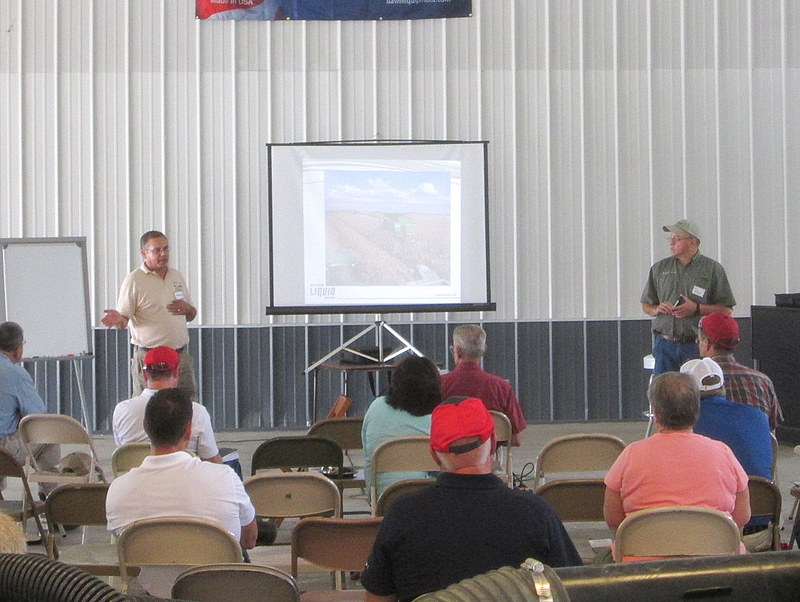
To pay for the free lunch, they had to listen to me talk about the products that Mike is using on his farm with great success.  Mike said that many growers were not aware of things like phosphate fixation and crop nutrient demands, so I did my best to lay it out, plus how research at the NCRS supports conservation and nutrient management practices.
Everyone else paid attention and hopefully learned some things.  But there were a few in the audience whose brains got filled up too fast and nodded off.  Fortunately it was only SAM Adam and Regional Sales Mgr Bob, who have heard it all before anyway.  At least they didn't snore. 
After that Mike came up to follow up on what he does with AgroLiquid and to have some Q&A. 
Mike also is a Dawn Equipment dealer.  And the last thing was a brand new prototype fresh from Dawn Equipment.  In fact it was just painted at the factory in Illinois last night and driven over this morning.  It is a planter attachment for planting into a standing rye cover crop.  The disks go in front of the row and bend the rye over, and then the rolling blades flatten and crimp the rye.  This would be able to kill smaller rye, but larger rye, like 4 feet tall, would still have to be sprayed.  But this would enable easier planting.  So this meeting was the first in the solar system to see it.  Everyone likes to look at equipment. 
So after that I headed back North to Michigan.  Tomorrow will be a very busy day on the farm as the Research Field Days start next week.  And here is a heads up for next Monday night.  Make sure to tune in to RFD Live on the RFD TV channel at 8 pm EDT.  You will see some of your favorite researchers Live From the NCRS.  (Hey that has a nice ring to it.)  So if you don't have Dish or Direct TV, then find someone who does and be there next Monday. 
 

Wednesday, August 7, 2013

Future Researchers?

So we have to say that we could not get all of the work at the NCRS done without some help.  This year like the previous two, we hired some college interns to assist with the various research tasks, and hopefully they learned a thing or two themselves.  This picture was taken earlier this summer at the start of their internship.  That's why they are smiling.  But I still catch a smile every now and then, and they tell me that it has been a good experience anyway.  Below we see Chance, Mike, Erin and Peter.  Details below:
Chance is originally from a family farm in Boise City, Oklahoma. So being an Okie he can't be all bad.  But now he lives in Amarillo where he is a senior at West Texas A&M University majoring in Plant, Soil and Environmental Sciences.  Prior to that, he spent four years in the Marines and was deployed practically all over the world, including Philippines, Germany, Kuwait, Australia and in Iraq.  He hopes for a career in research and consulting.  Mike grew up on his family farm in Pigeon, MI which is out in the thumb (hold out hand with thumb on right to look like state map.)  Mike is a youngster having just completed his freshman year at Michigan State as a Crops and Soil Sciences major.  He plans to return to the family farm after graduation.  Erin has the shortest commute being from right here in St. Johns growing up on the family farm.  She will be a senior at Michigan State as a Horticulture major.  She has an interest in food crops and a love of plants.  Well she fits right in here.  Peter grew up in East Lansing and had no choice but to attend Michigan State University.  He too has an interest in food crops as well as trees and tree crops.  So this is the perfect place for that.  Peter plays guitar in a band, and so we are all looking forward to the NCRS talent show.  All of us full-timers are very pleased with all four of these students, and hopefully they got an inside look at the workings of a leader in agriculture and how we support our products.  I feel they will go far in the ag world. 
 
I never remember stacking straw bales to be so much fun.  But that's the life of an intern.  I hope they remembered that during the seemingly non-ending job of taking stand counts.
Unfortunately (for us) their time at the NCRS is almost over as school will be starting up again in a few weeks.  But if you need some good summer ag help in the future, I would vouch for all of these.

Friday, August 2, 2013

Aeroplane Ride Over the NCRS

So yesterday was a special treat for Stephanie and Tim B.  They got to go on an aerial flyover of the NCRS with pilot Nick.  We try to do that every year, but it has been awhile since the last one.  Sadly, St. Johns has no municipal airport, so they drove up to Alma where Nick keeps his plane and then headed back South by air.
They soon reached cruising altitude, although Nick better keep his eyes on the road, er..air and not so much on the instruments. 
And here is a view of the NCRS office/barn complex on Farm 1.  It was a partly cloudy day which made it difficult for Stephanie to take pictures.  But you get the idea. 
This shows Farm 3 looking to the North.  You can kind of see the irrigation running.  To the bottom of the red barns is where Brian has some of his vegetable plots.
This is Farm 5 which has corn, soybeans, sugarbeets, winter wheat and alfalfa. 
This is Farm 7, one of the newer farms that we started farming in 2010.  It is very productive.  To the right in about the middle, you can see the plots on Farm 12, which is the demonstration and tour farm.  We will have a riding tour of Farm 7 to show some of our replicated plot field nutrient research.
This is Farm 12 looking back to the North.  You can see Farm 7 to the North, and in the middle on the right, you can see a drive across from that wheat field.  That is the Farm 8 apple orchard. This is area  is where our Research Field Days will happen.  Everything is conveniently close.  Regarding Farm 12, this is the first year we have had this farm.  You can see the dark soil with high organic matter.  In fact the bottom part would be considered muck.  It has very low nutrient levels, so it should be interesting for fertilizer comparisons.  That water area at the bottom is a gravel quarry, which is kind of strange to be right next to muck soil.  Hope you are coming to a field day to see it all for yourself.
 Next they flew over the new office building.  The old office is completely gone now, like it was never even there.  They are in the process of getting the grounds landscaped.  It already is looking pretty nice.
 This is a nice shot from the other end.  It does look like  barns from the back, which is intentional.  Haven't been out on the walking trail yet, although this place is so big on the inside that you do quite a bit of walking anyway.
 And then it was back to Alma.  I liked this shot that Stephanie took of all of the windmills up there.  I did not realize how many there are, and this is all pretty recent.  Hopefully there are none in front of the runway.
Safe and sound, back on the ground.  She brought her pics to show at the farm this morning, and I carried them straight to my computer so they can be up in blog land.

Specialty Crops on Display

So the first Research Field Day of the season was on Wednesday of this week.  It was for a tour of the vegetable and fruit crop research by Dr. Brian Levene and his staff.  Sadly I was at another field day out of state and missed it. But I received these pictures so that I could give a report.  Wouldn't you know that it was rainy that day.  So the new rain-proof trailers were put to the test.  They passed.  It was much better than sitting on soggy straw bales.   
They made the rounds through the various plots over five farms.  Here is a review of the cantaloupe plots on Farm 3.

The Riesling and Concord grape research on Farm 1.
Since many vegetable growers also grow field crops like corn, Stephanie talked about different AgroLiquid in-furrow options and showed fertilizer effects on corn roots at a stop on Farm 12.

 A tour highlight was a stop at the new apple orchard on Farm 8.  Brian talked about treatments and plot layout in the high density orchard.
The potatoes on Farm 2 were soggy on tour day, but here is a bonus shot taken yesterday (Thursday).  They are really growing nicely.  These are Snowden variety potatoes that are used for potato chips.  Mmmm...potato chips!
So that was that.  Hopefully everyone that came enjoyed themselves and learned something besides, in spite of the rain.  So the field day season is underway.  The field crop tours begin the week after next, although Brian's research plots will still be part of those events as well.

Thursday, August 1, 2013

Sloshing Through Kentucky Field Days

So if you were driving by this field outside of Hopkinsville, KY last Tuesday and saw all of these signs, it could only mean one thing.  Field Day!  And with the AgroLiquid signs at the front, you know that means fun and a chance to learn something.  Yes, this was a field day put on by Security Seed and Chemical at their main research farm.  Since the name includes seed, this is the start of their corn hybrid plots, with the soybeans down the way there.  Area growers and supplier vendors, like me, loaded on the trailers and set out.
There were several stops to see what was being tested there.  That is one nice thing about Security Seed and Chemical (SSC) is that they put the products they provide under careful scrutiny in the field before they provide it for sale to their grower customers.  There are so many crop input choices today that it can be confusing for growers.  So they run replicated plots to see what works.  Below we see SSC Fertilizer specialist Lang talking about in-furrow fertilizer options on double-crop soybeans with AgroLiquid. You may remember Lang and how he spent 13 years preparing for this important job he has now.   
And here is SSC Research Director Patrick talking about the different fertilizers being tested in this corn trial.  He has posters of how the corn looked on May 16, which was when I was last here.  In fact I posted those pictures on the May 18 blog if you care to see for yourself.  They also had some root digs similar to what we do for our Research Field Days that show the bigger roots with the AgroLiquid in-furrow applications. And they also showed pictures of tasseling differences where the AgroLiquid tasseled several days before the dry, 6-24-6 and 10-34-0.  So it is gratifying  to see that the plots here are showing results similar to what we see at the NCRS in Michigan.  So this means that AgroLiquid not only works in plots in Michigan, but in other places as well.  What a breakthrough! (Note to reader: this is sarcasm.  We've known this for years, but it's still nice to see.)
SSC's Tom and George gave the tour some information about some of the biological product treatments under investigation for nitrogen fertilizer enhancement.  There are a number of biological additives out these days, and they are often viewed with skepticism.  But under replicated plot testing now, there are several of these that are showing promise.
Patrick and Tom showed the wheat fertilizer trial results from plots here and at Morganfield, KY.  Here are the results of ferti-Rain and NResponse.  Over the past 4 years, the addition of 3 gal/A of ferti-Rain to the head scab fungicide application (usually Caramba) had an average yield increase of 4.7 Bu/A.  In 2013, this application with ferti-Rain had a 5.7 Bu/A yield increase and a similar rate of NResponse had an average yield increase of 5.1 Bu/A.  So addition of nutrition to a fungicide application can reap rewards.
Here are some of the fertilizer plots in Hopkinsville that I am working on with Patrick.  These are the start of some long-term corn/soybean rotation trials that are being conducted at the research farm here.  But when the tour came around, I barely got started ant it began to rain.  So we all moved to the SSC Hopkinsville store where I finished and then ate lunch.  Now that's a day.
So after the lunch and the field day was over, I had some unfinished business to attend to.  On one of my previous visits on April 17, I told about my visit to the Jefferson Davis memorial monument in nearby Fairview (in the April 19 blog.)  It is the tallest concrete obelisk in the world, meaning that is not made from blocks, but rather from poured slabs all the way up to its 351 foot height.  Well it was closed until May back then, and I vowed that I would re-visit it on a later visit so that I could go up to the top to peer out on the farmland below.  Well just my luck, there was a sign that said it is closed on Tuesday, Wednesday and Thursday.  That's an outrage! I blame the sequester.  Seeing that this was on a Tuesday, and I probably wouldn't wait around until Friday, I left.  But my vow still stands!
The next day was the field day up at the Morganfield research farm.  There is also a SSC store there.  Morganfield is about a 90 minute drive north of Hopkinsville.  Unfortunately, it had rained all day the previous day, and most of the morning.
But are we scared by a little rain?  Of course not!  The tour must go on.  We have people that came to see and learn.  It was a little muddy, but the trailers and people saw everything there was to show.  Again, Patrick and Lang talked about corn fertilizer options, and showed pictures from earlier in the season. 
 

Here are the double-crop bean plots again.  I was impressed by how good the corn in Western Kentucky looks. You can see some in the background in addition to the plots.  They have had ample rainfall this year and the corn looks great. Last year was a drought disaster.  I saw no evidence of N deficiency from too much rain and N loss.  Just about all of the solution N is sidedressed, and knifed into the ground.  They don't make broadcast or surface sidedress applications due to the heat and usual lack of rain.  They don't want to risk N loss from volatility.  That is different from Northern areas where "weed and feed" broadcast is common, as is surface banding of sidedress. 
And here is my tour stop.  I am either talking about Liquid fertilizer product descriptions and how they work, or giving a hula lesson.  Either way, I hope the growers saw the light.  (Glad I had my boots in the trunk.)

So it was a great couple of days.  I always enjoy my time in Kentucky and am anxious to return. (I didn't even mention the pulled pork and pork chops at the two lunches. And I did make sure I had catfish one night too.  So food intake met expectations.) Patrick and his crew do a great job of establishing the research plots and putting on informative tours.  And thanks to the research they do, the staff of Security Seed and Chemical are certainly knowledgeable about crop input options for the growers they serve.

Sunday, July 28, 2013

Happy Anniversary AgroLiquid

So at the start of the week there was an assemblage of AgroLiquid staff and Area Managers in Excelsior Springs, Missouri for an event called the Corporate Growth Conference (CGC).  It was at a hotel/resort called The Elms which is a very nice place to visit.  Anyway, the conference was to provide information and inspiration to those involved in the provision of AgroLiquid to growers.  (There was another conference for the other part of the country somewhere else the previous week, but I wasn't at that one.)
 One event the first night was to cut the 30th Anniversary cake.  Yes, Agro-Culture Liquid Fertilizers was incorporated in 1983.  How did people manage growing crops up through 1982?  The Dark Ages indeed.  I'm very glad to have been a part of it all for 21 of the 30 years.  Below we see Troy, Jill and Albert Bancroft cut the cake.  Give me a little piece, please. 
We were outside for this evening celebration.  It was a little warm, but no one wanted to sit down.  This is what most attendees enjoy: visiting and sharing stories with others. Renewing old and making new acquaintances.  There were nearly 200 in attendance.  I didn't have a wide enough lens to capture all of them.
There were a variety of presentations, one of which was the Research Update.  Below Dr. Brian discusses some of his fruit and vegetable research. 
There were also several guest speakers, one of which was Miss Emma Cannon.  She is the current North Carolina FFA President and a student at NCSU.  She spoke of the importance of ag education in the school system.  Not just for farm kids, but for all kids.  Fewer and fewer people know anything about where food comes from and what it takes to produce it, and that needs to change.  Emma is a very good speaker and certainly made an impression on this audience.  (My picture of her at the podium wasn't as good as this one of her visiting with Troy & Jill and a fan.)
Well surprisingly I didn't take as many pictures as I normally do.  How annoying is it to have someone taking pictures during a conference  anyway?  So, full of knowledge and drive, everyone dispersed and returned home to get busy.  Fertilizer selling knows no off-season.  I will say again that this was a great venue for our CGC.
And after all of the banquet meals and snacks, here is my meal plan for the upcoming week.  Or for a day maybe. We'll try an hour.
Well next week I have one more fertilizer mission before staying home awhile at the NCRS to prepare for the upcoming RFD's.


Friday, July 26, 2013

Ag PhD Field Day is a Big Draw

So yesterday was the ever-popular Ag PhD Field Day in Baltic, SD.  This is the fourth one that I have attended, and it is always a great day of education and socializing.  (Has it really been a year since the last one?)  Here is the AgroLiquid tent at the start of the row of exhibitor tents.  There were a number of Liquid folks there including AM Chad, Agronomist Cory, SAM's Brad, Bruce and Aarron.  And me.  There was good traffic of people from all over the country through the tent.  Everyone knew something about AgroLiquid from seeing us on the Ag PhD TV show, but now they got to find out more.
And look who else was representing: our CEO Troy!  This was his first trip to the show, but certainly not his last.  And who is welcoming him, none other than Darren Hefty, co-host of Ag PhD.  I do like the color of the shirts. Great people, and teams, wear orange. OK, the formalities are over, time to get to work talking to folks about our favorite subject: Liquid Fertilizer!
So right at the start, Hefty Seed agronomist Van from the Buhl, ID store showed me these corn ears he had brought all the way from Idaho in a plastic bag with ice.  He said the TSA agents at the airport were quite surprised, but let them pass.  Anyway, they are from a high-yield field planted in 15" rows at a population of 60,000 plants per acre. (For you non-cornites, most corn is planted in rows that are 30" apart at a population around 30,000 seeds per acre, depending on conditions and yield potential.  But this is one crowded field.)  And for planter fertilizer, it got 12 gallons per acre of Pro-Germinator + 8 gallons per acre of Sure-K all in furrow.  Now this too is higher than normal, but they are on a mission.  (There were also micronutrients, but I don't remember what.)  Anyway, at that population, it is surprising to see ears of this large size, so a big yield is anticipated.  This is to show that Idaho can grow more than good potatoes.
Here we see Hefty agronomist Mike taking care of some final phone business before the show starts.  Mike stayed in our tent all day as he is quite knowledgeable on Liquid.  He is in front of the corn and soybean plots across from our tent.  Actually, all of the corn and soybeans at the whole show got AgroLiquid fertilizer at planting.  This would be all of the seed company plots, herbicide and fungicide plots.  They all looked outstanding.
Here are some early birds making their way down the row of vendor tents on the right and accompanying plots on the left.  Did I mention that all of the corn and beans got AgroLiquid at planting?  Well they did.
Soon it was time for Brian and Darren to lead folks down the row of plots to explain what is going on.  It was crowded.  But very informative.  They had something new this year: several Brian vs. Darren plots where they picked the different crop inputs like chemicals and the like.  The fertilizer was Liquid, but they picked their rates.
There are several herbicide plots, including some new products, so it is very informative.  And just in case you think it is staged in a low-weed pressure situation, just look up on the right side where there was no herbicide.  It is solid weeds.  I guess the no-chemical crowd can hoe or eat those weeds.
There was also a stop on cover crops. Always popular as they are rapidly gaining use.  For non-farmers: cover crops are crops like specialty grasses and broadleaves, (like turnips or legumes), that can be planted after a crop is harvested like wheat or soybeans.  This provides protection from erosion and can "scavenge" nutrients like nitrogen to keep it from leaching.  It also can build soil organic matter.  Then the crop is killed prior to planting the next year, which releases the nutrients back into the seed zone.  There are a wide variety of cover crop programs. 
Now the caravan is going past the AgroLiquid tent.  Everyone listen as they explain what is gong on in the plots.
What is going on in this big bare spot?  Well this is at the Dow Agrosciences tent. It seems that they have developed a new line of crop protection chemistry called Enlist Duo.  This is a combination herbicide of 2,4-D and another herbicide.  To go with that, they are working on the development of a new line of GMO corn that is resistant to the herbicide.  This is of interest since you can't spray larger corn with 2,4-D without injury.  Well the plan was to plant some of this corn for demonstration well past normal planting time, and then destroy it right after the show.  But the EPA wouldn't let them since it isn't approved yet, and were worried about contamination or something.  So it dragged on for awhile, then the official no.  So this is where it was supposed to go.  That darn government interference!
And who better to talk about government interference than the lunch guest speaker: Sarah Palin.  This was quite a treat for the crowd, and crowded it was.  She did not surprise or disappoint, as she talked about the similarities between farming and her commercial fishing for a living in Alaska.  She did give acknowledgement to her farming relatives in North Dakota.  She told how farmers built this country and feed the world, and would be better off if the government would back off the business of farmers.  Now who can argue with that? I think we're all in debt to Sarah for stating what needed to be said. I am particularly glad that there were so many children there to hear that speech. Not only was it authentic, it expressed the courage little seen in this day and age.
Well the show went on through the afternoon as well. There were some estimated 5000 or more visitors. The weather, exhibits, guests, clinics, food and hospitality in 2013 will certainly make me return in 2014.
Thanks to Brian, Darren, and all of the Hefty Seed/Ag PhD folks for making this possible.  (This was the end of my week.  I will post about the start of the week next.)  And thanks to Stephanie for her bringing everyone up to speed on what is happening at the NCRS this week as we prepare for the Research Field Days.