So yesterday we harvested this soybean test on Farm 5 and this morning we planted another winter wheat experiment. This one will evaluate timing of application of Pro-Germinator and Sure-K. Here is Phil running the drill.
And here is a picture from my familiar spot in the Hagie making broadcast applications. The main fall-applied wheat fertilizer around these parts is none, even though we have demonstrated significant yield increases with Liquid. Many growers are too busy with harvest to spend time with fertilizing wheat. But we will keep trying to spread the word. Also few drills are set up with liquid attachments. Anyway, a challenge with broadcasting liquid fertilizer is all of the crop residue on the soil surface.
Then this afternoon it was back to soybean harvest. We harvested three soybean tests on Farm 7 today. There are only two more soybean tests to harvest, and those are on Farm 3.
On my way home, I stopped by the wheat field that we planted this morning and was happy to see that it was up already.
Wednesday, October 12, 2011
Tuesday, October 11, 2011
One Thing After Another
So harvesting continues. Yesterday we harvested our Black Bean plot. As you can see, it was great fun.
Black beans are unloaded into the trailer as they begin their journey to market. Hope they aren't disappointed.
Here is Doug late in the day harvesting one of our "production", or non-test plot fields. Pretty, isn't it.
Then today we established a winter wheat experiment after the black beans were harvested yesterday. It is an interesting array of treatments, some drill-applied, and some broadcast. That's Doug running the drill and your author in the sprayer, in this pic taken by Stephanie.
Here we see Doug and Stephanie mixing another treatment for the drill to apply during planting. Generally we find that drill-applied fertilizer works the best. But we have also had good results with sprayed planter-time fertilizer.
After planting wheat this morning, it was back to harvesting soybean plots this afternoon. We have made good progress with bean harvest in this stretch of warm weather. The end of soybean plot harvest is in sight. But rain is forecast for later in the week, and we have one more wheat plot to plant tomorrow. So the rain will be good for that.
Saturday, October 8, 2011
Beautiful Day Out...Let's Harvest Soybeans!
So this incredible summer weather continues. It got up to 81 degrees today. But today the trees are really starting to show fall color. This is on the Road to Farm 7, where our adventure begins.
We started harvesting there yesterday. Below is what an unharvested soybean experiment looks like when we arrive. Each experiment usually has 10 treatments with 4 replications. Let's see....that would be...(just checking)....40 plots to be harvested. Each plot is 265 feet long. It takes about an hour and a half to harvest one experiment. Today we harvested two, so that would be...let's see.....(just checking).....ok, about 3 hours. Not too bad for a Saturday afternoon.
Phil opens up the experiment by harvesting off the border rows. It is plenty dusty, as beans usually are. And they were dry, less than 13% moisture. Don't worry Mom, I have a dust mask when in the dust trails.
And the familiar site of the weigh cart chasing the combine from plot to plot.
Thursday, October 6, 2011
More Soybeans Harvested Today
So remember last Wednesday when I showed a picture of a big field of soybeans that I said I would show again after harvest. Well here it is and that's Doug planting wheat. This field was tiled last fall and was still a little rough as it was no-till this year. So I'm sorry to say that we worked this ground to smooth it out, and we will return to reduced tillage in the future.
In the meantime it was back to soybean plot harvest, today on Farm 5. And that means the grain cart was again chasing the combine around the plots.
Here is Phil dumping the beans from a plot into the grain cart for weighing.
Stephanie was back in the chair at the scale today as I conveniently had a meeting at the Liquid world headquarters this morning and early afternoon.
Wednesday, October 5, 2011
Busy, Busy Day
So I was walking outside the office barn here at the NCRS and out of the corner of my eye I see a couple of sunbathers with their backsides to me, sitting on the sand. I tell them to please not turn around.
And then on closer inspection I see that it is just a couple of gourds (or some sort of butt squash) that Brian grew in the vine crop area. I will have to ask him what kind of mad science they are doing over there.
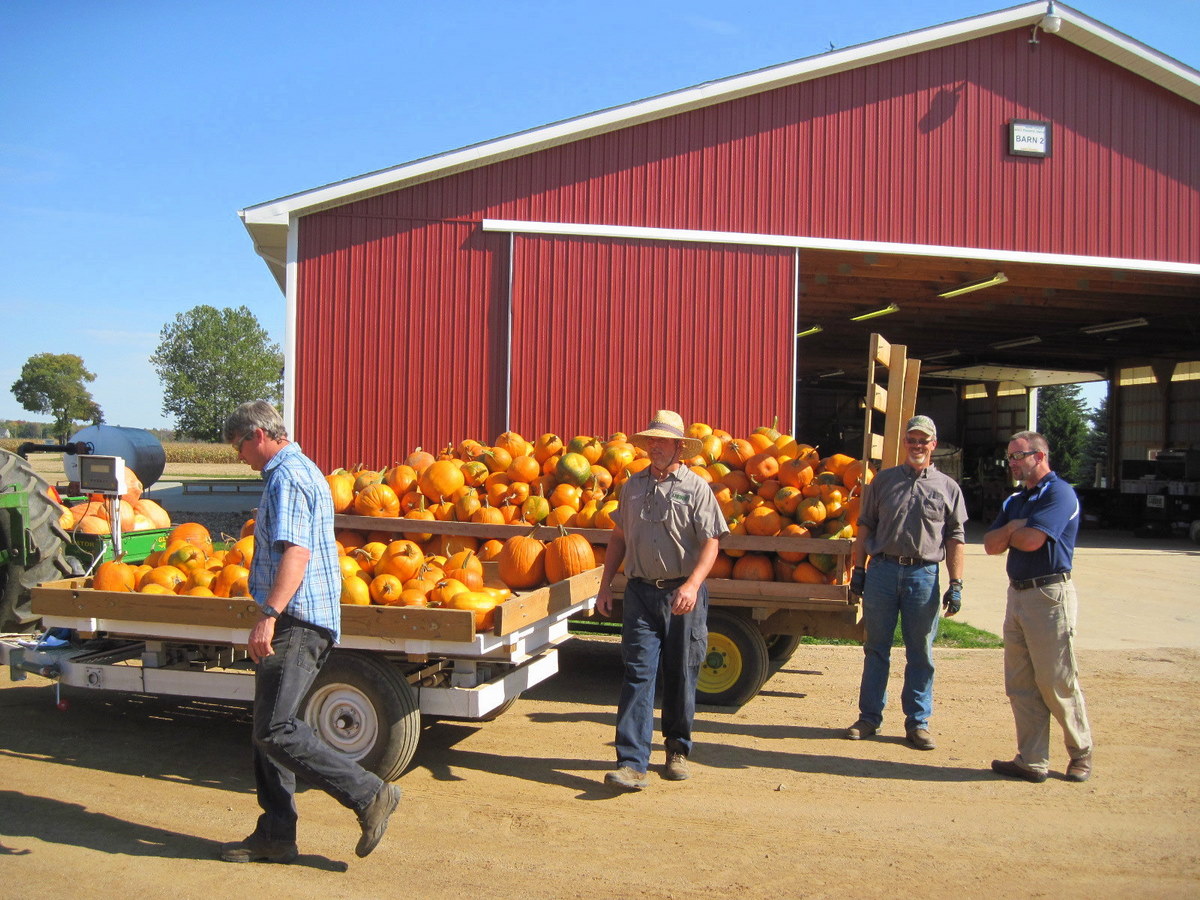
In the meantime they had brought up pumpkins from the pumpkin plots. Most are given away. (Note to self: claim a few for the front porch at home before they are all gone.) Below we see Dan, Tim and Brian. And who is that on the right? Why it's Tony who came all the way from town to see us. (Wonder what he really wants?)
Today we got started planting wheat. Remember the other day I said that we would plant a wheat experiment after Navy Bean harvest? Well that is what we are doing below. Phil guides the drill through a plot.
And just like we all do, Phil proves he is letting the auto-steer do all of the hard work by saying "Look Ma, no hands!"
And as if that were not enough, we had another group stop by for an afternoon plot tour. These were a couple of Michigan dealers and a grower who used Liquid fertilizer for the first time this year. They were accompanied by Brian Martidale, Area Sales Manager for this part of Michigan. He is below on the right. Here Stephanie explains what we were doing in this soybean foliar fertilization experiment. We hope to harvest it pretty soon.
And then on closer inspection I see that it is just a couple of gourds (or some sort of butt squash) that Brian grew in the vine crop area. I will have to ask him what kind of mad science they are doing over there.Tuesday, October 4, 2011
Soybean Harvest Begins
So following Navy Bean harvest yesterday, we started on soybeans today. But first there was some PR work to do. It was decided to make nice with the neighbors of all nine of the farms of the North Central Research Station. Especially since there may have been some noise and distractions from some of the construction projects this year that may have interupted the sleepy rural setting. Since it was likely that they would not really like a bucket full of corn and soybeans, it was thought that a basket of stuff that you could actually eat would be better. So Stephanie got a hold of real baskets while Brian, Tim and Dan assembled a supply of potatoes, bell peppers, carrots, onions, watermelons, pumpkins and gourds for distribution. Tim and Stephanie then hit the road delivering the goods. It went over well. Don't you wished you lived next to the NCRS?
Then this afternoon after the dew burned off, we started with the soybean experiment on Farm 6. This ground is pretty sandy and tended to be pretty dry this summer. So these reached maturity before most of the other farms. In fact most of the soybeans around still had some patches of green beans, and so we could use a good freeze to finish the job. It was my turn to ride in the grain cart and record the plot weights. Ron ran the combine and Doug drove the cart tractor.
We have never worked much with cover crops at the NCRS. Sometimes we have planted oats on some lighter ground that give some residue and hold the soil in place. Oats are killed by frost in the early winter, and so do not get very big. But this year we are working with some cereal rye planted right after harvest here on the light ground of Farm 6. This will survive the winter and will need to be killed prior to planting. You don't see much cover crop planting this far North, but we will give it a try as some growers swear by it. It could give some residue and perhaps build organic matter over time. Some think it helps with weed control from allelopathy.
We planted alternating strips of rye and will have treatments in corn next year both with and without the rye to see if there is an effect. We plan to repeat this over time, planting rye after soybeans each year. There was good soil moisture, so hopefully it gets established quickly.
Monday, October 3, 2011
Lights, Camera...OK, not much action
So today I got to make a movie. Well maybe not a real movie. It's not like we're down on a Caribbean beach or something. No we are at the North Central Research Station and I am giving a season-ending summary of the Year In Research. It was our first day of fall harvest which made a nice background. I'm not sure when this will be through final edits or if I will ultimately end up on the cutting room floor, but I gave it my best. I use the "method acting" technique where I try to identify with my character who is a research agronomist for a leading fertilizer manufacturer. Oh wait....
We are once again under the direction of Mick Rizzo of Creative Services, shown below on the right. That's Michael on the left. They use two cameras, one with a tight shot and one with a wide shot, and then put them all together with what looks best.
And here is the first field crop harvest of the fall: Navy Beans. We do these beans first because there is a severe dockage penalty if there are other beans, like soybeans, in the load. And so we will switch to soybeans tomorrow, as cleaning out a combine of all the loose beans is a big pain. Although we will have to do it next week when the Black Beans are ready. But that's not till next week and we researchers live in the present. Below we see Phil at the combine controls with Ron pulling the weigh wagon with Stephanie inside it. Well actually he is driving the tractor that is pulling it. As previously mentioned, we harvest the middle four rows of the six-row plot, with the outside rows serving as borders. The border rows are taken off in the next round with the combine.
As I have said before, we really like the AWS Wind Reel on the front of the grain head. It blows air that helps feed the cut bean plants and shattered beans into the feeder house of the combine. We used to have problems when we got to the end of a plot and bean plants would still be sitting on the cutter bar, and you would have to shake the grain head up and down to get them to feed, and that didn't always work. Plus this slowed down harvest. But those problems are a thing of the past, and we are thankful for that.
Subscribe to:
Posts (Atom)