Sunday, September 29, 2013

King Harvest (Has Surely Come)

So Friday was just a beautiful day here in mid-Michigan. Warm, sunny and no wind.  It was also the first harvest of a soybean test on Farm 7 at the NCRS.  Senior sales manager Galynn was in town, so we went out to check progress without being in the way.
Well that didn't last long as Galynn was soon up in the weigh wagon-grain cart sharing wisdom(?) with Stephanie.  Phil was at the combine controls and that's Tim D down guiding the tractor.  The beans were drier than we expected, running around 10.5% moisture.  What is that in Stephanie's hand?  It's an iPad that records the plot weights and then instantly calculates yield and gives treatment summaries when finished.  This is the first year for that, having retired the pen and clipboard used in the past. 
It can also act as a shield against bouncing soybeans.  I'll bet the Apple people never thought of that as an iPad app. 
Some "production" soybeans also on Farm 7 had been harvested earlier, and Jeff gets started planting winter wheat in this field.  With rain predicted for the weekend, it should be off to a good start along with the Liquid fertilizer that is applied at the same time.  (Note: the tank is on the back side of the drill in case you were going to call me out.) 
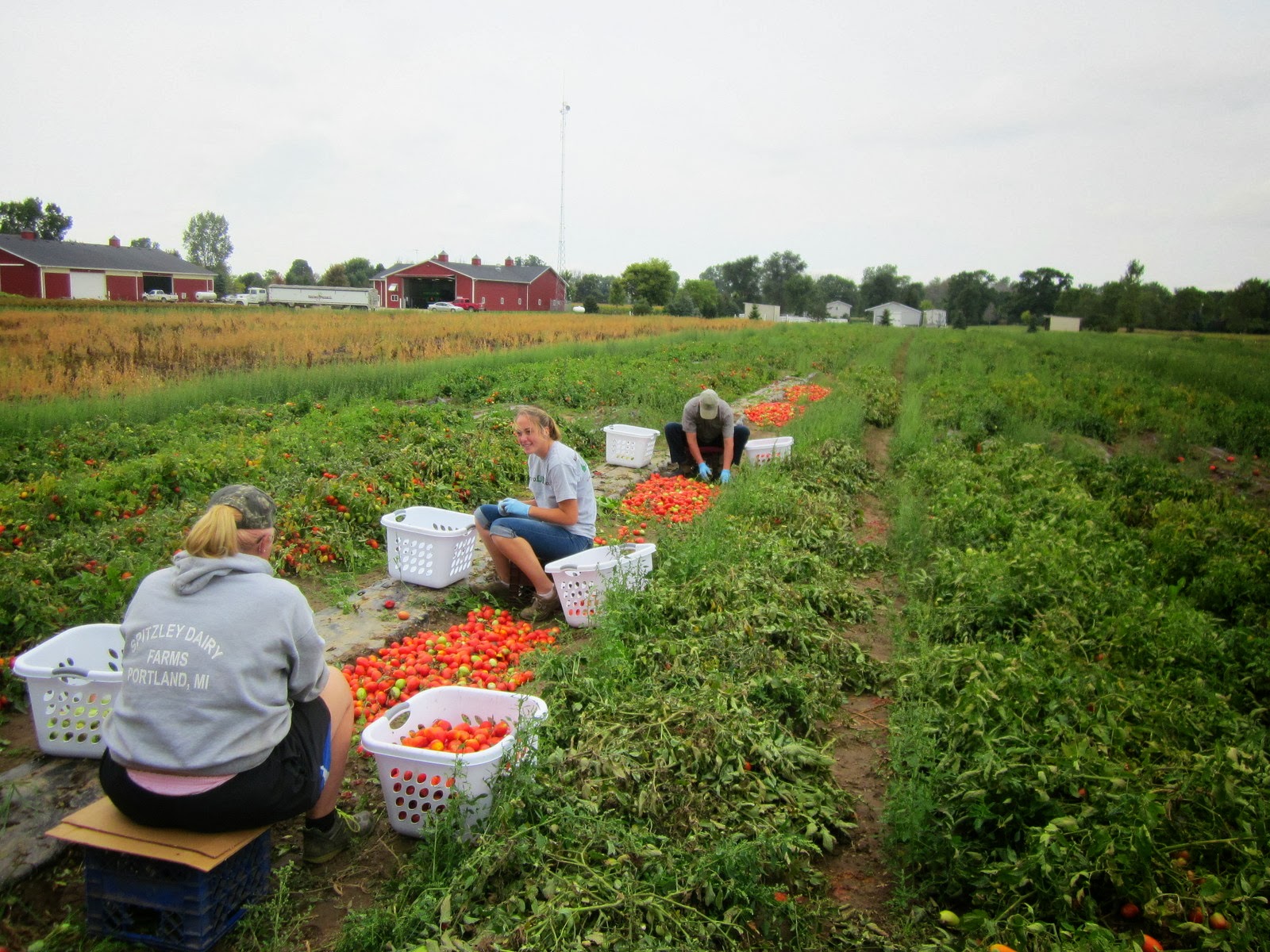
In addition to the field crops, the vegetable crew has been busy recently with all sorts of harvest activity.  Here are Gina, Erin and Tim B harvesting some Roma tomatoes.  This is all hand labor, so they deserve to sit while they work to get closer to the ground.. Look at all of the tomatoes from a short distance of plants.  Look for salsa next week. 
The vegetable crew is also the fruit crew, and here they are harvesting Concord grapes from the NCRS vineyard. We see Brian, Erin and Gina picking away.  I will say that all of this picking is pretty hard work and not for everyone.  We are grateful for the help of Gina and Erin this fall.  I believe that hard work with a purpose will make any young person a better older person no matter what they do in life. 
So how do you like the brand new Liquid T-shirts?  This is a trial run, but Renee from Marketing and I approve.  There are two versions as seen below.  What do you think? 
The next few weeks will be nothing but harvest as we find out the results of all of those fertilizer applications made way back when. 


Friday, September 27, 2013

In and Out of Always Exciting ND

So this past week it was a visit to Eastern North Dakota.  There are some contract research plots there that I needed to check on.  North Dakota is under the sales jurisdiction of SAM Brad shown here keeping watch.  I was with Brad last week in Nebraska and failed to show a picture, so here you go.
There is a replicated plot test of liquid and dry fertilizer comparisons in corn.  Here I am discussing plot info with the contract researcher.  We have worked with this particular facility for several years on spring wheat and canola with favorable results.  But never corn until this year.
It has been dry this summer, but the corn looks pretty good.  Harvest isn't too far away.
We also had some fertilizer comparisons in spring wheat here.  Here is where those plots were.  The data hasn't been summarized yet, so I don't know yet how it turned out. 
It is something to see all of the corn that is now grown in North Dakota.  I remember years ago when I first started with Liquid seeing the first soybeans being grown in ND.  And then corn a few years later.  Now there is corn virtually everywhere, thanks to the new short season hybrids that have been developed.  And good Liquid fertilizer too.
And I have also never seen so many new grain bins around the country.  They are all over the place.  Although North Dakota produces a lot of corn where we were, they are 14th in US corn production.  Iowa and Illinois are by far the biggest states if you were wondering.  But I'll bet ND leads in new bins.    
In the Red River Valley, sugarbeet harvest is just beginning as fields are opened up to get the beet sugar plants started.
Potato harvest is getting started as well.  Here is a big field that has had had the vine killer applied and is awaiting digging.  If you look close you can see the smoke from the American Crystal beet sugar plant in the background.
We also saw a number of soybean fields being harvested.  Again, it was a dry summer and yields are down. But the good price is holding which helps.
So by Thursday afternoon I was back at the office.  But I always enjoy my time in North Dakota.
 

Saturday, September 21, 2013

Nebraska-Colorado-Kansas Drive By

So this week was a fertilizer mission out to visit some more contract research plots.  The first stop on Tuesday was in Aurora, NE on irrigated corn.  I was embarrassed to note on my return that I did not have any area scenery pictures, nor one of my host, SAM Brad.  But it was kind of drizzly and muddy, so I was mostly concentrating on avoiding a slip and fall.  But anyway, the plots looked good.  We are evaluating nitrogen and phosphate comparisons, including some experimental products.  In the plots below, the left side had no planter fertilizer and the plot on the right had 2.5 gal/A of Pro-Germinator + 2 qt/A Micro 500 applied in furrow.  Both had the same nitrogen treatment.
The next day, Wednesday, I was in Yuma, Colorado at the Irrigation Research Foundation (IRF).  We have had plots at the IRF for many years and I enjoy my visits.  They use an Orthman 1tRIPr machine there, and that is where we got used to strip till applications with it, leading to our partnership with Orthman and a 1tRIPr purchase for the NCRS.  Below we are looking at a sugarbeet fertilizer experiment.  That is Dale and IRF manager Charles on the left, and SAM Brian and RSM Sean on the right.  We have had favorable results with strip till sugarbeet comparisons at the IRF in the past, and hope to continue.  Foliar applications of ferti-Rain have proven an effective treatment.  See the research reports for details.
As the IRF name implies, these are irrigated.  I like the long plots.
We also have some strip-till plots in irrigated soybeans.  It's kind of hard to see in the picture below, but we noticed that the soybeans on the left of the middle were a little taller.  These received two 1 gal/A foliar applications of ferti-Rain with glyphosate.  But yields will tell us the real story.  We have good results on soybeans from the IRF also in the research report. 
But alas, not all of the plots were irrigated here at the IRF.  Here is what it looks like without irrigation.  It was a dryland corn fertilizer experiment.  Below Brian and Sean are looking for any corn plants that did not perish in drought.  They came up empty.  This whole region suffered this year.  That is why irrigation out here in NE Colorado is so critical.
Then on Thursday Brian and I were on a tour of crops in the Goodland area, in NW Kansas.  It was rough going for dryland crops out here too.  Brian told me he shakes his head when he hears us talk about "dryland" crops at the NCRS, because we don't ever face situations like this drought-killed milo field below.  Message received.  I will see that we will use the term "non-irrigated" from now on.  I have said before that a technical term used is "rain fed".  I always thought this sounded odd, but maybe we could throw that term around too.  But I got my fill of real "dryland" on this trip.  However I have been out in this area in the past where there was definitely ample "rain feeding", but not this year.  You no-doubt heard of the recent terrible rain storms that fell in the Denver area.  Well this area also received heavy rain, but not as much as Denver.  Out here in Goodland, some 200 miles from Denver, they got 4 to 6 inches or more.  But it was so dry it soaked in, and we didn't get muddy or anything.  But the good part of that is that there is ample moisture now for wheat planting that will start soon.
Here was a circle of irrigated corn that had some farmer-applied planter fertilizer comparison plots.  One thing with farmer plots is the large equipment, in this case a 24-row planter.  (At the NCRS we have a 6-row planter.  And it's getting harder to find new equipment that small.)  But anyway, this corn looked outstanding with very large ears, having received Pro-Germinator and Micro 500 in-furrow at planting.
And of course since I was in Goodland, I stopped by the Liquid fertilizer manufacturing plant.  As usual, it was a busy place with tanker trucks lined up to be filled for delivery to farms and dealers near and far.
So I drove back to Denver on Thursday afternoon for my very early flight back to Michigan on Friday morning.  I got off the interstate (I-70) near Limon and took Hwy 86.  Towns are few and traffic is almost non-existent, and the prairie scenery is very pretty.
So one more fertilizer mission next week, and that will conclude my visits of existing research around the country.  I am encouraged and anxious for the harvest reports.  Speaking of harvest, at the NCRS it has been going on for awhile in vegetables, and began in field crops on Wednesday with Navy beans.  Hope to report on that sometime.

Tuesday, September 17, 2013

Open House at the New Office

So last weekend was the long-awaited corporate Open House for the new office building.  It's kind of like Christmas, well except for the birth of a Savior.  But for so long it was out there in the future, with lots of planning and preparation, and ta-da...here it is: Open House time!  Last Thursday evening we had an employee dinner at the office.  There was some rain and then some sun and then...a rainbow.  Stephanie was Johnny...er..Janie on the spot to catch this picture.  You could certainly say that this building is a pot of gold in the way it looks and functions.
There are probably lots more Open House pictures somewhere, including the building from the outside which I don't have here.  But here are a few shots that I had of the events.  Like on Friday was the open house for ag industry and government guests.  Troy is seen giving a nice speech during the lunch.  I guess it was such a big event that it could be called a "luncheon."  This was out in the storage building behind the office.
After that it was the official ribbon cutting.  Here are three generations of Bancrofts as well as Mrs. Cook doing the honors. 
Saturday morning was the big public open house.  Here are some employees out in the lobby prior to the door opening.  It wasn't quite like Black Friday after Thanksgiving, but we did have over 4500 guests throughout the day.  Everyone was impressed with the place and felt it made a nice addition to the town of St. Johns. 
Here was my post, or at least within the Chemistry Lab itself.  Chief chemist Chris and assistant Hudson described what goes on here.  They put on a display of how AgroLiquid can overcome compatibility issues of calcium and magnesium with phosphate fertilizers.  Probably should have taken a picture of that, but the room was constantly full. 
Off to the side I talked about how we take experimental nutrient formulations from the lab and apply them out at the North Central Research Station.  This is to see if any will become a new fertilizer product, as has been the case with a number of products in recent years.  I also described how, since we are a nationwide business, that it is important to conduct field research experiments around the country on a variety of crops.  Such is the basis for my many Fertilizer Missions.  This was my picture display of some of the current plotwork.  Most people were surprised that we sold fertilizer over such a wide area of the country, plus out of the country as well.
Here is a new display that was conceived by Renee in Marketing.  It is like the family tree of Liquid, and serves as a room divider screen up on the second floor where it is prominently displayed.  It is appropriate that Research is on the top branch. Very nice Renee.
Here is the living roof.  These are succulent type plants that keep the roof cool and are watered by retained rainwater.  They are supposed to survive the winter and re-grow in the spring.  Looks nice, but you have to push roots off your desk if you are underneath on the first floor like I am. 
Also out back is a collection of antique tractors on display.  We also had our new equipment from the NCRS out there too. Troy, in orange, is so proud of this and everything about the day. 
So that was that.  The fanfare is gone, but hopefully if you missed the open house, you have the opportunity to see the new building someday.  It will be quite a while before the newness wears off.


Thursday, September 12, 2013

Research Field Days? That's A Wrap

So Tuesday marked the last Research Field Day for the year.  Hope you were among the nearly 600 visitors that we had in all of field days this summer.  If not, I hope you can make it next year as we are already laying plans for then.  (No, we really are.  It will be great.)  Here is the sun breaking through the clouds Tuesday morning as I was heading over to Farm 7 to get my ears laid out for the Research Tour stop.  Corn ears that is.  You may think I am obsessed with the sun since I show so many pictures of it.  Well you are right, as it does make for a nice pic.  Plus it's pretty important for lots of other things too I hear.
Here we go again.  Part of the tour group is at the soybean fertilizer placement demonstration. The soybean leaves are really turning fast now.  Won't be too much longer till we start harvest.  But for now there is still time for fertilizer learnin'. 
Stephanie definitely has the story down for nitrogen applications for corn.  I think the Hagie N applicator made for a nice backdrop.  After year one of using these, I give a hearty thumbs up.  For plots or production, it is a good way to inject nitrogen at sidedress.
We were fortunate to have a couple of special guests this time.  Not only does the picture below show four Okies, but the one next to me is the former two time governor of Oklahoma Brad Henry, and his former chief of staff and current business partner, Gerald Adams on the far left next to Galynn.  Since leaving office in 2011, the governor and Gerald are business consultants, and are interested in learning more about agriculture.  But truth be told, Galynn and Brad are former fraternity brothers at...(relax, just breathe and type it)...the University of Oklahoma.  But in spite of that, he is really a nice guy and a pleasure to meet and visit with.  That goes for both he and Gerald, who had the good sense to go to Oklahoma Baptist University.  In fact we all had dinner together that night.  Not to be out numbered, I invited my wife and fellow OSU alum Cathy to even the score.    But they invited me to call next time I am in OK to get together, and I hope to do that.  (And even though it's been a long time since I left, I still consider myself an Okie.  I do keep my dues current.) 
Here Galynn is showing them some of the high tech advancements in liquid fertilizer rate controllers. These were from Ag Xcel.  They remarked that they had no idea that farming is so technologically advanced.  It is still our job to fill that knowledge gap. 
 As before, there is a great lunch.  It was very hot, in the mid-90's.  At least it was Fahrenheit.  But there was a steady breeze that kept it somewhat comfortable.  But after that, it was off to the research plot tour. 
A new stop was planter fertilizer comparisons presented by Jeff.  This was his first solo presentation.  He did his homework and did a great job.  Also at his stop was a presentation about the 4R Nutrient Stewardship program.  This was initiated by the International Plant Nutrition Institute to promote responsible nutrient management.  (Why does that sound familiar?).  With regard to crop nutrition inputs, it advocates using the Right Time, Right Rate, Right Source and Right Place.  All of this is in line with what AgroLiquid has promoted for years.  But now we need to publicize this as farmers need to feed an ever-growing world population. 
That was Tuesday, and yesterday (Wednesday) we hosted a group of 55 attendees of the Michigan State University Soil Academy.  This event had the theme of the 4R's mentioned above.  There was an indoor morning session near the MSU campus that discussed different aspects of farming, then a tour at MSU and then all the way up to the NCRS to see our place.  The group consisted of farmers, MSU extension agronomists, and some industry folks.  Tim, Stephanie and I put our heads together to come up with stops at experiments that dealt with each of the 4R's.  After showing off our nice equipment, we set out.  Here Tim on Farm 5 discusses the Right Place for fertilizer as it pertains to different row spacing in soybeans, and then corn. 
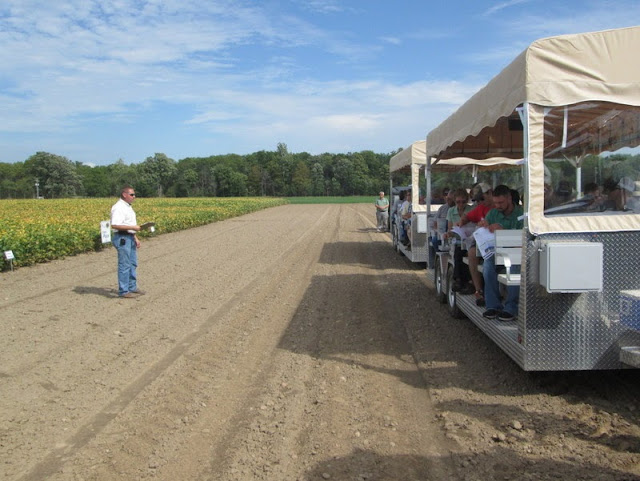
On Farm 3 Stephanie presents the Right Rate as it applies to nitrogen in corn.  There were different responses from High NRG-N, 28% UAN with eNhance, and 28% UAN alone.  Earlier on Farm 5 she presented the Right Time, again with application timing of nitrogen on corn.  Nitrogen application to corn is really critical for yield and the environment, and it's so important to get it right.
I talked about the Right Source on Farm 7.  (I took this prior to the tour, so don't think that no one came to hear me.)  But it was the same as the RFD tour stop where we are running different types of fertilizers in a long-term corn/soybean rotation experiment to follow sustainability of programs.  So far, so good for AgroLiquid.  So it passes the Right Source test.
And we concluded the NCRS visit with a cup of Bancroft 2-cylinder homemade ice cream back in our shop.  Our County Extension Director Marilyn Thelen, who also lives nearby, gave a summary of the day and gave a reminder to practice the 4R's in the way that we farm.  You know we will here at the NCRS.
So with that, Tour season is over.  Let harvest season begin...soon.

Monday, September 9, 2013

Research in the Empire State

So did you know that the Empire State is New York?  Well that's what they say anyway. (And sorry for the lack of blogage for so long.)  I went on a fertilizer mission to New York last week.  We are conducting some alfalfa research in Central New York just South of Auburn, which is a little ways West of Syracuse.  There is a company there called Agricultural Consulting Services, or ACS.  ACS does general crop consulting plus a program called Farmer Driven Research, where they conduct scientific plot tests on growers farms.  It is usually a topic that is raised by the grower, and ACS seeks the inputs to make it happen. There are a lot of dairies here. One topic of interest is comparing dry fertilizer, like potash, to liquid fertilizers, like Agro-Culture Liquid Fertilizers, for alfalfa yield and quality.  So we worked on a program of AgroLiquid vs muriate of potash.  They had a field tour of this, and other plots in the area.  Here we are getting the experiment details.  It was a cool morning, in the 50's.  I wore a long-sleeve shirt for the first time since spring.  But some folks, like SAM Benjy, dress by the calendar, and the calendar still says it's summer.

Here we are out in one of the plots.  The fertilizer treatments were applied after the first cutting, with Liquid treatments also after the second and third cutting.  This has worked well to re-apply some of the nutrients that are removed by harvest.  Jim Saik of Finger Lakes Agronomy made the Liquid applications with his Miller sprayer.  Jim is also an Area Manager for the area and has been making Liquid applications to dairy alfalfa for quite a while.  There were three treatment: potash, Liquid after cuttings, and a combination.  The farmer did not want a check plot of no fertilizer.  Go figure. But each treatment was replicated four times.  The plots are pretty big, 90 feet wide and 500 or so feet long.  ACS conducts research following guidelines consistent with those of Cornell University, so that the research results will be acceptable to everyone.  So the Cornell method of yield evaluations in these large alfalfa plots is to throw out a hula hoop in three spots per plot and cut the plants within the hoop.  So for an average sized 40" hula hoop, this represents 0.0002 acres.  But there are three samples per plot, so that is 0.0006 acres.  Not surprisingly, they had a lot of variability.  We did that one year at the NCRS, many years ago.  I did not like it and we changed to methods that enable larger harvested areas.  But that takes equipment, and I guess this is a way for researchers to collect on-farm data.  But it's hard to show significant treatment differences due to variability.  So we will see.  
Here are John, of Finger Lakes Agronomy, SAM Benjy, and Jim Saik discussing what they saw at the end of the tour.
This part of New York has been besieged by rain this summer.  There is quite a bit of yellow corn around that shows the effects of N loss from leaching, as well as growing in water logged soils.  We also have yellow corn around here, but it is from the opposite: no rain.
Activities ended in late afternoon and I didn't fly home until the next morning from Syracuse.  I had never been to the Lake Ontario shoreline of New York, so I turned north for the short trip up to the lake.  I got there in time to catch a spectacular sunset.  This was actually taken with my iPhone with no editing or enhancements.  Pretty cool. 
Well this week its back to the conclusion of the NCRS field days.