Monday, March 24, 2014

New Faces...and a face full.

So last week I was in St. Johns all week to get caught up on important stuff.  I went out to the NCRS one morning and took a pic of this cool sunrise through a grain storage system.  
There are two faces at the North Central Research Station (NCRS).  One is Mitch who started in January as the NCRS Operations Specialist.  This means that he will be the general overseer of equipment and buildings at the NCRS.  So don't you dare use a wrench and leave it sitting out on a bench when done. But we needed someone to keep up with vehicle and tractor maintenance and upkeep of buildings and property.  Mitch has his bachelors degree in Crops and Soils from MSU, and was manager of a research station in the Michigan State University system for several years.  He also farms and has his CDL besides.  So he ought to be ready for anything that is thrown at him.  (That's just a saying by the way, don't try it.) 
Next is Dan who just started a couple of weeks ago as the Specialty Crops Research Coordinator.  He will be working with Brian and Tim B on the specialty crop research plots, such as fruits and vegetables.  But he will be working a great deal in the new apple orchard.  Dan is well qualified for that as he operates his own apple orchard at his home.  Dan has a bachelors degree in Biology from Grand Valley State University and has worked for many years in a contract research business.  So he comes well qualified for plot research.  So you'll be seeing both of these new guys when you make it out to the Research Field Days this summer.
Well I think I might have said that there are many groups that use our new office building for meetings. There are various types of meetings going on weekly here.  Mostly they just sit and talk or look at slides.  You know, regular stuff.  But this display for a training meeting of the Michigan Milk Producers Association was certainly eye-catching.  So being curious, before their meeting started, I went in and asked the meeting coordinator what's up with this cow stuff?  She said it was for dairy worker training on how to correctly apply cow teat dip.  Now there's a class!  Sorry I didn't sign up my own self.  But it's an important part of milking to apply it correctly before and after milking to prevent infectious disease like mastitis and to keep the milk pure.  She said one of the MMPA guys built all of these himself out of ceramic plaster.  Look at the accuracy right down to the veins.
Naturally I had to try one out.  Mmmm.  Fresh from the tap!
Should have brought my Cheerios.

Sunday, March 16, 2014

St. Patrick's Day and Wheat College (What a Week!)

So Happy St. Patrick's Day.  I'm pretty sure there is no Irish blood in my circulatory system, but any excuse for a party, right?  My town of Grand Ledge celebrated the day with a parade and other festivities this past Saturday.  (I have reported on past parades on past blog posts.)  You wouldn't know it was already mid-March by all of the snow still on the ground.  But at least the sun was shining and the no wind made the low 30's temperatures bearable.  I was again with my Knights of Columbus group and our train full of kids and passing out Tootsie Rolls to the thousands of people...well hundreds I'm sure. There's the Leprechaun out looking for his Lucky Charms or some Pro-Germinator.  (I think AgroLiquid is having a big St. Patrick's Day price mark down on all of the green fertilizers: Pro-Germinator, Micro 500, ferti-Rain, and whatever else is green.  Well maybe not, but they should.) 
Here we are downtown.  There were lots of marcher groups, and even two bagpipe marching bands. I'm sure it was chilly in the kilts that they wore.  Again, no wind, so that persistent question could not be answered.  Anyway, it was fun and I enjoy doing it every year.
Earlier in the week Stephanie and I went to Dallas for a meeting with Galynn and some of the Sales Account Managers (or SAM's).  Well nothing there was blog-worthy.  But wouldn't you know that on Thursday there was one of the Farm Journal crop colleges up in Ardmore, OK.  This was a one-day Wheat College, so we went along with SAM Clint.  I made Clint pull over at the Oklahoma line for pictures.  Here are Stephanie and myself as Clint took the picture, documenting Stephanie's first venture onto Oklahoma soil.  She is now among the gifted.
The college was worthwhile.  Among the speakers was well known wheat agronomist Phil Needham.  Among his tips and observations, mainly for OK wheat, but could apply some of it anywhere:

  • Poor stand uniformity is the biggest hindrance to good wheat yields.  Check your drills for uniform seed distribution.
  • In Oklahoma, there should be around 450 heads per square yard in dryland, and 600 in irrigation.
  • To determine head count number (in 7.5" rows):  count the number of heads per yard of row x 4.8 to get heads per square yard.
  • Base your spring topdress rate on tiller counts.
  • You should include a nitrogen rich strip as an indicator.  This rate would be a higher rate in the 60 to 100 lb N/A range.  So use this strip as a guide.  If wheat under your rate of applied N looks like the N-rich strip, then you applied enough.  If your wheat starts to look pale compared to the N-rich strip, you may consider applying more.  But use stream nozzles if you apply more of a UAN solution.
  • There should be 60% ground cover at the jointing stage for maximum yield.
  • One problem for no-till crops following wheat harvest is poor distribution of chaff and straw out the back of the combine.  In England, where Phil is originally from, they routinely grow 120 bu/A wheat.  One thing they do is have smaller grain heads, like 20 or 25 feet or so, so that the trash spread is not narrower than the width of the grain head.  He did show some newer tools, some still experimental, for better spread.  There was one that could even be adjusted for wind and blow it more evenly even in wind.  Pretty cool.
  • He does not like spinner spreaders for urea.  Use an air machine for that.  And stream or fertilizer nozzles are recommended over broadcast for UAN.  But watch boom height if using the 3-stream fertilizer nozzles.  He showed pictures of streaking when too high or low.
And there was plenty of other useful information from him and the other speakers as well.  Stephanie and Tim have been to corn college in Michigan and thought highly of it.  But it included outdoor field stuff and was in the summer.  But this was a good day of wheat information, and it was cold so I was glad to be inside.

Sunday, March 9, 2014

Good times in Carolina (both of them).

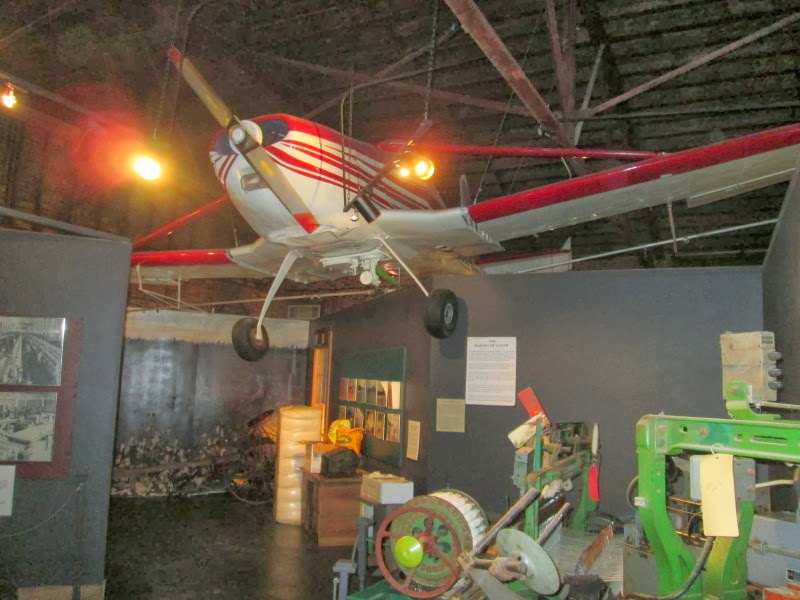
So last week I made my way to Raleigh, North Carolina where I was met by SAM Ashley.  This was my first on-the-job visit to North Carolina.  Ashley has only been there less than a year.  Anyway, we had several tasks to complete over the next few days.  One of those was to meet with some researchers in North and South Carolina about conducting some fertilizer plot work.  But on our way to Southern South Carolina, there was a sign for the South Carolina Cotton Museum in Bishopville.  Well you know me and interesting sounding roadside attractions.  So we took the exit and found our way to the museum.  And it was well worth the price of admission.  Here we see Ashley all excited to begin the tour.
It showed some of the old time tools of cotton production.  Like this tool for application of guano called the Guano Sower.  What's guano you ask?  Well it's bird and bat droppings.  And I don't mean feathers. In this case it was mostly sea gull droppings according to the description.  Now I don't know who had the job of following sea gulls around with a bucket to get the supply of guano.  But that would certainly be an inspiration to do well in skool.  Not sure if farmers used to go to meetings where guano sales and research reps would try to get growers to use their brand.  How far we've come.  (Or have we?)
And here is a fertilizer grinder.  I think this was in the post-guano period in 1920.  But the sign says it was for "soda, acid and kainite".  What's kainite you ask?  Well it's a blend of potassium chloride (potash?) and magnesium sulfate (epsom salts?).  It has a handle on the side to grind it up.  Hope it worked.  But this was in the period when fertilizers were gaining more use. Before, cotton was not fertilized at all and people wondered why it didn't yield well after a couple of years.  
And everyone has probably heard of the boll weevil.  It was the number one pest of cotton for many years.  Anyway, below is the Cotton Mopper. It was used back in the 1930's and the cloth was coated with molasses and some sort of weevil poison and would spin as you walked along to coat the flowers with the stuff to kill the weevils.  It was sticky and dirty work.  But was the best way to control the pest at the time.  Evidently they used to really use mops before this tool came along.  In fact, I read a little of the "mopping" history, and evidently no one liked doing it. You got covered in molasses and flies. They used to make kids do it, since the adults didn't want to.  There is reference to former president Jimmy Carter mopping cotton as a kid in Georgia.  He would stand his pants in the corner at night since they were so stiff from the molasses. 
Here is a boll weevil model.  I didn't know they were so big.  No wonder they were so hard to control. But now thanks to Bt cotton, the cotton plant can defend itself and it is no longer necessary to spray multiple treatments of insecticides.  Or to mop either.  Thank goodness for GMO technology to increase cotton production while protecting the environment.
They had lot's of old machines that turned the cotton fiber into thread.
There was plenty to see and it was well worth the stop.  I give it a hearty thumbs up.
After meeting with several researchers about test plots on crops like cotton, soybeans and tobacco, we proceeded to the other activity for the fertilizer mission.  That being a grower meeting at our AM in Eastern NC: Dark Water Enterprises of Pantego, NC.  They have been selling Liquid fertilizer for several years in this part of North Carolina.  It is run by the Boyd Family and they have done a great job in a relatively short time.  There is a lot of good farmland around here, large and flat fields growing corn, soybeans, cotton and some tobacco, sweet potatoes and other crops.  It was my first time here.
Need some Liquid fertilizer?  They can certainly provide...and deliver as well.  That's just one of several tanker trucks on the premises. 
Ashley started the meeting with an interesting lead in on AgroLiquid history and products.  But she made the connection and tied it all together very well.
The farmland in this area has an interesting history that I was not aware of.  It seems that much of this area was covered with cedar swamp.  But in the early 1970's a Wall Street millionaire ended up buying 325,000 acres of this ground and set about clearing it for farmland, starting in 1973.  Specifically, it is in the Albemarle-Pamlico Peninsula, if anyone wants to know the exact location. He called the operation First Colony Farms, and had the goal of establishining a sustainable crop and livestock operation once the ground was cleared.  Well there was so much trees and swamp, that drainage ditches were also built and the cleared trees were put in piled strips.  Some of the land had many feet of peat and tree residue, so another operation was started to harvest the peat for an energy source. But as with many gigantic ventures, it never came to be and the investor saw his millions dwindle away into bankruptcy.  Kind of like the joke: "How do you become a millionaire in farming?  Start with ten million."  It was re-bought a few times and the most of the land was in fact cleared and is farmed today. But not as a super farm.  I'm not sure where the boundaries are of this venture, but somewhere around where we were.  But most of the land was at one time covered with swamp and cedar forest.  We talked to a researcher near Dark Water, and the ground is generally high organic matter.  Plus it is high in P and K from chicken litter, a common application.  Below is one of the fields where we may have some plots this summer. 
It was cold and rainy most of the week.  On the way back to Raleigh, we passed a piece of ground that was evidently being cleared.  So this is what it might have looked like back in the 1970's when it was being cleared.  Except there are no bulldozers seen here in the winter. It is definatily dark organic ground. 
So now there are some large individual farming operations in place, and it is our goal to have AgroLiquid feeding the crops there.  There was a lot of interest after our stellar grower meeting.  At least I thought it was. 

Tuesday, March 4, 2014

Florida Field Checks (No Wonder So Many People Come Here in the Winter)

So after a couple of days at home in Snowland after my trip to California, it was time to make some field checks in Florida last week.  I mean, that's where stuff is growing this time of year.  The only thing growing in Michigan is frustration with the non-ending winter.  Anyway, there is a lot of Liquid activity going on in Florida.  One of the stops was to see our fertilizer test on sugarcane.  Below we see Field Agronomist Mike and SAM Paulino trying to keep up with me as I excitedly walk the line looking at the field-sized plots.  It was in the low 80's so I was extra happy to be there.  
Below is a field shot taken last November 13.  I posted this in the blog back then which was on my last visit.  This sugarcane was planted in late September.
And here is the same place now, or on Feb 26 when I was there.  It's over my head, the size of the cane that is.  It is time for the next application which will likely be the last time the high clearance ground rig with drop nozzles will be able to make it through.  But it may be possible in the next one in May, but we will have to see.  Otherwise it will be aerially applied.   
Everyone says to watch out for alligators that will often come out to sun themselves in the numerous drainage ditches through the fields.  Well I have never seen one yet in my two visits here.  That would be a great addition to the blog.  Below Paulino is on gator watch.  I asked him to dangle his feet in the water to try and attract one.  But he said "no".  Well actually it was a little more colorful than that.  I guess he is not an animal enthusiast like I am.
Below is the smoke from a sugarcane field being burned before harvest.  Fields are burned to remove the leaves which makes the cane harvest easier.  They burn really fast and it does not harm the sugarcane.  They harvest from late fall through as late as April.  I don't really understand the whole sugarcane growth procedure.  In Louisiana where I have reported on our sugarcane research before, the sugarcane emerges in late March, then fertilizer is applied one time, and it is harvested in November.  Easy.  But in Florida, it is planted in early fall, grows all winter, gets fertilized several times over the next year, and then is harvested from late fall to the next spring.  Our plots here probably won't be harvested until a year from now.  That will be around a year and a half since planting. But maybe it will be earlier.  It all has to do with scheduling with the mill.  But that will give me extra time to visit it.  
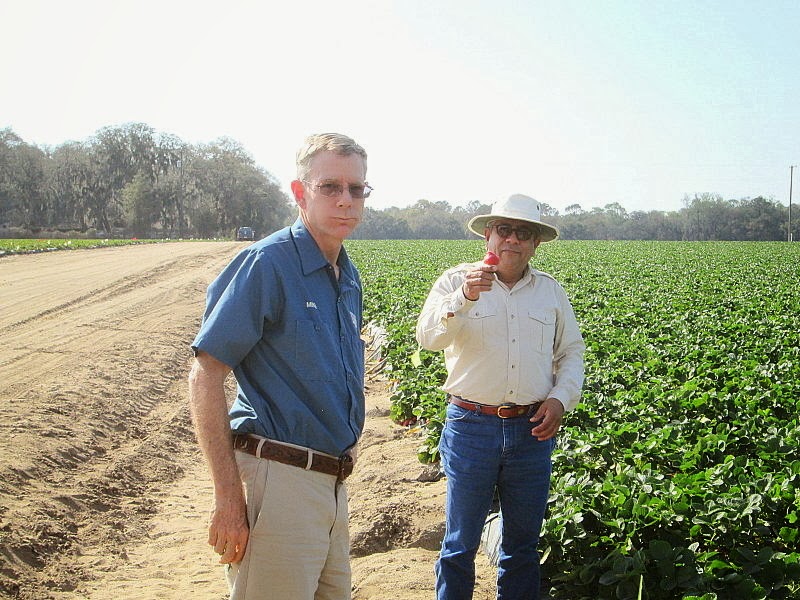
We also visited a crop that has more immediate personal gratification: Strawberries!  Now who doesn't like a fresh picked strawberry?  If you raised your hand, then seek help immediately.  Actually there are solid Liquid recipes established for growing strawberries in Florida where they are being used extensively.
Below we are in a field that was picked today. They are picked every couple of days as the berries keep coming on. Here they have 4 rows per bed compared to the usual 2 rows per bed.  They think it has higher production.  It is late afternoon and the pickers have quit for the day, but you can see the picking equipment in the background.  They are picked, and put into the clear "clamshell" containers that are in the stores, and shipped all over the country.  Most likely the strawberries you see in the store now are from this area of Florida.  There are probably several weeks of picking left.  The liquid fertilizer is run through the drip lines under the plastic over the beds.  Fertilizer is run in small doses usually every day along with the irrigation water.  We see Paulino, Mike and Area sales manager Jim making inspections.  Jim is busy with fertilizer business on the phone.
Paulino is still enjoying the strawberries (all in the name of science), but it looks like Mike has exceeded his fill capacity.
Here is how you see them in the store.  Enjoy the Liquid fed goodness.
We also visited a field test at another location.  The pickers were in action here.  They pick thousands of flats every day.  Not sure how big a flat is, but thousands of them must be a lot.
We finished my Florida fertilizer mission with a visit to a Dole blueberry field.  Like the strawberries, Liquid has been feeding here for several years. Jim is still busy with fertilizer business on the phone.
Look at all of the future blueberries on this branch.  They are really loaded up and will be picked in a few weeks.  After blueness sets in that is.  Make room in the fridge for some delicious blueberries, coming soon! 
Well the next day it was back to Michigan.  Snow or not, it's home.
But it was sure nice being warm for a few days.  Look at my ever-so-accurate car thermometer as I left for AgroLiquid HQ yesterday morning.  That would be 103 degrees colder than where I was a few days before.
Cold or not, it's home.


Friday, February 28, 2014

Bountiful Winter Crops

So last week (the week of the 17th) I was out to the annual research meetings of the Fluid Fertilizer Forum in Scottsdale, AZ.  I have attended that many times over the past years, and it is a good opportunity to hear the latest in university research with fluid fertilizers.  After that I went on some fertilizer missions out into the desert.  First stop was Yuma, AZ to visit a Liquid dealer there.  What turns desert into crop land?  Water of course.  And thanks to the Colorado River, many areas of desert are providing winter crops to feed the country.  And when things are growing back up North, this area of the country is trying to stay cool as it's too hot to grow anything then.  Below is a Google Earth pic of where I was.  That's Yuma in the lower right corner.  You can see irrigated farmland there.  Next I went to the Imperial Valley of California which is that green area below the Salton Sea.  But let's not get ahead.  (Google Earth is so cool, isn't it?)
 I have been to the Yuma area before as several years ago we conducted some experiments on Lemon trees with the University of Arizona at their experiment station nearby.  We had favorable results that are posted on the Research Tab of the website (in Research Results.)  That research contributed to the importance of micronutrients for tree crops and the product ferti-Rain.  This area is considered the salad bowl of the country in the winter as much of the nation's lettuce comes from here.  Below is a field of cabbage.
 Here is a harvest crew picking lettuce.  Now that's real work to do that all day every day.
 Here is the reason for all of the crops grown here.  They said since this is river water, that they aren't as threatened as the rest of California that relies on rain and snowmelt to support crops.  But it is still a very precious commodity.
 Here is a field of spinach that is just coming up and being irrigated.  This grows to maturity in 30 to 40 days now that the days are warmer.
 Here is another field.  It looks so pretty in the nice straight beds.  Now that I know how much work it takes to grow it, I try not to leave any in my salad bowl.
 And then as you can see in the Google Earth picture above, go West and you are out of the crop land and into the desert.  There is a stretch of sand dunes, that you can also see on the Earth pic.  It is popular with sand dune vehicles, and I know that Albert has ventured here to test his sand rail.  It has also been the site of many movies shot over the years.  In fact, I understand that my uncle, who was career Army, was part of a war movie that was shot here back in the years after WW2.  He was one of the many soldiers that you see in such movies going across the dunes in battle.  (Although I never did learn what it was.  Hmm..)
Then about an hour up to the Imperial Valley.  I had never been there before, but had always heard of it.  Like the Yuma area, it is an important area for winter crops.  It has over 500,000 acres of cropland, which was started in 1901 when the Colorado River was diverted through a series of canals and water channels.  So that made it possible to grow crops in an area that receives less than 3 inches of annual rainfall.  Well wouldn't you know, but in 1905 there was flooding which overran the irrigation channels and all that water ran into an area that became the Salton Sea.  I understand that it used to be used for recreation, but now it is salty and there is some agricultural runoff that had gotten into it in the past.  So environmental stewardship, especially in a place like California, is of concern.  Anyway, today the irrigation river water is distributed more responsibly and everyone is happy.  Top crops are alfalfa/grass hay (and large dairy and beef operations), spinach, carrots, onions, wheat, lettuce....and, believe it or not, there are around 25,000 acres of sugarbeets.  When I learned of this last fall, I was surprised.  But they have been growing beets in the Imperial Valley since 1932.  And as it turned out, we were able to participate in some field plots with planter applications of Pro-Germinator, Sure-K and Micro 500. Below are some of the plots with Liquid fertilizer.  They have them at two locations.  These were planted in late October and will be harvested in the summer.
Harvest is one of the interesting things with these Imperial Valley beets.  In the North where most of the sugarbeets are grown (like North Dakota, Minnesota, Montana and Michigan), they are havested in the late fall and then hauled to piling locations, where they are piled up in huge piles.  (Interesting how "pile" can be both a noun and a verb).  Then they are trucked to the mill and re-piled then run through the mill in fall and winter producing sugar.  But they can't do that here with harvest starting in May.  It is so hot by then that they would just rot away.  So they schedule harvests such that only what can be processed is brought to the mill.  So they sit there in the ground until it is their turn to be dug and hauled to the mill. That could be as late as August when it is over 115 degrees!  So it is a challenge.  I am happy to visit the plots now when it is in the low 80's, but I'll ask for pictures at harvest.

Another thing I learned is that there is a weed there called wild sugarbeet.  It is an annual weed that is genetically close enough to sugarbeets that they could cross pollinate.  Now sugarbeets grown here generally do not produce seed.  Sugarbeets are a biennial crop that requires vernalization or a cold period or dormancy in order to reproduce and make a seed.  Kind of like winter wheat.  In fact, sugarbeet seed comes from the Pacific Northwest after a complicated process of transplanting and pollination after dormancy in mild winter (vernalization).  But there is a small chance here for a rogue beet plant to "bolt" or become reproductive.  Well almost all sugarbeets are now glyphosate (Roundup) resistant, and there is fear of a Roundup resistant cross into a weed sugarbeet, which would lead to Roundup resistant wild sugarbeets.  That wouldn't be good.  So as soon as Wild Sugarbeets are seen in a field, they are forcibly removed.  That is a wild sugarbeet in the picture below.  I saw to it that it would not become a reproductive threat.
Below is the sugar mill in Brawley, CA.  Look at the silo. It has a line that says "sea level".  The Imperial Valley is some 235 feet below sea level!
So after an exciting day in the beet fields and seeing and learning about all things Imperial, I headed West back through the desert.   
Amazing going from "with water" to "without water".  


Thursday, February 27, 2014

Aerial Assault

So I was sitting at my desk today, and it seemed like something was missing.  Hmmm...what was it??? And then I remembered:  Hey, I've got a blog!  Has it really been almost a month since my last post?  Has anyone missed it?  Well, whether you did or not, here is the next installment.  (And I'm sitting on several adventures that I will get on the blogosphere ASAP).  

So some people may think that this is the slow time for us folks at AgroLiquid.  I mean, most of the country is under snow, how much fertilizer stuff is going on now?  Well plenty.  There's planning, answering phone calls, planning, buying stuff for the upcoming season, planning....and grower meetings.  All of us researcher types have been involved in some meetings around.  Stephanie, Tim, Brian and even me.  Like the week before last there were some dealer meetings in North and South Dakota.  Now Cory happened to be in St. Johns and since the meetings were kind of hard to get to, we rented a small plane to take us out there.  Cory is a junior pilot himself, so he took the right front seat to watch and talk to our pilot all the way from Michigan to South Dakota.
We left in the late afternoon and got to watch the sun go down as we headed West.  
We flew to Watertown, SD to pick up SAM Brad and then went up to Jamestown, ND for the night.  Here we are lined up on the runway to land.  It was incredibly cold and windy after getting out of the plane.  It was North Dakota after all.
Tyson, who works for AM Chad picked us up that night and the next day drove us into the coldness of the ND winter to our meeting.  It was a thumbs up performance.  Then back to Jamestown and fly to our next meeting back in Watertown.
Here Brad enjoys the scenery on the trip.
Cory explains the many virtues of AgroLiquid to the spellbound audience.
Then the next morning it was goodbye Brad, drop Cory out, I mean off near his home in Iowa, and then back to Michigan.  I got to sit in the front then.  I made sure I didn't touch anything.  That's the frozen Mississippi River below.
And we landed back where we started at the airport in Grand Ledge, MI.  Which coincidentally is where I live.  Well several miles to the North anyway.  That plane ride was a good way to get around. 
 Thanks to our pilot Pete who has flown Liquid people around before, but I'm sure this was his favorite trip.