Monday, May 25, 2015

Road Trip, Part Deux


 So back to the Moline adventure and the visit to John Deere World Headquarters.  At the building entrance there is an exhibit of farm and construction equipment, and this cool "through the years" display case, er...I mean...exhibit (they don't like to use the word Case).

This caught my attention: An 1885 announcement of a farming demonstration where a man is pulling a plow.  Not sure if he lost a bet or lived in an area that never realized that horses could be ridden and pull plows.  He seems dressed for the occasion, although I would have loosened my tie. A little bit anyway. 
Here is a replica of the original John Deere plow, which started it all.  In the sandy, dry and rocky soils of the East, wooden and iron plows worked the soil very well.  But in the heavy moist soils of the Midwest, plows would collect soil such that they could not be pulled very far, by horse or harnessed man, before you had to stop and clean it off.  But John Deere got a piece of steel from a sawblade and shaped it into this curved design, and polished it smooth. Now it was able to glide through the soil without any buildup.  Thus it became the Self Scouring Plow.  Seems simple, but it was a novel idea in 1837.
We also had an opportunity to tour the Harvester Works, where they build combines.  It was a big place.
Here is how they form the metal into the combine body.
Here are the robot painters applying the shiny last coat of green paint.  Oh...no pictures allowed in the plant.  Sorry.
Back in downtown Moline is the John Deere Pavillion where they show company history, tractors old and new and lot's of other items of interest.
Watch out Galynn.  This combine is about to harvest you.  And I can't afford to be docked for foreign matter.  Even though you are from Oklahoma.
Displays of the old....
...and of things yet to come.  Like this automatic lawn mower.  Now you're talking!
That was a day well spent and thanks to the John Deere folks for the nice visits and tours.  I'm still on the lookout for the auto-mower.

Road Trip

So last week it was time for the AgroLiquid Senior Managers to embark on their spring summit meeting.  This year we went to Moline, IL for some internal meeting and discussion.  But we also paid a visit to John Deere World Headquarters for a look around and exchange with another industry leader.  Now I am aware that few things are more divisive in agriculture than tractor color.  But all of you red riders please read on...you will enjoy learning a little about the green side.
I had never been here before.  This building was built in 1964 at a time when John Deere was becoming a world leader in implements for farm, construction and yards.   It was suggested that they should move their headquarters to New York or San Francisco or some other large city closer to the world.  But management felt it was more important to stay where they started, and be closer to their farm heritage and workforce.  So they did.  I will say that the building is unlike any that I have ever seen.
 It is constructed, both inside and out of Cor-Ten steel.  It is left bare and unpainted and forms a stable rust-like appearance.  In fact, over time an outer layer forms that protects it from further corrosion, and will last a very long time.  It is now 51 years old.  It blends in well with all of the trees. I still can't decide if I like it or not...but I can't look away.
Fascinating place.  Here is a view from the back.  Incidentally, for all of you crossword puzzle enthusiasts, the building was designed by architect Eero Saarinen.
Here is a look out back to the lake and the island with a Henry Moore bronze sculpture on it that had to be lowered in place by helicopter.  The public is allowed access to the beautiful grounds.  How neighborly.
Here is a view of the atrium area on the inside.  It has the same Cor-ten steel here too. We actually ate lunch there.  Cool.
We received a nice tour of the buildings.  Here is a connecting hallway that we are walking through where you can see the beautiful grounds.
There is quite a collection of art in the halls.  Here is an appropriate painting.  It was painted in 1885 by Uridge Whiffen if you want to make an offer.  Incidentally, we learned that the deer was incorporated into the company logo in 1876 after other manufacturers patterned their logos with similar typeset and a diamond to look like the John Deere logo of the time.
We did have a chance to meet with some company personnel to discuss, among other things, how Deere and company incorporates their company philosophy with employee training and developing pride.  We met in their auditorium where once upon a time they would bring in their new farm equipment to show at various meetings accompanied by much fanfare.  You can see how the stage rotates.  Well those days are over as much of today's equipment is too large to fit. It is still used for stockholder and other meetings, but also for municipal events like plays and concerts.
Well as you can see from the smiles on us manager types, the visit to JD HQ was both informative and entertaining.
But that's not all.  Oh no.  Read on for more.

Thursday, May 21, 2015

Springtime at the NCRS: New Growth and New People

(So this was supposed to be in the company newsletter this week, but was mysteriously left out. Maybe they're trying to tell me something.  So I decided to post it in the research blog where it will reach infinitely more people.)

As crop researchers, we are all glad to be outside now at the NCRS establishing a new year of fertilizer testing.  All the planning is done, the cold weather is gone and just like farmers everywhere, optimism reigns as the seeds are put into the ground or the trees and vines begin leafing out in the new year.  This is the 22nd year of field research at the NCRS, and it gets busier every year.  There are also some new personnel on board.  The pictures below tell the story of last week.

We have a new soil scientist at the NCRS is Dr. Zouheir Massri who will be conducting a series of tests to monitor nutrient movement in the soil.  Dr. Massri is a native of Syria and has been in the US for several years conducting soil chemistry and physics research.  Most recently he was at Michigan State University and we are very fortunate to have this internationally famous researcher on our staff.  As a native of Syria, Zouheir and his family were fortunate to barely escape the terrible civil war and unrest there.  He had to leave behind most of his books and research material.  So wish him luck here.
 Stopping to re-fill the planter with the next load of fertilizer being tested is the field crop crew.  Here are Tim and Stephanie with MSU interns Quinten and Chris helping out.
And off goes the planter which will plant another fertilizer treatment in the replicated plots.
 Dr. Levene makes a soil application of Liquid fertilizer in the apple orchard.  There are two varieties and a number of nutrient comparisons being evaluated.
 With thousands of apple trees all needing training of branches along the wires and stakes, researcher Jacob Emling uses an electric tying tool to hold the stem in place.  This is a great addition to the specialty crop equipment where hand tying of limbs used to take forever.
MSU interns working in specialty crops are Ryan and Seth, who are applying Roundup and pruning lower branches in the apple orchard, respectively.  There are actually six college interns working this year in what is being called a “diversified” internship program.  They will all rotate time in the two crop teams at the NCRS as well as in Sales/Marketing and Agronomy.  So it should be a great program for them as well as AgroLiquid.    
We will profile all of the interns later like we always do.  But that's the way it is up here at the NCRS.

Wednesday, May 13, 2015

Another Excellent Adventure

So on Monday, Senior Marketing Manager Lonny Smith and I went to Washinton D.C. to attend the 2015 4R Nutrient Stewardship Summit.  We arrived in the late afternoon, so as expected, I was anxious to play tourist and see as many of the famous sites as we could.  The meeting hotel was right downtown, so we could walk around for awhile.  And walk we did.  It was really hot, but nice and sunny for pictures. Here is the Washington Monument.  Didn't have time to go up it though. 
 And here is the World War II Memorial.
And of course we had to see the Lincoln Memorial.  Looks like lots of others did too.  There were lots of school groups there making their class trips at the end of the school year.
 And here is the famous statue of good ol' President Abraham Lincoln.
Partway up the steps is a marker for where Martin Luther King, Jr. gave the famous "I Have A Dream" Speech during the March on Washington for Jobs and Freedom on August 28, 1963.
 Here is the view from that spot.  Imagine people all packed around the pool and steps at the time.
 Here is the King memorial.
We had to delay sight seeing for a bit as Lonny had some business to take care of in this building.  Keep smiling...they like it when you smile.  Or so I've heard.
Here is the Jefferson Memorial across the water.  Our (my) legs were getting tired by then, so we enjoyed it from here.  You can see him standing in there.  Well the statue anyway.
Here is the Korean War Memorial.  It looks pretty somber with the figures marching though the field. The artists captured that pretty well.  I was in D.C. on a previous quick visit around 20 years ago, but did not see this before.  So glad I did now.
And here is the capitol building.  It was kind of blurry in the strong light of the setting sun.  And the dome is under renovation.  Blurry and broken where Congress meets.  The irony is not lost.
So that was a great couple of hours.  I would sure like to spend more time there and actually go into some of the memorials.  Like we walked by Ford Theater and the Holocaust Museum and would like to see those from the inside.  But it's good to have something to look forward to.  I'll report on the actual meeting that we were there for tomorrow.  Hopefully.  Oh and we did see the White House from the cab on the way to the airport the next day.  Seeing it leaving town was fine.

Friday, May 8, 2015

Busy Week at the NCRS

So it's been a busy week here at the NCRS.  After some rain delay early in the week it was full steam ahead after that.  Several times I have shown Brian planting potatoes, but maybe you haven't gathered how that planter contraption works.  Well here you can see the seed potatoes in the planter.  These are 'Snowden' potatoes.  The planter drops them into the ground as Brian applies the different fertilizer treatments in the test through the shanks on either side of the row.
 Here you can see a seed potato that has dropped into the soil.  There is also a nozzle applying insecticide before it is covered with the closing hilling disk.   This has been a great way to do potato fertility plot research.  I can't think of a better way of running potato research as it is similar to commercial potato equipment, which increases the validity.  

Here we see Tim walking along behind to make sure that it is planting properly.  This is necessary and a great exercise program.  I dare you to challenge Tim in a walking race.
 Yesterday, on Thursday, we had our first corn emerged.  This was over on Farm 6 which was planted last Wednesday.  It is pretty sandy and should emerge quickly.  But like a parent at the newborn hospital unit, we are so proud.
 And look, here are some sugarbeets.  These are over on Farm 7 which has heavier loam soil.  These were planted the previous Monday.  Sugarbeets are always tricky to have good emergence as the seed is somewhat delicate.  But after emergence they will grow quickly to ultimately be the big root crop we all know and love.
 Here is the orchard yesterday, as this variety was in bloom.  Did you know that the state flower of Michigan is the Apple Blossom?  Well now you do.  It has been since 1897, so even then they knew the importance of apples to the state.  And how many state flowers turn into something you can eat? So there you other states.
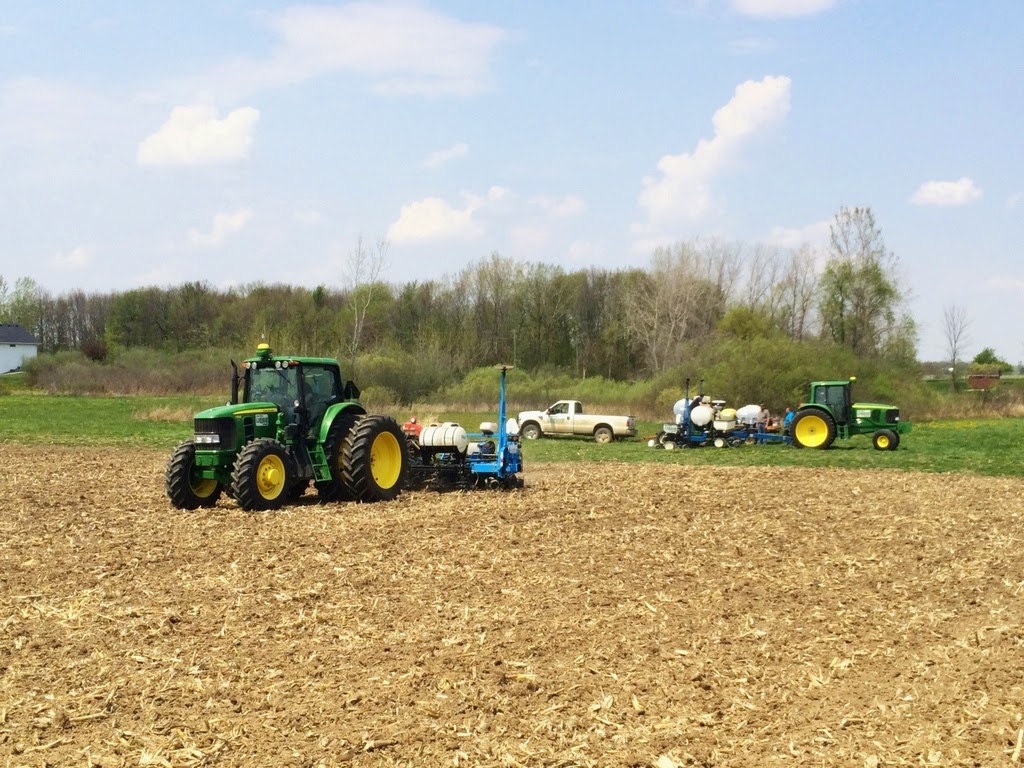
Yesterday was still a busy day of planting corn.  Here we see Tim planting a test plot with the Monosem planter while Jeff has stopped by for a fill up for the Kinze from the fertilizer wagon.  As you can see it was a nice day.  The temperature was up in the low 80's which is unusually warm, but it felt good.  We are behind on rain, but have good soil moisture, particularly in our no-till fields. Most of the fields are planted in no-till, although we do run our vertical till machine over the corn stalks in some fields of corn on corn, which still kind of counts as no-till.
 Today we planted some soybeans.  Here is the drill on Farm 7 planting no-till in corn stalks.  Both of the planters were still planting corn, so it was good to get the drill in action.
So it has been long days here lately.  But that is the way of farming in the spring.

Wednesday, May 6, 2015

Soil School is Now in Session

So last week I got to be a teacher for a class.  The Agriculture, Food and Natural Resources class from nearby Fowler High School came by for a lesson.  From me no less.  There were around fifteen students who showed up at 7:40 to listen and learn.  And that's a.m. by the way.   So I filled their heads with a lesson on soils, soil chemistry and nutrients, growing crops and careers in agriculture. Now there's a class worth taking. In fact if I wasn't the teacher I would have enrolled just to hear it. But it was fun for me and I know the students learned a thing or two.  

Well during the class I talked about the importance of a soil test as a guide for farmers to know what fertilizers to apply to the crop they are growing.  I mentioned that how a soil sample is collected can influence the results.  Now I have often talked about how you should use a clean plastic bucket to put the samples in, and not to use a metal pail as this could influence results.  But like a lot of know-it-all talkers, I had never actually done a comparison.  So I made the students do it for me.  Isn't that what teachers do?  
So we went outside to a field behind the parking lot.  I'm not sure who is farming there, but sadly they don't use AgroLiquid fertilizers.  Anyway, we had three sampling comparisons.  First was the use of a stainless steel probe and a plastic bucket, which is the recommended procedure.  Second was the use of a stainless steel probe and a galvanized bucket.  And third was the use of a shovel and hand scoop. Many people use this when they don't have a probe.  But you stick the shovel in the ground, pull it forward leaving a space in the soil, and make an upward scoop with your hand from a depth of around eight inches.  Then put the soil in a plastic bucket.  So we took ten samples around the field, with each method collected right next to each other.  I sent the results to Midwest Labs, and just got them back.  Selected results are in the table.
The results were similar for pH, organic matter (%OM), cation exchange capacity (CEC) and P1 phosphorus.  The phosphorus is really low here.  (I would use Pro-Germinator for sure.).  Potassium has a little variance, but is generally close and also very low.  (Kalibrate would help.)  But look at the Zinc readings.  The level from the galvanized bucket is super high.  After all, galvanization is a zinc coating of steel, and enough flaked off into the sample to alter results.  So don't do that!  The copper level was also higher, but not sure if that is from the metal pail.  Maybe there was a penny in the ground or something.  But lesson learned.  Class dismissed.  (And no one even gave me an apple.  Do they still do that?)

Friday, May 1, 2015

Farming Big Time at the NCRS

So planting at the NCRS is in high gear now.  It's still pretty cool in the air and soil, but warmer weather is coming.  Yesterday Brian and Jacob planted potatoes for the fertilizer tests on that important crop.
 One of the new farms had some trees cleared and it was finally dry enough to have them hauled away.  No more planting through the woods. 
Here is Phil applying herbicide after a corn experiment was planted.  Having gps guidance makes this so much easier, and more accurate, than the days of foam markers.  The boom covers 45 feet or three plots per pass, which is plenty for our tests.
Over on Farm 12, Stephanie and Tim had a visitor.  Troy dropped by to check progress.  He gets antsy if planters aren't planting when the weather is nice.  And he found his "antsy" alert was a false alarm.
 After getting loaded with another treatment, Tim makes another round.  Repeat till done.  Then move on to another test.
I will give an unsolicited plug to one of our equipment suppliers.  We use Ag Xcel's GX2 Tower Pump System on our Monosem planter.  It is the most accurate and trouble-free pump system that we have ever seen. Each row applies exactly the same amount of fertilizer over a range of rates used in our tests.  In our work, accuracy is the key, and this does a great job.  It is a little spendy, but is well worth it, especially considering the cost of inconsistent output and downtime.
So we hope the nice weather holds for awhile to get further ahead.  More reports to come.