Wednesday, June 7, 2017

What Else Happened on June 8???

So it can be fun to look back in history to see what happened on a particular date.  Like June 8.  Well around that date in 1992, the June issue of Agro-Cultural News came out.  It was much smaller then, basically a sheet folded in half for 4 pages.  On the front page it talked about how Agro-Culture Liquid Fertilizers was a growing company and had been recognized as a Michigan Private 100 company, which means out of all the private companies in the state, ACLF was in the Top 100 for growth.  A trend that would continue for sure.
And inside there is a section of At Your Service featuring employee news.  Hey, that guy looks familiar.  Well kind of.  Maybe.  But if you read it, it's about the new guy they hired for research and market support.  Has it been 25 Years already??? 

Anyway, twenty five years of hard, but rewarding, work does have an effect on a person.  And it's all positive!  (Except maybe the hair part).  We were a lot smaller then, as I think that is nearly all of the employees in that picture on the cover.  After all this time, and all the employees now, there are only three that have been here longer.  And I'm gaining on them. But I remember my first day.  There was no NCRS then, but Troy showed me around the place that would become the NCRS.  And I remember we built the first grow-out boxes as they were called.  A wood frame with plexi-glass sides that enabled viewing seeds growing under the effects of different fertilizers.  The light bulb started to light up with that.  I was an agronomist, but had specialized in weed control and not so much with soil fertility.  I remember company founder Mr. Cook (may he Rest In Peace) saying "Well that's good.  Because now you won't have to un-learn everything that is wrong about soil fertility and feeding plants."  Sounds funny now, as I began to understand that it's not how much fertilizer you apply, but of what you apply, how much gets into a plant and has a positive response.  That was said many times by Mr. Cook as his basic explanation of how Agro-Culture Liquid Fertilizers are different.  It was a good job, but we were so small that I remember driving to work thinking: "This is alright, but I'll just do this till something better comes along."  And nothing ever did!  I shared that story later with Mr. Cook and he had a big laugh.  I also remember thinking that this shouldn't be so hard.  Give me a few years and we would have everything pretty much knocked out for proving ACLF performance against "conventional" fertilizer, and the rest would be easy.  Well, still working on that.  But with an increased product line, a top-notch research farm and staff and all kinds of employees At Your Service...the next 25 years should be sweet!

Sunday, June 4, 2017

AgroLiquid Ad Recognition

So certainly everyone remembers the AgroLiquid ad campaign that debuted with A New Game Plan. We saw where Farmer Dave has had no luck with his conventional corn fertilizer and makes a change to AgroLiquid where he finds great success.  The reason for success is explained in the soil where a new game plan of protected nutrition makes the difference.  It was on web and television.  Well these viewers weren't the only ones taking notice.  It seems that various entities who recognize excellence also took notice.
As such, the awards came rolling in, and they were recently announced to the folks at AgroLiquid World Headquarters in St. Johns.  Here are the awards that the New Game Plan campaign amassed. The Silver Telly (National TV ad under 60 seconds), the National Agricultural Marketing Association Merit Runner Up, and the Bronze Addy (60 second TV campaign).  Here is Luke Butler of Harvest Creative Services presenting the Addy to the Marketing team of Albert Bancroft, Angie Bunn, Adam Baudoux, and Kathryn Kendall.

So that was very exciting and well deserved.  But the bad part is that you have to top that with the next campaign which is already underway.  Surely you've seen the Sports guys and the new story with Farmer Dave and reporter Jenny.  Riveting, check it out!

Wednesday, May 31, 2017

Visit to Asparagus Town, Part 2

So to continue our visit to America's premier asparagus growing town....we are looking at new Retail Partner Todd Greiner's fertilizer storage just put in this spring.  Here are Katherine, Troy, Greiner Farms salesman Tim and Burt.  Very impressive.  They have several nurse trailers and fill totes to take fertilizer out to growers.
 It's easy to know what is coming out of the hose.
 Accurate measurement with a Murray meter.

 Now out to a field.  This is our quest....asparagus ready to pick.  Each field is picked multiple times as the stalks grow back quickly.

 Here is a harvest cart.  Actually I don't know the official term, but harvest cart works.  These are actually built nearby.  But you sit in your seat and pick stalks as they go by.  The guy in the middle steers with his feet.  There is only half a cart crew here.  But we watched them go back and forth.  The crates of picked asparagus are taken to the packing plant and put into a cooler till ready to pack.  So it was really cool when we were there, in the 50's.  But the previous week it was in the 80's and they said the asparagus would grow an inch an hour in that heat.  So cool is better.  In fact on those hot days they couldn't pick it fast enough and had to mow much of it that grew too big.  Then come back and pick the re-growth later like today.  There are fields big and small all over the place.  They like the sandy soil, this being so close to Lake Michigan.

 After ten or more years, it is time to replant the crowns.  Now we have asparagus at the NCRS, but I guess I was absent the day it was planted.  They grow "crowns" in the field from seed.  The crown is a perennial root mass that looks like a wad of spaghetti.  It is harvested and then planted the next year in a new field in a trench.  Before planting, Liquid fertilizer is banded in the bottom of the trench, like 8 to 10 gal of Pro-Germinator.  Then throw in the crowns and fill in the trench.  This field was planted with crowns earlier in the spring and the emerged stalks are now visible.  These won't be picked this year, but next year they will be.  As far as fertilizer, they will band AgroLiquid Pro-Germinator, Kalibrate and High NRG-N over the row in the spring.  Then after harvest the stalks go to "ferns" and those are sprayed with FertiRain, then they are mowed and can receive another band of fertilizer before fall dormancy.  Todd says he really loves FertiRain and sprays it on all of his crops and his family and workers thinks he would drink it too.  Whatever works!

 In this field, there was a harvest cart on the edge, so us rookies got on to try it out.  Unfortunately they took the key.  But we were ready.

Here is a new tart cherry orchard of Todd's.  He is impressed how fast it has grown since establishment last year.  Bands of AgroLiquid plus foliars of FertiRain and Fase 2 have made it grow much better than other fields without.  Katherine checks it out.  Every tree has a little bag on it? What is that for?  Well it's deer repellent.  Evidently she's no deer.  And if you've never seen cherry harvest, it is unlike anything else as far as harvesting.  Hopefully I can be around during a harvest to report on it.

 I reported on some freezing weather a few weeks ago.  Well it was really bad over here.  This is a branch of a tart cherry tree. All of the blossoms there frosted and died. There is only one cherry in the whole bunch.  It's interesting because we talked to another grower there and he says at least that will reduce the unsold cherry stocks left over from last year.  A familiar problem for every crop at times.
 So we were close to Lake Michigan, and went out into the dunes around Silver Lake.  It is a popular place for riding Sand Rails as they are called.  Well I turned my back to take some pictures and got separated. They said they didn't desert me in the desert.  Hmmm.  Well I will say that it's rough being abandoned without food or water.  I must have been out there for many minutes.

 We were very close to Lake Michigan and it seems that this Ohio girl had never seen this Great Lake.  So we drove over so she could see what it feels like.  Wet was the report.

So that was fun and informative.  Again, get some Michigan asparagus and serve it up three times a day!

Tuesday, May 30, 2017

Visit to Asparagus Town, Part 1

So if you were walking through a grocery store and saw this sign, well you would want to load up, right?  Well the guy in the sign is not only an asparagus grower and packer, but is also a Retail Partner selling AgroLiquid.  Meet Todd Greiner.  His operation is in the asparagus capital of Hart, MI in Oceana County.  Michigan was the #1 asparagus producer for years, but California has kind of taken over. But talk is there is less acreage due to conversion to tree crops.  We will see.  But CA can produce for 7 months whereas the asparagus season in Michigan is only around 5 weeks.  We are in mid-season now.  Now as nice as this sign is, Todd has had to tell them (Meijers) to take down the sign after the Michigan season is over and South American asparagus comes in from Peru.  Best asparagus is Michigan asparagus for sure.  Let them get their own guy for signs.
                                                                                      (photo credit: SAM Ashley Stickler)

I had not been over to Hart to see Todd and his operation.  Last Thursday SAM Burt Henry was going over, and before he knew it Troy, intern Katherine and I volunteered to go too.  As I said, Todd not only grows it, but also processes and packs it for shipment to grocery stores all over the country.  He has an employee that all he does is talk to stores and arrange shipment.  Greiner Farms runs two packing houses that we visited.  We watched how the asparagus is brought from the field to coolers, washed, then through a sorting line, cut for uniformity, bundled up and boxed for shipment. Unfortunately pictures weren't allowed.  I understand, it's competitive.  Who knows how many spies read this hoping to get a tip.  Well they can see this though.  They have a new product now that is just being introduced: microwave asparagus!
 There is the family pic and farm info on the back.  That's Todd's wife Sarah who runs the packing operation.  Boy is she busy.
Well this was the only microwave bag they had in the office.  And when they offered it to me, Katherine obviously didn't hear clearly and tried to intercept MY asparagus.  Just like the THE OSU type.  So she had a trick move and made the grab.  But she had to give a pic and review for the blog. 
Meanwhile, Burt and Troy bought a box of regular asparagus that was just picked that day.  
 Here is what it looks like.  So if you see asparagus in your grocery store with that purple band and says Todd Greiner Farms, then you know you have the best.  After all it received AgroLiquid.
For lunch we went to a restaurant that had, what else, Fried Asparagus!  That was a first for me.  We got a big order.  Well after it was all gone, I realized that I forgot to take a picture.  But this drawing is pretty close.  And you can tell from the wiggly lines that it's hot.  Dip in Ranch dressing and enjoy.
Katherine kept her promise and sent me this pic of the microwave asparagus.  She added butter and some garlic said it was delicious.  So keep an eye out for it.
 I had to cook mine the old fashioned way on the stove in shallow water in a skillet.  An excellent addition that makes any meal better.  And so pretty to look at.
So that was only part of the fun.  Tune in tomorrow for our visit to fields of growing asparagus, asparagus harvest, new asparagus fields, plus cherry trees and probably more.  If you didn't like asparagus before, you will now.

Sunday, May 14, 2017

Season Finally Starts at NCRS

So usually we are pretty far into planting by May 8.  But with frequent rain and cold, field activity just got started last week at the NCRS.  And it was nice all week, so it was busy every day.  We are having some more buried drip tape installed on a small field near the field office.  It will be on display at the Agro-Expo.
 Believe it or not, there were frost warnings last Sunday and Monday nights.  So Tim B loaded up some foliar fertilizer into the Prop Tech orchard sprayer and gave the apples a blast during the day on Sunday and Monday.  This is to get some nutrition in the leaves to help ward off the cold.  Well it got down to 27 degrees both nights.  Well actually more around just before sunrise.  We saw no damage.  There were areas around where the fruit trees were hurt badly.  Every fruit growers worst nightmare.
 At the Agro-Expo there will be silage corn demonstrations.  The grower who is working on this part of the Expo came over to plant the hybrid plots, plus the part of the field where the silage choppers will run at the show.  This is also the grower who installed the Precision Planting parts on our planter. Naturally AgroLiquid fertilizer will make for a good show plot.
 I couldn't imagine having to make seed changes on a 16 row planter.  But they are like a pit crew with two vacuums with long hoses to empty out the planter boxes, and then put in the next one.  Everyone on the crew had a specific job, so you didn't want to get in the way.
 Phil and Jay check wheat plots for frost damage.  Hard to say right then.
 Later in the week Tim was applying the banded Liquid fertilizers in the orchard.  It's hard to see, but there is fertilizer coming out of a tube that runs along where the drip tape will water it in if it doesn't rain.  
 So the orchard is fenced to keep out all types of four-legged pests.  As I said previously, there are lots of robins in the orchard.  Now I did not know that robins nested on the ground.  Maybe it's because the trees are too small for nests?  I don't think so.  I will have to check into this. But there are no cats in there, so maybe they like it better.  This was the last nest with babies still in it.  There are larger juveniles around that can fly a little, but mostly scurry on the ground.  It was entertaining.  And by the way, we flagged this so as not to give them a fertilizer bath.  We do that with killdeers out in fields too.  I like birds and we are nice after all.
With the new line of Primagro fertilizers, the fertilizer wagon (or War Wagon) had to be expanded.  It's loaded and ready.
I described the new Kinze planter earlier.  Tim is loading tanks and moving product around and checking pumps.  Certainly more complicated from the old speed and pressure liquid planter used at the start of the NCRS.  But with well over a thousand plots to plant, timeliness and accuracy are important.
It worked great with excellent precision and monitoring everything.
Here are the four college interns who will be spending the summer at the NCRS.  They are learning about loading the fertilizer treatments.  They will have a diverse experience with all types of operations at the NCRS and a variety of other places.  More on them later.  I will say that three of them are from Michigan State (Go Green) and one is from OSU.  Well not the same OSU as me, but that other one just to the South. You know, THE OSU.  But so far so good for all of them.
There was another video made at the NCRS this week. This one about the Y-Drop fertilizer application system from 360 Yield Center.  We have had good results with it in our plots, and actually bought a system for our field Hagie applicator for use on our production corn.  Our friend Stephanie Smith with 360 Yield Center came out to be in the video along with Agro Stephanie and Tim.  I missed the actual video shoot, but reassembled the actors for this fine pic.
So this one should be out soon.  You can see other fine videos from the NCRS on the AgroLiquid Facebook page.  So it was a very busy week, but the work is far from over.

Monday, May 8, 2017

Desert Fruit. No Extra Salt Needed.

So back to the Way-Out-West adventures with Carlos.  We left Yuma in the morning a few weeks ago and crossed the border into California.  It was desert for sure when he turned off the highway into this big melon farm.  It seems that he and Jeramie (remember the golf course Retail Partner?) had worked with this farm to run a comparison with their fertilizer on 12 acres of cantaloupe melons.  Here is a view to the North looking at the AgroLiquid side. 
OK, they weren't given the growers standard program being used, only a soil test and a rough cost.  And it wasn't a high cost program by any means. So they put together a blend of High NRG-N, PrG (hey it's California), Kalibrate, S-Calate, Micro 400 and FertiRain that was applied through drip irrigation.  Here is the West side of the Agro block.  See that road on the right?  That's the border.
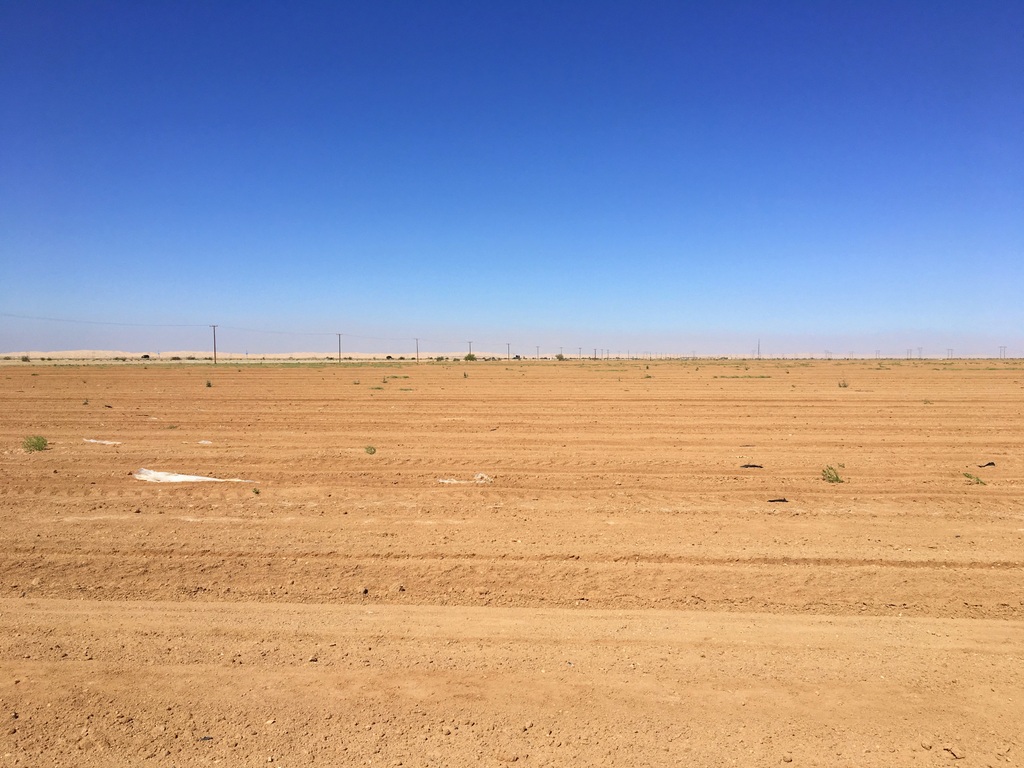
 See that same road now on the left?  Well that's the same road as above, meaning we are now on the conventional side.  Good thing I took pictures because you can't describe differences like this.  The soil test was unlike any I've seen.  It was medium to high on P,  Low on K, Very Low on all micros except Boron that was Very High (3.5 ppm), high pH (8) and Very High sulfur from all of the elemental sulfur trying to lower pH.  But the shock was that it had over 20% base saturation of sodium!  Over 1000 ppm!  I have never seen anything growing in such conditions.  But here it is, and as is the case in most stressful soils: advantage AgroLiquid. 
 Here is Carlos looking under the vines for melons.
Here are some Agro melons.  The leaves are scorched from some mildew.  Plus there is blowing sand. They said a real bad storm blew off most of the first flowers earlier.
Want a better look?  Here are a couple to feast your eyes on.  They are a few weeks from harvest, which means by now they should be real close. So I am certainly banking on a higher yield on the Agro side.
In addition they grow watermelons here.  They were just now flowering.  No AgroLiquid here though.  Well not yet.
 Here is what it looks like just beyond the field edge.  They have this bedded up for a future planting.  Amazing what water will do in the desert.  Even in all of that sodium.  You can see sand dunes in the background.
 Sand Dunes mean dune buggies.  Or I guess Sand Rails is what they are called.  I took this from the highway as we drove West. I texted it to Albert who is a big-time Sand Railer (is that what they are called?)  His reply was brief: "So jealous".  Actually he has hauled his machine out to this very place. So he knows.  Never done that myself, and Carlos didn't want to take the F-150 over for a go.
Oh well.  There were more adventures ahead.  And it wasn't even noon yet.

Thursday, May 4, 2017

Drone Correction

So I hope everyone enjoyed yesterday's blog about the wheat field.  But early this morning I got a message from Stephanie saying that the NCRS drone flew at 260 feet while taking the pictures, not 500 feet as reported.  (I have since made the correction.)  Legal maximum altitude is 400 feet.  She said she didn't want the "drone police" coming after her.  I don't blame her.  They can be pretty rough.  I regert the mistake, probably the first and only one ever in the blog.
Later that same day, Adam from Marketing went out with the Marketing drone and took some pictures.  Pretty impressive.  His camera takes a real view picture, unlike the RGB image with the NCRS drone.  I'll have to study on what RGB does (something to do with crop stress maybe), but I do like the real view.  Not sure if we have one for the NCRS drone.  You can also see where the drainage tile lines are.  They have been getting a workout.
We will keep an eye on the field as I would expect the urea part to green up sometime.  But the AgroLiquid has a pretty good head start.