Tuesday, July 19, 2016

Wyoming Welcome

So last week I had the opportunity to again visit Wyoming.  Although you may not think so, there is quite a bit of high production agriculture there.  But it's mainly in several key areas.
One of those is down in Southeastern Wyoming where there is ample irrigation water to grow some high yielding field crops.  This is the family farm near Lingle run by Chris Cook, a 100% AgroLiquid user now for several years.  I have reported on previous visits, and it's always a pleasure.  Chris grows alfalfa, corn and pinto beans.  His alfalfa regularly yields in the 9 Ton range which is phenomenal.  It wasn't always that way, back several years ago using dry fertilizer.  But since using Pro-Germinator, accesS, Sure-K and micros, production and quality has soared.  In fact, all of his hay is now shipped to a large dairy in Colorado that produces milk for Wal-Mart.  And he said that there is a code on the jug that lets them know that the hay for that cow's milk came from their farm.  Now that's really farm to table!  So here they are baling a recent cutting.  
They also grow irrigated strip-till corn with all AgroLquid.  He is regularly in the finals for the Wyoming Corn Growers high-yield contest.
And here is a nice field of pinto beans under a new pivot.  He says he really likes center pivot irrigation for the speed and uniformity compared to managing furrow irrigation.  Probably most people aren't aware of furrow irrigation.
With furrow irrigation there is a large water pipe on the edge of the field that has a slide-door or gate over a hole that lines up with the furrow.  Prior to irrigation, a furrow is made with a tillage tool to give the water a clear path.  Obviously the field must be flat.  With some fields, a "sock" is attached to the pipe and the water flows through the sock and down the furrow. The sock prevents erosion where the stream of water would hit the soil.  But you can only run so many furrows at a time due to water supply.  So after a period of time, ranging from 8 to 24 hours depending on the size of the field, the gates are closed, socks removed, and move on down the pipe.  This must be done every day.  So farmers with furrow irrigation have a hard time getting away during irrigation season.  So we just attached the socks and opened the gates in this field of pinto beans.  And yes, I said "we".  Although probably more of a hindrance than a help, Chris schooled me in the art of sock attachment and water flow regulation.
With the Cook's, irrigation management is a family affair, with his wife and two young boys.  Here we are at a field of corn that is tube irrigated.  
You stick the end of the tube in the water, cover the other end with your hand, shake it up and down a couple times to create suction, and set it down quickly so the water will siphon from the source to the ground....and down the furrow.  I watched and learned.
And after a couple shakes, I proclaimed myself an expert.
So where does all of this water come from?  Well we often hear tales of the wisdom of our forefathers, and that is truly the case here.  At the turn of the last century, spring snowmelt and river flooding would put this ground under water, backed up to the mountains.  Well back around 1910, they graded the ground, built large water canals, and then implemented a water distribution system that would pull the water out of the canal and move it all around this valley so that they can irrigate. Otherwise it is a desert.  They are still using these irrigation systems that were built over 100 years ago.  There is no way we could afford to build something like this today, and would it last 100 years?
Here is one of the big canals which doubles as a rock skipping place.
There is always a challenge though, and that is with algae, or "moss" as it's called, clogging up gates and pipes.  Here we see a clump at one of the risers that feeds the pipes.  So you are always pulling it out of the gates.  It comes out of the canal, and they do put up screens at places to block it.  But some still gets through.
So I enjoyed the day with the Cook family, as I always do.  We also talked about crops, soil tests and fertilizer.  This picture was from the night before in Torrington, WY  
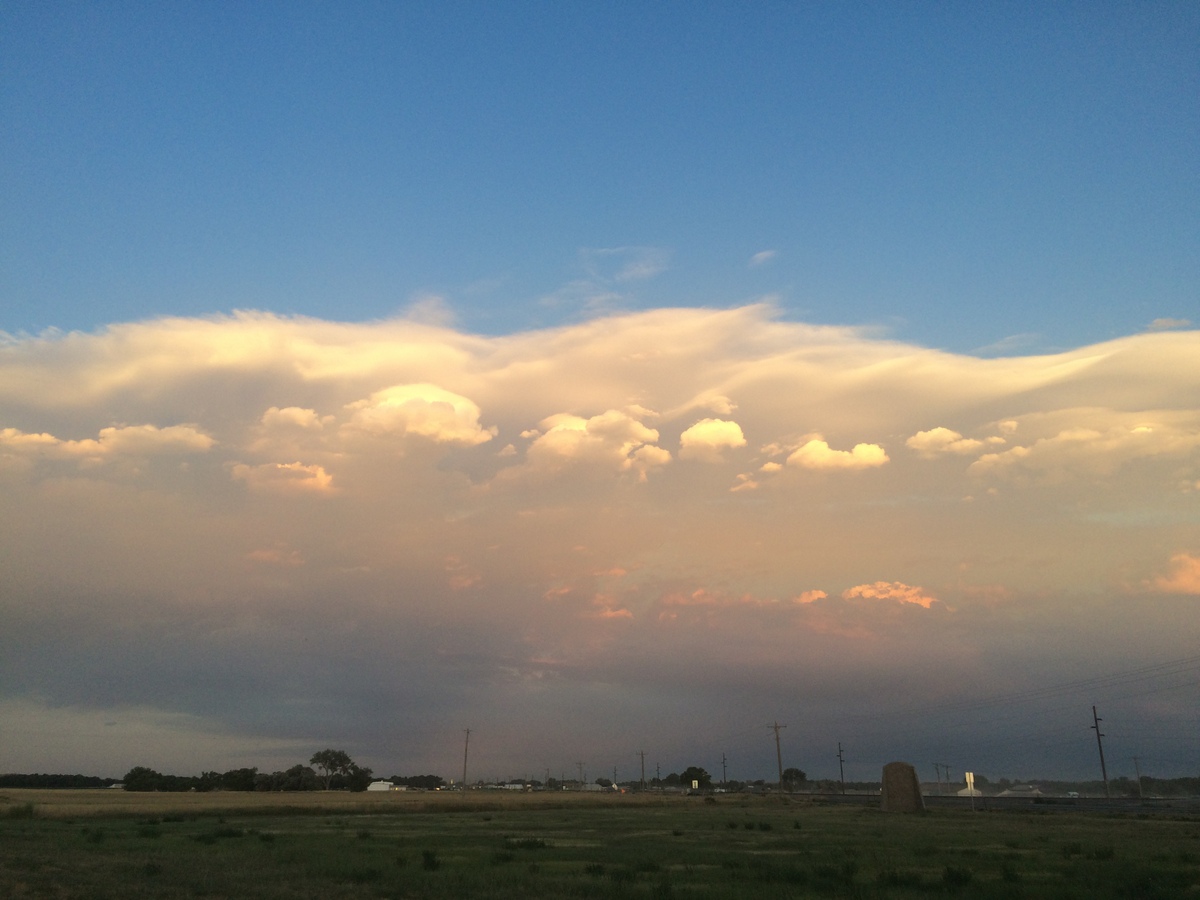
Just like in Central Michigan this summer, what looks like rain clouds is only a tease.

Sunday, July 10, 2016

Out in Nor'Dakoda, You Betcha!

So last week I made my way to North Dakota on a fertilizer mission.  Coming in to land at Bismarck, the state capitol, you could see the Missouri River.  I just saw it recently in Montana too.  So you know what comes next...just think, Lewis and Clark paddled by here late in 1804.  Still an amazing feat. Anyway, Sales Account Manger Brad drove all the way up from Nebraska to meet me.  I was pleased.
The first order of business was to visit a contract research plot for spring wheat.  It is testing different P and N fertilizers, methods and timing of applications, etc.  It looks good, but it is very dry. You can tell it's research because there are flags.
 Brad and researcher Tanner discuss what's what.
The evening found us in Jamestown.  So how many times have you been asked the location of the World's Largest Buffalo, and had to hand your head in shame because you didn't know.  Well now you can reply: "It's in Jamestown, ND". The sign here says so.  No argument from me.
 They offer buffalo rides, so I can't say no to that.  I like the black hair on top.  Ride 'em Cowboys.
One of the things for the next day was a visit to our new storage site under development in Carrington.  I had never been here, but it looks impressive so far.  That is a half million gallon tank that had been full of Pro-Germinator this year.  But it is down to around 5 inches depth, according to the gauge. But that is still more than 5000 gallons.  See those tanks on their sides in the background? Well those are going into this hole once the lining is put in.  Well just like you, I see the stairs going up the tank, and of course want to go up on top.
Here are site manager Jared and Brad up on top, around 35 feet or so above the ground.
Jared says we can go inside the tank.  Well I didn't want to get wet, but he said we could go down the stairs between the double walls.  Now there's excitement!
Now I knew this was a double walled tank for prevention of a spill should something happen to the inside wall.  But I had no idea that there was this much space in between the walls.  Learn something new every day.
So of course Brad and I wanted to go down.  There was a little delay as no one wanted to go first or second in case the last guy decided to play a joke and padlock the door.  So as the most mature member of the group, I went last.  No incidents were reported.
Down at the bottom, Jared closes one of the valves.  I learned that there are three  lines in this tank: one for filling, one for emptying, and one for sparging, or for enabling circulation I guess. There are no lights down here, this is light from the door (with some brightness editing on the picture.)  Jared said that during filling of the tank he was up and down those stairs quite a few times a day.
 Later that day we went over to one of AgroLiquid retail partners in Hurdsfield, which was a Hefty Seed location owned by Chad Weckerly.  Here we are with Chad and two of his agronomists, Melissa and Emily looking at some corn planted with Pro-Germinator + Micro 500 + Liberate Calcium. 
 One thing you see almost throughout North Dakota is the abundance of water holes in fields, along with numerous lakes and ponds.  It is difficult to manage since to any plans to install drainage tile or work to drain them requires permission from the state wildlife agency (or whatever it is there) as it is considered wildlife habitat.  Well there is plenty of room for them outside of these small sites in a field.  I like ducks, but you shouldn't have to watch these water holes get bigger every year.
 Here is a large field of soybeans that will find their way into bags of Hefty brand soybeans.  A little rain would sure help.
 Well that was a fun trip, as most fertilizer missions are.  
Especially ones to North Dakota.  The Peace Garden State, right?  That's what it says on the license plates.  I reported on my visit to the actual Peace Garden several years ago.  It is on the border with Canada.  It must work as North Dakota is at peace with Canada, as far as I know.

Wednesday, July 6, 2016

More Big Sky Adventures

So to continue my recent visit to Montana...Bruce and I visited some research plots in winter and spring wheat established by friend and long time Certified Professional Agronomist Neal Fehringer. That's Neal below next to Retail Partner Mike Kilzer, Neal's plot agronomist, and then SAM Bruce on the right.
 There were a variety of plots evaluating N, P and seed treatments.  Here is a plot of winter wheat.  It is very dry throughout Montana this summer.
Neal also helped setup a sidedress nitrogen test with an experimental additive.  It is on a nearby AgroLiquid customer's irrigated corn.  So lot's to learn come harvest.
 We also visited some of Mike's customers in the area, like this field of irrigated malt barley.  It is looking good as expected with AgroLiquid nutrition.
And here are some furrow irrigated sugarbeets, also growing well with AgroLiquid.  This is a long-time customer who commented on the purity and effectiveness of AgroLiquid.
No trip to Billings would be complete without a trip to the AgroLiquid rail and storage site.  I learned that before too long it will relocate to another site on the other side of town, as they have outgrown this site.  I can remember visiting this place years ago when they were just setting the tanks thinking how big it was...and now it is too small.  That's growth for you, which is a good thing.
Bruce counts railcars being unloaded.
 After that, Mike and I paid a visit to long-time customer Tvetene Turf.  They grow sod for distribution all around Southern Montana.  
They grow beautiful turf, both fescue and bluegrass.  I recall working on the recipe years ago with Mike, and we were almost there, but there was a missing ingredient to make it super green.  It turned out to be Manganese.  So MicroLink Manganese became  part of the fertilizer blend with excellent results.
The fertilizer is applied through the center pivot irrigation, pumped from the tank there.  There are several pivots at this and nearby locations.   They are a good customer for Mike.  I talked to their field man and he said they love using AgroLiquid.
 They cut the turf in rounds under the pivot.
In addition to growing turf, they also are equipment innovators.  They build and have patents on harvesting and transport equipment like the machine below.
 And here goes a load of sod to some lucky customer who will have a beautiful lawn of Liquid-fed grass.
And since I was in Montana, it was great to see this family of Grizzly Bears.  A beautiful wildlife scene for sure.
Well actually it was a picture in the hotel I was at.  You can kind of see my reflection.  But I was in Montana when I saw it.

Tuesday, July 5, 2016

NCRS Interns on the Move

So one of the many advantages of being a college intern at the NCRS, I mean besides all of the fun labor here, is being able to learn more about AgroLiquid in far-flung regions of the country.  Or maybe I should say "continent'.  Three interns were on the move last week.

That's Lacie below across the border in Ontario, visiting an apple grower there along with  fertilizer "area manager" (Canadian for "Retail Partner") Clare Horst and Sales Account Manger Steve Ledoux. So it is important to see and learn about the sales process from these professionals.  Thanks to agronomy manager John Leif for the pic.
 Agronomy manager Dan Peterson has some potato plots with a researcher over in Wisconsin.  Intern Jared learned how to take petiole samples, which are used to monitor certain nutrient sufficiency,  So after learning, he is put to work gathering samples.  Now maybe he will be able to use this in the future, who knows?  But at least he has an understanding of this practice common to potato growers.  
Georgina won the long distance award for a trip to the Imperial Valley in far Southern California. Agronomy manager JW Lemons sent this picture of Georgina and SAM Carlos Palavicini by a sulfur burner.  Now I have been to the Imperial Valley a number of times and they never took me to see no sulfur burner.  I will ask her what's up with that. 
So the other three interns are waiting for the call to action where they will slide down the pole to who knows where.  But hopefully it will be as fruitful as the ones this week.

Monday, July 4, 2016

Celebrating Our Freedom Today

So here it is Independence Day again.  And fortunately it also falls on July 4th, so an extra special holiday this year.  We are thankful for our many freedoms, that much of the world would love to have.  And while this election year in particular illustrates the many faces of the "American People", one thing we all have in common is that we need, and like, to eat.  So those of us at AgroLiquid and the North Central Research Station will continue making that happen by providing the best plant nutrition available today!  Chow down today in particular...I will.

In addition to the fireworks, I have a couple pictures of recent happenings at the NCRS.  Like the pictures below that were sent to me by Zouheir, who is running the potato research this year. Below Tim B is hilling the potatoes while applying nitrogen.
Zouheir is apparently pleased with the outcome.  In addition to fertility investigations, this experiment is also monitoring nutrient movement in the soil through the use of lysimeters that have been shown here previously.
On Friday Tim D made applications of foliar fungicides plus fertility to some of the Yield Challenge plots using the Undercover application.  There are three nozzles behind those big black things above the Y Drops that enable excellent coverage within the foliage.  There was some debate as to the need for fungicides during a drought (see the grass outside the plot.)  But we went ahead as a means of increasing overall plant health. We will see.  By the way, recall that we have subsurface drip irrigation here on Farm 12.  So dry on top, but moisture in the root zone.  More on that shortly.
Here is an attempt to show the thorough wetting to the lower leave after application with the Undercover spraying.
 Here is an interesting view of the grass on Farm 12.  We have the subsurface drip lines on 30" spacing under the crops.  But under this grass area they are on 60" spacing.  Can you guess where they are?  Glad we have that on this farm, especially since the AgroExpo is going to be right here. Recall that it was installed during the 2014 growing season, and has been a lifesaver this year.  Non-irrigated fields are pretty sad looking, especially in the afternoon.  Only had around 0.4" of rain in all of June.  It seems that there is no consistency in years, as last year we had ample rainfall and didn't even start overhead irrigation on the two farms that have it until July.
Tim and I took a look at a buried drip tape under a row of corn.  It is around 16" deep.  There are roots growing all around it.  It looks dry, but was moist around the tape.  It is set to run for two hours a day, but we may increase it an hour now since it is so dry and corn is really wanting to grow fast. There are 7 irrigation zones on Farm 12, as you can't run it all at once.  They just completed a piece where different fertilizers can be added to the subsurface drip, allowing for six comparisons on six row plots.  It will be featured at the AgroExpo on August 16-18.
Well that is most of the news for now.  Enjoy the day.