Wednesday, August 10, 2016

Ag PhD and the NCRS: Shared research project to help corn farmers

So did you know that there was a bonus event at the recent Ag Ph.D. field day?  It was a joint research project conducted at the Ag Ph.D. farm plus at the NCRS.  It was an experiment evaluating different nitrogen advisement programs for corn.  Of course the corn had a planter application of Pro-Germinator + Kalibrate to get it off to the best start.  The interested participants assembled in the new building by the field day site.  The AgroLiquid inflatable marked the place.
 Brian Hefty gave the welcome and provided some insight for being profitable in farming today.
 Then we went out to the test site.  Darren gave his thoughts on growing a great corn crop from soil to providing a good growing advantage.
 One of the reasons people like to listen and learn is the many stories Darren shares about growing a top crop.  Darren will be on the Responsible Nitrogen Management plot tour at the AgroExpo next Thursday.  So come join us.  I guarantee that you will learn a lot.  I know I have, and I work there!
 Hey, there goes the AgroLiquid tanker off on another mission.  Galynn and Quinten wish him well.
Since this was an experiment on in-season nitrogen applications, Tom Mundorf from Midwest Labs talks about the Pre-Sidedress Nitrate Test (PSNT) that can indicate how much nitrogen to apply based on how much is already found in the soil.
 But to get an accurate result, you must take an accurate soil test.  Tom goes over the principles for that as well as how to handle the soil after sampling.  Send it to Midwest Labs and get a nitrogen recommendation.  The PSNT has been around for years and can be a good way to better manage nitrogen applications so that you don't over or under apply.  Especially in challenging economic times like now.  In case you are noticing that this corn is way short for this time of year, that was intentional.  We planned for some late planted corn since we are talking about side-dress nitrogen for this field day.  Clever huh?  It was my idea.  Brilliant.
 Ag Ph.D researcher Glenn Herz explains how the experiment was conducted.  Glenn is responsible for the planting of this test as well as the plots on the field day grounds.  Darren wisely gets some shade on this sunny day.
 Now in addition to the PSNT, there are several newer programs available to give nitrogen application advice. Two are based on weather models for the field.  Certainly weather and specifically rainfall can influence crop growth and nitrogen availability.  Here Troy Hageman of Climate Corp. explains that program.
 And Jamie Sietzer of Encirca introduces their advisement process. Now Encirca was not part of this actual field test, but Jamie did a nice job of explaining how Encirca works.  (Encirca is part of the NCRS test.) In addition, there was a plot from 360 Yield Center that used the Soil Scan, a machine that will measure soil nitrate level right there.  They will give a nitrogen recommendation based on that rather than weather models.  However, their rep wasn't able to attend as his wife picked the previous night to have a baby, and he thought he should stick around.  I guess she forgot about her husband having to attend this important field day.
It was noticed that the nitrogen rates recommended by Encira, Climate and PSNT were all pretty close.  So that is reassuring I guess.  But all were lower than the so-called "regular" farmer application.  So there is great potential for achieving yield goal while applying less nitrogen which is good for the wallet and environment.  Well these will be harvested to see.  Now you should all come to the AgroExpo next week to see the similar test at the NCRS that will be featured there.  So it was nice to run a similar experiment both in Michigan and  South Dakota to see how the nitrogen advisers measure up.


Friday, August 5, 2016

Early Look at the AgroExpo

So I was at the office today and happened to look out the front window and saw a piece of farm equipment going by, headed North.  The same direction as the NCRS which is the site of the upcoming AgroExpo on August 16-18.  So I called Jay to see what's what and he said that there was already some equipment being brought out even though the AgroExpo is still 11 days away.  I was curious and decided to go out and take a look. 
 I stopped by Farm 12 which is the main AgroExpo site.  On this field they had it flagged for different equipment and other show items.  Wait, why is that corn on the left all dried down?
 Well there are different seed companies coming to the AgroExpo with demonstration plots.  Is this some new 50 day hybrid that is already at maturity?  Well not this year anyway.  It is actually some corn that Tim sprayed with paraquat yesterday, using 360 Undercovers and the Hagie boom nozzles.  It did a great job, but what's up with that?  Well I think they want to have some harvest demos for stalk management or something.  You'll have to come to see what it's all about.  But I'll bet that turns some heads of people driving by.
And here is where the early equipment is staged until the AgroExpo starts.  It's on Farm 3 HQ.  I see a grain cart, a sprayer, a manure spreader, a stalk mower, the silage bagger I saw out the office window, a rock picker and probably something else I missed.  Lot's more will be showing up next week as it takes time to get all of this organized.  But there will be lot's to see come showtime. 
So next week will be very busy with all of the AgroExpo prep work.  So be sure to come out to see us.  I will say that there will also be research plot tours as there always have been.  I will be leading those, so come make my week by taking a look around the NCRS, won't you?

Ag PhD Field Day

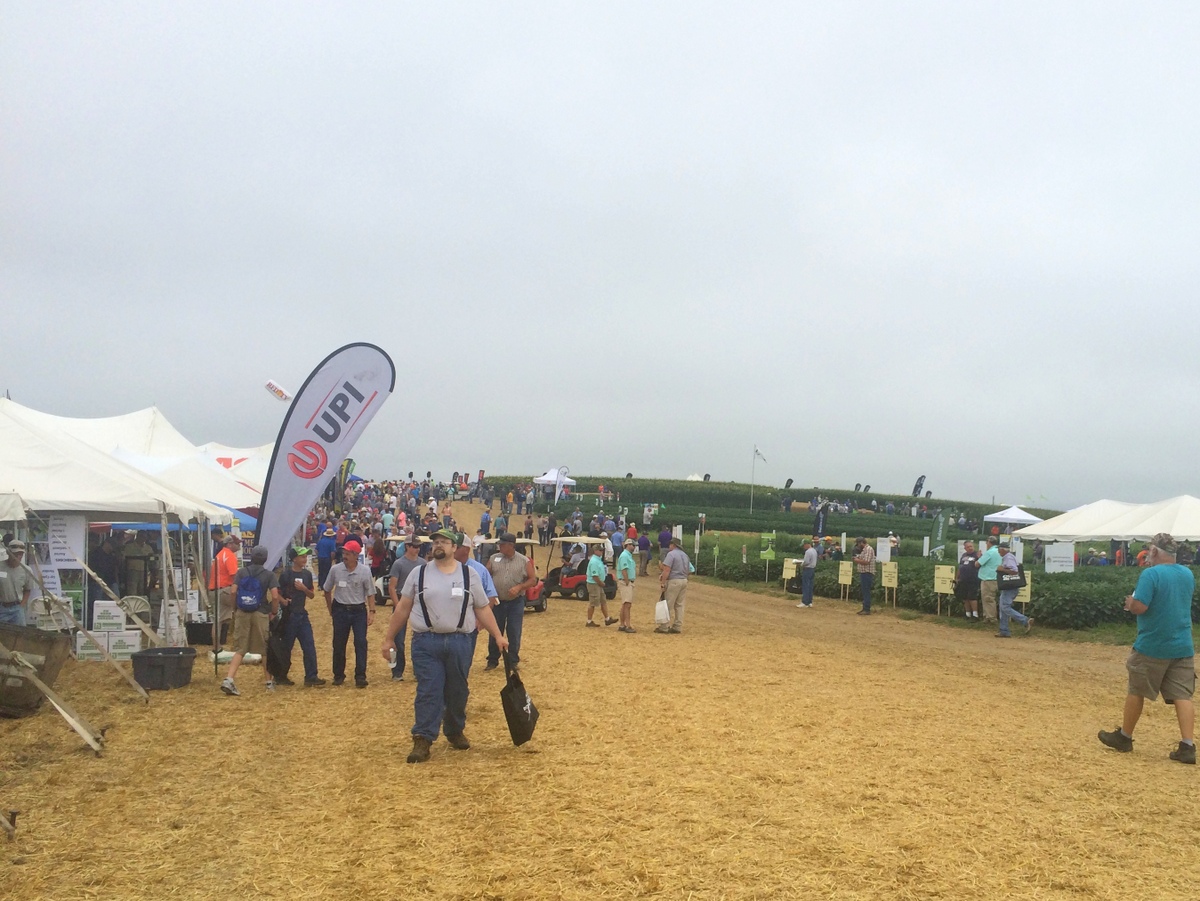
So Thursday of last week was the annual Ag PhD Field Day in Baltic, SD put on by Hefty Seed Company.  It is a huge one-day event attended by upwards of 10,000 farmers and visitors from almost all states and many foreign countries.  This is my seventh one, and it gets bigger and better each year. AgroLiquid had a good number of folks present to meet the attendees in out tent. Senior Business Development Manager Lonny Smith picked some of us up in Sioux Falls to take us where we needed to go.  We were in a hurry but I didn't think he needed to go over 100!  On closer examination it was 100 kilometers per hour which is like 62 mph.  This rental van had Canadian plates and was for followers of the metric system only.  Canadians!  Give 'em 2.54 cm and they'll take 1.6 km.
Here is the entrance to the show grounds.  We had a tanker on call in case any of the attendees needed fertilizer right away and it could follow them home.
Wednesday was set-up day.  We actually had participants in two tents.  The AgroLiquid tent and the Responsible Nutrient Management Foundation (RNMF) tent.  Here Dale carries in some stuff while Galynn watches RNMF Board Members Kay Meyer of the Pacific Northwest Direct Seed Association (who has been in the blog several times) and John DeBoer of Midwest Labs get moved in. 
Many vendors have give-aways to spark interest.  But this is ridiculous.  Sorry Stuart.
Probably the chance to win an Enduraplas fertilizer storage tank would be more desirable to most people.  (Although probably not all people.)  And how do you like the new inflatable logo?  I had not seen that before, and you can't not see it here! 
And now it was time for Brian and Darren Hefty to lead the throng of attendees down the main exhibit row to talk about the different things on display, including the AgroLiquid demonstration plots.  This parade is a tradition and gives people an overview of what is there so that they can go back later and see more for themselves.
 And there is plenty to see.  Like this demonstration showing the effects of heavy equipment on soil compaction.  They do have unusual soil layering here in South Dakota.  Or maybe they meticulously made it just for this.  Either way it was noteworthy.
Thousands of people on the move all day.
 The AgroLiquid tent had plenty of traffic as well.  You could talk to our staff, enter to win that tank, get product information, learn about new financing programs, and lots of other things as well.
We were pleased to have two of our favorites stop by.  Here are Ray and Charlotte Bohacz who drove all the way from Hackettstown, New Jersey having a visit with Troy.  I have shown them several times in the past, including at last year's show wearing their LIQUID shirts then as well.  Looks like we need to get them some new one's with the new logo.  Ray is a well known writer on engine technology, and this year they are AgroLiquid customers as well.  They grow and sell sweet corn and vegetables to grocery stores and other places and used AgroLiquid on it all this year.  They worked with The Mill in Eastern PA to get them set up.
Brian and Darren always bring a variety of speakers to the field day, including yield record growers to motivational people.  Here is former University of Nebraska football coach Tom Osborn.  He was head coach for 25 seasons from 1973 to 1997.  I remember watching OSU lose to Nebraska plenty of times back in Stillwater.  He coached three national champions in the Bowl Alliance/BCS era and his last five seasons they went 60-3.  He talked about coaching with integrity and promising "opportunity" and not guaranteed things.  Nebraska is still decent, but nowhere near what they were when he was coach.  It was nice to see him in person and hear what he had to say about former days.
So that was a fun and eventful day.  But there was still more to come.

Friday, July 22, 2016

WY to MT Byways

So last week on my way back up to Billings, MT to fly home, I had a little extra time to see some sights.  Like the Stagecoach Museum in Lusk, WY.  They had a lot of nice historic things on display like this two-headed calf born just North of town in 1943.  (It wasn't still alive in there, that would be cruel).  And small world: while there, I saw a family and the kids had on OSU Cowboy t-shirts.  The Mom was a graduate.  We're everywhere!
I have showed some of the nice crop land, but much of the state is just wide-open spaces.  There is lots of room for people in crowded cities to move out to the country here.  Not sure what they would do once they got here though.
There are interesting rock formations along the highway.  It's easy to pull over and take some pics as there is hardly any traffic.

And there is a lot of pretty scenery if you get off the highway.
 Maybe this was a little too far off the highway.  I had no phone service, food or water, and saw no other traffic.  So rather than keep going on this "scenic route" to the North, I went back to the highway.  In the end I was glad I did as you'll see.
Wyoming is a big oil and gas state.  In some parts of the wide-open spaces there are all sorts of things pertaining to that.  I wonder how often someone has to drive way out here to check on them.
 Here is a building in old downtown Shoshoni, WY.  I thought it had character, or used to.  Pretty dry here with only 4" average annual rainfall.
Here is the old main street I guess.  Not much going on these days.  Now there is more of a town with some actual businesses just to the West of here.  But this was probably a happenin' place back in the day.  
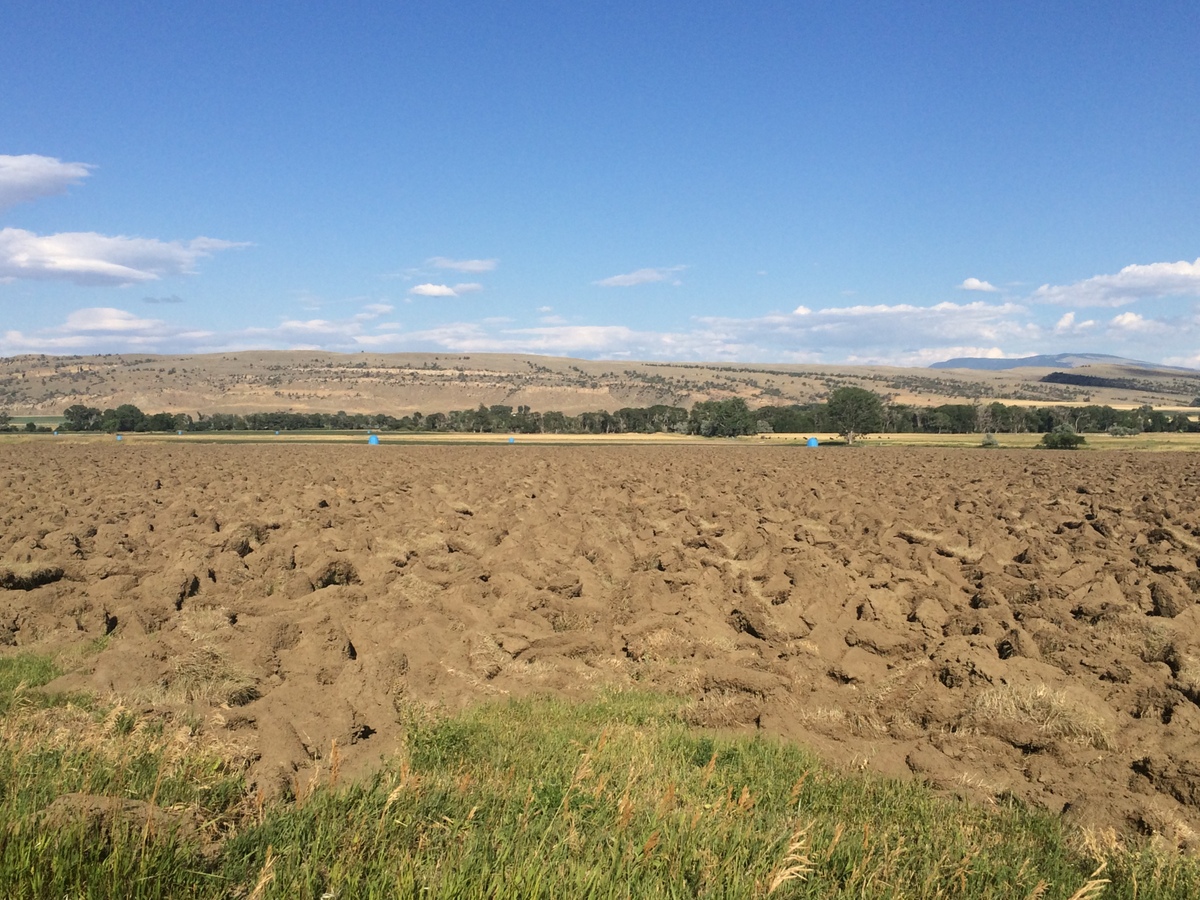
Now crossing back into Montana near Hardin, I did a double-take as I passed this field.  I had to turn around and take another look.  I had never seen a field that looked so heavily plowed. It must have been a giant plow and would have liked to see what kind of tractor pulled it.
But I saved my favorite picture for last.  I was passing through the small town of Belfry, MT and happened to see this sign for the school.  And when I did, I made another U-turn.  This has to be the best mascot name EVER!  The BELFRY BATS!  That made my day.
Kind of hard to see, but they have a bat on the pole by the sign.  I'd love to go cheer at a home football game and get my picture taken with the mascot.
You can tell it's Friday.  Have a good weekend and send any rain our way.  We need it more than you.

Thursday, July 21, 2016

Another Intern on the Move, Plus More NCRS Happenings

So last week NCRS college intern Jake took his field trip to North Dakota.  He was met in Bismarck by Sales Account Manager Brad and Field Agronomy Manager Reid.  From there they went down to the extreme Southwestern part of the state to Bowman, home of AgroLiquid Retail Partner Southwest Ag (well what else would it be called?).  They spent the next several days travelling with some of the Southwest sales agronomists visiting customers both in the Bowman area and near their other site in Mandan, next to Bismarck.  MSU student Jake said that many of the crops looked good but some had been hampered by dry weather and hail.  Now that's a cruel combination.  That's Jake on the right.
In other news...the NCRS has long been Environmentally Verified by the Michigan Agriculture Environmental Assurance Program (MAEAP, or pronounced "Meep" in conversation).  This is a state program that recognizes farms that keep good spray, planting, application, et al, records, safe storage of pesticides, containment of fertilizers, irrigation records and all of the things that make a farm a good neighbor.  The NCRS passed inspection the other day and was awarded an updated sign, held by NCRS department manager Jay.  This one is cool because it is one of those that shine brightly at night from headlights.  Look for it on your next visit.  Come at night for the ultimate sign experience.
Well the winter wheat research plots have all been harvested, but there were still some production acres awaiting harvest.  Here is our fearless leader Troy taking the helm of the combine, having a last conversation with truck driver Ron.
And he's off.  This actually is some soft red winter wheat.  In general, these kernels are a major ingredient of flour used by private companies that bake cookies.  Yummm.
Faster Troy.   There's cookies to be made!

Drove by our vineyard that is looking good this time of year. You can see some green bunches in the
foliage.  These are Concord grapes, and thank goodness we have drip irrigation.
We are still making applications to the Challenge Plots at the AgroExpo site.  Brian Hefty called for a coulter injection treatment of High NRG-N, Kalibrate and Boron now that the soybeans are in the R2 stage of growth.  So we did.  (Nice picture Lacie.)
Now here's an odd picture, also at the AgroExpo site on Farm 12.  We noticed on a plot area planted to soybeans in 15" row spacing, that every other row was showing severe potassium deficiency while the other rows all looked fine. Hmmm. This soil is quite low in soil test potassium (STK), but even stranger is that there was no fertilizer applied at planting or any other time.  Hmmm #2.  What's up with that I wondered?  Come to the AgroExpo and learn more.
So it has been a busy week, and it's still not over. 

Tuesday, July 19, 2016

Wyoming Welcome

So last week I had the opportunity to again visit Wyoming.  Although you may not think so, there is quite a bit of high production agriculture there.  But it's mainly in several key areas.
One of those is down in Southeastern Wyoming where there is ample irrigation water to grow some high yielding field crops.  This is the family farm near Lingle run by Chris Cook, a 100% AgroLiquid user now for several years.  I have reported on previous visits, and it's always a pleasure.  Chris grows alfalfa, corn and pinto beans.  His alfalfa regularly yields in the 9 Ton range which is phenomenal.  It wasn't always that way, back several years ago using dry fertilizer.  But since using Pro-Germinator, accesS, Sure-K and micros, production and quality has soared.  In fact, all of his hay is now shipped to a large dairy in Colorado that produces milk for Wal-Mart.  And he said that there is a code on the jug that lets them know that the hay for that cow's milk came from their farm.  Now that's really farm to table!  So here they are baling a recent cutting.  
They also grow irrigated strip-till corn with all AgroLquid.  He is regularly in the finals for the Wyoming Corn Growers high-yield contest.
And here is a nice field of pinto beans under a new pivot.  He says he really likes center pivot irrigation for the speed and uniformity compared to managing furrow irrigation.  Probably most people aren't aware of furrow irrigation.
With furrow irrigation there is a large water pipe on the edge of the field that has a slide-door or gate over a hole that lines up with the furrow.  Prior to irrigation, a furrow is made with a tillage tool to give the water a clear path.  Obviously the field must be flat.  With some fields, a "sock" is attached to the pipe and the water flows through the sock and down the furrow. The sock prevents erosion where the stream of water would hit the soil.  But you can only run so many furrows at a time due to water supply.  So after a period of time, ranging from 8 to 24 hours depending on the size of the field, the gates are closed, socks removed, and move on down the pipe.  This must be done every day.  So farmers with furrow irrigation have a hard time getting away during irrigation season.  So we just attached the socks and opened the gates in this field of pinto beans.  And yes, I said "we".  Although probably more of a hindrance than a help, Chris schooled me in the art of sock attachment and water flow regulation.
With the Cook's, irrigation management is a family affair, with his wife and two young boys.  Here we are at a field of corn that is tube irrigated.  
You stick the end of the tube in the water, cover the other end with your hand, shake it up and down a couple times to create suction, and set it down quickly so the water will siphon from the source to the ground....and down the furrow.  I watched and learned.
And after a couple shakes, I proclaimed myself an expert.
So where does all of this water come from?  Well we often hear tales of the wisdom of our forefathers, and that is truly the case here.  At the turn of the last century, spring snowmelt and river flooding would put this ground under water, backed up to the mountains.  Well back around 1910, they graded the ground, built large water canals, and then implemented a water distribution system that would pull the water out of the canal and move it all around this valley so that they can irrigate. Otherwise it is a desert.  They are still using these irrigation systems that were built over 100 years ago.  There is no way we could afford to build something like this today, and would it last 100 years?
Here is one of the big canals which doubles as a rock skipping place.
There is always a challenge though, and that is with algae, or "moss" as it's called, clogging up gates and pipes.  Here we see a clump at one of the risers that feeds the pipes.  So you are always pulling it out of the gates.  It comes out of the canal, and they do put up screens at places to block it.  But some still gets through.
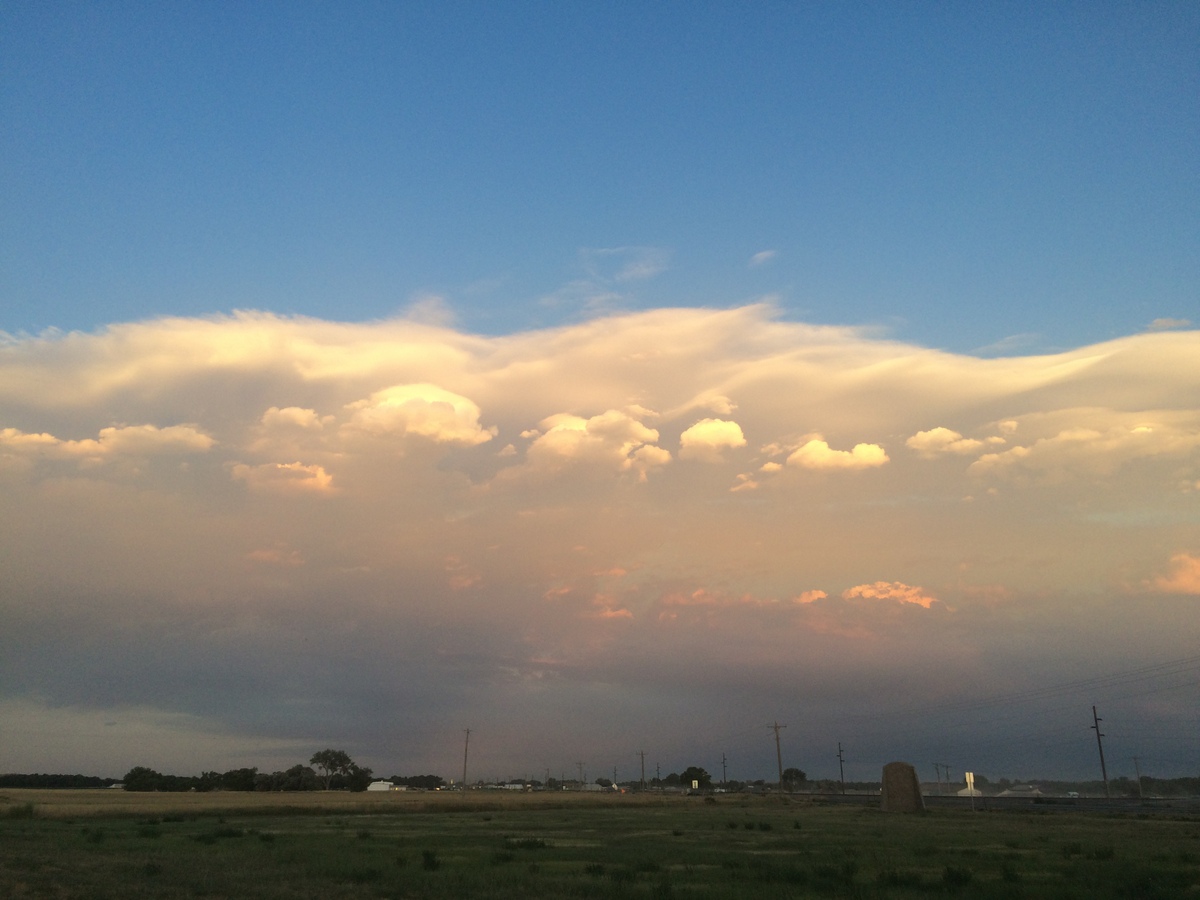
So I enjoyed the day with the Cook family, as I always do.  We also talked about crops, soil tests and fertilizer.  This picture was from the night before in Torrington, WY  
Just like in Central Michigan this summer, what looks like rain clouds is only a tease.