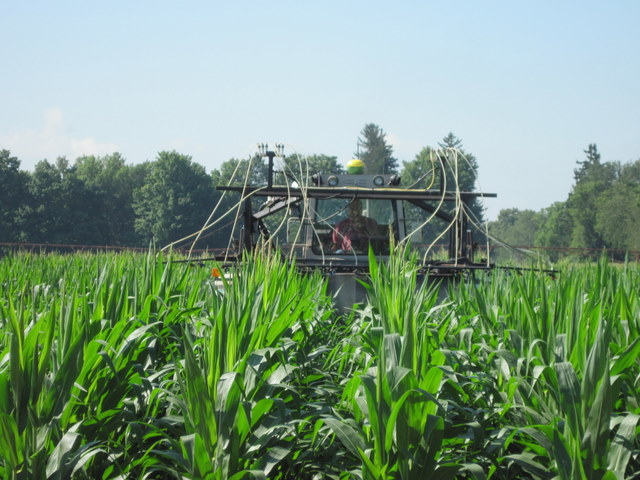
So apparently I can't stop spraying, or even talking about it. I don't know, it seems I am often very motivated. And today it was to add a final shot of nitrogen on corn in combination with a fungicide application. All of the corn on the farm has either tasseled, or has tassels emerging as seen in the cab picture below. The fertilizers used today were High NRG-NR and ferti-Rain. Both have shown farvorable yield responses with foliar applications to a variety of crops. They were each applied separately at a rate of 3 gal/A along with Headline. The recommended spray volume of 20 gal/A was followed, and I had the pressure at 85 psi.
To ensure good coverage, I used 30 inch nozzle spacing, with a 110 degree nozzle shooting midway between the rows. This worked well at the high pressure since the corn was higher than the boom. We have not had any burn problems with this application in the past.
The crops are looking good for the most part here at the NCRS. We continue to be hot in the afternoons, so I get spraying done in the morning after the dew lifts some, but the temperatures are in the upper 70's. There is one field crop left to which we have not made any foliar applications. Can you guess what it is? Well hopefully you will find out on Friday. I hope to show something entirely different tomorrow. Thanks for reading.
Wednesday, July 14, 2010
Saturday, July 10, 2010
Wheat Harvest Today
So today we did get into the field for harvest of our wheat plots. The moisture came down to under 15% this afternoon and away we went. So I will just show some pictures that describe what we do for harvesting plots. The same routine applies to all of our grain crops. The picture below shows Doug harvesting one of the forty plots in this test, which means 10 treatments times four replications. Remember that the plot width is such that my plot Hagie can stradle it for foliar applications. Oops, I said I wouldn't mention foliar spraying again, sorry.
Friday, July 9, 2010
OK I Promise This Will Be The LAST One About Foliar Spraying (Until the next one)
So I know I've been talking alot about foliar fertilizer applications, but this is the time of the season to be doing that. We have a made a big effort to test foliar fertilizers on a variety of crops as a way of increasing yield and quality. Well today we finished the majority of foliar application efforts, and I am glad to get out of the sprayer. For those who don't wish to follow today's spray log blog, then just look at one of Brian's cantaloupes below. They are coming along nicely, and he also said that pickle harvest commences next week. Halleluja!
Another crop you haven't seen too often at the NCRS is grain sorghum, or milo. Here we have some different planter programs, as well as some foliar applications. Birds have been rough on the milo plots in the past, but maybe this year they will all be at the sunflower plots.
Thursday, July 8, 2010
Today We Were Rain Fed
So remember yesterday I showed pictures of rolled corn and planting cucumbers in dry soil? I commented that some rain would sure be nice. Well look here, we did get some rain! And it was...nice that is. It started around 11:40 am and rained pretty steady for 3 hours, and then started up again around 5. When I left there was 0.7 inchees in the gauge. With the rain came relief from the heat. So needless to say we did not run any wheat today, maybe tomorrow when it is supposed to be sunny and lower humidity too. Some of our soybean experiments still have some late foliar applications due before it gets too late. So Holy Cow, I hope I can spray again tomorrow!
Before it rained, Stephanie and I did some more crop tissue testing for nutrients. This particular experiment is evaluating several different existing and experimental N fertilizers applied at a range of rates. So knowing differences in crop uptake may be useful, along with yield of course. Personally I am still at odds over the effectiveness of tissue testing due to often conflicting results that don't follow through to yield. But testing often does eliminate wondering. As stated in an earlier blog on tissue testing, correct sampling and staging procedures will influence results. So here is Stephanie standing next to a corn plant with lots of leaves, but not yet tasseling or silking. So we know it is still in the vegetative stage of growth. So what is the correct stage? You know that you need to count leaves with a collar, but where do you start???
The first leaves have mostly fallen off by now. But the leaf that extends down to the brace roots should be the V5 leaf, as shown in the picture below with the hand attached.
Then it's a matter of counting up to the last leaf with a collar. That is, it is a totally separate leaf and not still rolled up inside a complete leaf. This corn is in the V14 growth stage. So that is the leaf to sample as it is still in the vegetative stage. After tassel emergence it is in the Reproductive stage, and there are different leaf guidelines then. (But I'm not covering that today.) Below, Stephanie is sampling the uppermost vegetative leaf. Inside the rolled up leaf in her left hand is the tassel which will soon be emerging, indicating it is then in the reproductive stage. You may be surprised to learn that Stephanie is already in the reproductive stage, as she and husband (farmer and Liquid fertilizer user) Ryan are expecting child number 3 in late December. We couldn't be happier for her and Ryan. Stephanie has worked with me for over 10 years, and she is not only an invaluable research agronomist and friend, but also a great mother. Only now I am going to have to find someone else to make the parathion applications.
Once the samples are collected they need to be placed in the sample bag provided by the test lab, and then mailed promptly. Since today is Thursday, it is likely that normal shipment would arrive at the lab on the weekend, and then sit till the following week. This is not a good idea for bags of leaves in an enclosed box. So we paid the extra cost of overnight shipment so that they will be processed tomorrow.
The picture below is near where we were sampling on the new Farm 7. It looks back to the West in the alley between replications of the North-South planted corn rows. You are looking at several different corn experiments. Do you know how far it is to the last row in the picture? Well it's probably pretty far.
Wednesday, July 7, 2010
Give Me AC!
So like much of the Eastern US, it has been hot and humid at the NCRS for the past several days, and are all grateful for air conditioning in the farm office and equipment cabs.
OK, the above picture is not actually from the NCRS, but rather my West-facing enclosed porch this evening at 6:00 when I got home. (Alas, I've stooped to yellow journalism to get readers.) But at the NCRS it was in the 90's with humidity and it was pretty uncomfortable working outside today, or so I was told. Well I went outside some, in fact to take some pictures of getting the combine ready for wheat harvest. Below Phil brings up our grain head out of storage.
Below, Ron runs the grease gun to get the combine good and lubed. Wheat harvest has ben running for a few days now in the area, although much of the grain moisture has been running in the 17 to 18% range. We hope to get started on our plots tomorrow, hopefully with lower grain moisture. In the last installment, I mentioned that we are quite a bit ahead of last year in heat units. Last year we didn't harvest our wheat until July 24, and this year we are ready to go now. In 2009 from April through June 30 we received 873 GDD. This year we have received 1134 GDD for the same period. In 2008 it was 953 GDD. So that is why the wheat is ready for harvest.
Another thing we did was plant some cucumbers for our tour demonstration site. Our plan is to demonstrate the effectiveness of foliar applications of ferti-Rain. Cucumbers have been a crop that has shown consistant yield-increasing response to such applicatons. Our dealer and farmer tours are in late August. If you need more information about the upcoming tours and PLFP, contact Stephanie at stephanie.zelinko@agroliquid.com or your local Area Manager or Sales Account Manager, who can be found at the agroliquid.com website. However, we are practically bone dry now. Thank goodness we have irrigation on some farms, but on the new Farms 7 & 8, crops are "rain fed". (I always thought that was a funny term for non-irrigated.) So we will need some help from Mother Nature to get these cucumbers up.
Below, Doug checks for seed placement while Stephanie stays within earshot in case of any mistakes or questions.
The picture below shows some of the corn on Farm 7 this afternoon. You can see the leaves are rolling in the heat in a response to conserve moisture in dry conditions. I always thought this was a pretty ingenious response where the leaves roll up so that the stomates on the bottom of the leaf can stay open for temperature regulation, that is, to help the plant stay cool. But by being open, there will be net moisture loss. But by being rolled up, the moisture level can stay relatively high close to the leaf surface within the rolled leaf, and this reduces net moisture loss from the leaves. If the leaf stayed flat, the moisture levels would dissipate in the hot air, and there would be a steady loss of moisture from the leaf. We do hate to see this, but in our fertilizer comparison plots over the years, we have usually seen corn fertilized with Agro-Culture Liquid Fertilizers do better than corn treated with conventional fertilizers under stress conditions due to the reduced salt index. In other words, reduced stress from fertilizers in the seed and root zone. So this may be a good test. But I am hopeful for rain, as I hate to see my children suffer. Supposedly, there is a chance for some tomorrow, so I would rather wait on wheat harvest if we could get some rain.
Saturday, July 3, 2010
Make It A Double
So today covers two busy days, Friday and Saturday, of foliar fertilizer applications, mainly to soybeans. The soybean applications had two areas of focus: applications at the R1 stage of growth (see picture) and the follow-up to glyphosate applications. Regarding the latter, our research has shown no negative effects to the mixing of ACLF Manganese fertilizer with glyphosate, rather than waiting 9 days after application of glyphosate to make the Manganese application. But we continue to test. And regarding the R1 application, it is our recommendation that foliar fertilization to soybeans in 30 inch rows not be made until the R1 stage of growth. If you look closely at the picture below, there is a small purple flower at the base of the lowest trifoliate, indicating that this soybean plant is entering the reproductive stage. Now stand back and give her some room.
Here I am again spraying soybeans. Although I am used to it, this sprayer may look pretty strange to some. But it is very effective for plot work. It is an old, I mean, experienced Hagie 8250. But we have removed the large tanks and added five 30 gallon tanks for plots. We have also cut down the boom to 15 feet, just the width of a plot. And with the gps globe on top, it may look like a space craft. Perhaps someday I should emerge from the cab wearing a conehead costume!
Here is a picture during a foliar application. There is plenty to watch: the gal/A and speed display on the Raven, the Red Ball (Wilgers) for each nozzle to make sure they are all level indicating even nozzle output, the pressure gauge for the desired psi, the JD gps monitor to make sure it is recording the application, and make sure I am driving straight, as this doesn't have auto steer. I have taken to turning off the radio during plot spraying to minimize distractions. I don't want to make Stephanie mad.
I was driving by the wheat plots yesterday and it looks like wheat harvest is not too far off. This should be an early harvest, especially compared to last year, which was way behind on heat units. I should check with Stephanie, who keeps track of this stuff, to compare this year to last for heat units, and report it to you.
Here is something rare at the NCRS: sunflower plots. They are looking pretty good I think. We are watering them with drip tape that was laid down. It is pretty dry and we could use a rain. Both overhead linear irrigation systems are currently running this weekend on Farms 3 and 5. We will see how the sunflowers turn out. We have always had a severe bird problem prior to harvest in the past. But we haven't told them about it yet, so maybe they won't bother it this year. Mums the word.
Another application I made today was a late application of N to corn using drop nozzles. I just use spray nozzles turned sideways to make a band application. In this treatment, the sidedress application several weeks ago was split so that some of the N is applied later with drop nozzles. However, previous testing has not shown an advantage to this split application. But it will be tested again here.
Thursday, July 1, 2010
Foliar Fertilization Applications Continue
So I returned to the NCRS this afternoon from my fertilizer mission. It was a beautiful day, in the low 70's with no wind. You are probably thinking the same thing I was: "Find me something to spray!" Field Agronomy Research Manager Stephanie had a list waiting, and we happily went to work. Recall that this year for the first time we are using John Deere gps technology for all field applications, from planting to spraying. Gone are flags and marker stakes as plot markers. Now we use RTK for planting, the highest level of accuracy to ensure proper placement of plots. But in my sprayer, I am using SF1, which has a little less accuracy. But all I need to do is find the 6-row plot, and I can use the rows themselves as guidance. But before I go, I have to go through the lengthy setup procedure on my monitor. There are a lot of steps to get all of the information entered, such as equipment, type of application, Farm number, field number, rates, materials, weather conditions, growth stages, et al. And if something is not entered correctly, it won't let you record the application, indicating that something is missing. I often feel like a real Mr. Gleek.
But all of this labor is helpful in the end as we have all of the
information for that application recorded and saved to a data card. And with all of the experiments we have this year, that is very helpful. You would think that this steel-trap brain of mine would remember all of this information, but...OK, what was I talking about? In the experiment below I am spraying foliar fertilizers High NRG-NR, ferti-Rain and a competitive product on corn in the V-10 stage of growth. This experiment has three (3 or III) different stages of growth for application. An earlier application has already been applied, and the final application will occur at tasseling, or as we like to say, VT. I am spraying 3 gallons of fertilizer plus 7 gallons of water for 10 gallons per acre. I am also spraying at 55 psi, so it was blowing into the corn pretty good. At the VT application, we plan to add a fungicide. We will be making foliar applications next week as well as the soybeans should be in the flowering stage then, or as we like to say, R1. As long as there is foliage and we can get through it, it will be sprayed. More tomorrow, so stay tuned.
Good night from the NCRS.
Subscribe to:
Posts (Atom)